Independent comparisons. We may earn from shop links. More info

Welding goggles buying guide

Updated: October 2026

You are standing in a UK workshop with a gas torch or welder ready, but the online listing says only welding goggles. This welding goggles buying guide explains what must be clear before you buy: the process, the shade, the relevant marking, the seal and the amount of face coverage. Price and star ratings come after those checks, because neither proves that a lens suits your work. Compare the current amazon.co.uk options, in GBP, on our [welding goggles comparison](/hub/soldering-and-welding/welding-goggles), then reject vague listings before they reach your basket. A qualifying purchase can earn a commission at no extra cost to you.

You are standing in a UK workshop with a gas torch or welder ready, but the online listing says only welding goggles.

Our top picks

Laser Laser 6724

Best overall

Laser Laser 6724
9.2/10about £16.75
YESWELDER YESWELDER LYG-R100A

Alternative

YESWELDER YESWELDER LYG-R100A
9.0/10about £37.99
Portwest Portwest PW60BGR

Preis-Tipp

Portwest Portwest PW60BGR
8.8/10about £7.28
On this page

Start with the process, not the price

Gas welding, brazing and arc welding do not create the same optical hazard, and one dark lens is not interchangeable between them. A passive filter around shade 5 is a familiar UK trade option for oxy-fuel work, while MIG, TIG and MMA normally call for darker filtration and more face coverage. JSP's UK guidance places MIG on steel at about shade 10 or darker depending on current, fitted to a welding face shield. That is a different proposition from a £7 pair of green gas goggles. Write down the process and the likely operating range before you compare products. If you use an oxy-acetylene torch, the gas welding goggles guide deals with shade 5 and when flow can move that number. A title that lists MIG, TIG, arc and soldering is a search description, not a filter specification.

Read the shade number on the lens

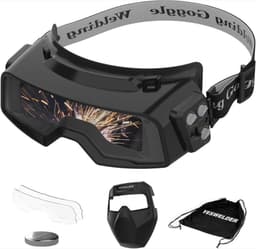
The shade number tells you how dark a welding filter is. A higher number means a darker filter. Colour alone is not enough. Bottle green, anti-dazzle and solar welding lens can describe appearance without saying what the filter is for. If the listing gives no number, record the shade as unknown rather than assuming that green means shade 5. Check the marking on the product and in the instructions, not only the web page. The Laser 6724 amazon extract names gas welding and EN 166 but omits a shade. Laser Tools' page identifies model 6724 as shade 5. Portwest's PW60 datasheet likewise identifies shade 5, although the amazon extract used here does not. Those documents help you investigate a known model. They do not relabel an ambiguous marketplace item. Confirm that the delivered model number and the lens marking match. Auto-darkening filters need a light state and a dark range. The YESWELDER LYG-R100A listing claims 4/5-9/9-13, whereas several cheaper auto-darkening glasses in this set state no shade at all. That difference is more useful than a small gap in star averages, and it still does not prove that a unit switches correctly.
Laser Laser 6724

Testsieger

Laser Laser 6724
9.2/10about £16.75

Look for a standard with a buyer-facing meaning

Standard numbers describe different parts of the protection. EN 166 has been the general personal eye-protection standard. EN 169 concerns passive welding filters, EN 379 automatic welding filters, and EN 175 equipment that protects the eyes and face during welding. BSI says new eye-protection certifications move to EN ISO 16321-1 from 11 November 2025, while valid EN 166-certified stock can still remain on sale. Do not describe goggles as certified unless the listing or identifiable manufacturer documentation supports the claim. A general EN 166 marking does not by itself tell you the welding shade. The Office for Product Safety and Standards reported one unmarked auto-dimming goggle, sold online as HW008, as a serious risk to sight because it lacked required conformity marks and documentation. That report is about that product, not every low-cost pair. HSE also advises that welding filters should meet relevant British and European standards.

Check the seal, face coverage and spectacle fit

A correctly specified lens still fails if light enters around the nose or the goggles move when you look down. Put the frame against your face and check the whole rim, not only strap tension. The Laser 6724 is stated to fit over personal spectacles, yet one reviewer still found a nose gap. XLTXWD feedback includes a pair sliding off during downward work. Fit has to be judged on your face. Enclosed goggles can mist because warm air is trapped. An N mark under EN 166 indicates tested resistance to fogging, according to JSP, but ventilation is a trade-off. Do not lift a dark filter while the flame or arc is still active. Arc radiation and spatter can reach the cheeks and neck even when the eyes sit behind a dark lens. The YESWELDER includes a face shield, and a UK reviewer reported facial sunburn after leaving it off. If ordinary work allows a helmet, broader cover is the more straightforward arc choice. That split is on welding goggles versus a helmet.

What your pounds buy in this comparison

The entry band in this amazon.co.uk set is roughly £7 to £13. It includes several products whose extracts state neither a shade nor a welding standard. That does not prove every inexpensive pair is unsafe. It means the online evidence is not enough to match them to a process. Asking the seller for documentation, or choosing an identified trade model, is more rational than letting a £2 difference decide. At about £16.75, the Laser 6724 extract claims EN 166 and over-spectacle use, although the shade appears on the maker page rather than in the amazon text. At about £37.99, the YESWELDER states the broadest dark range in this set and includes a face shield, but reviews raise fit and switching concerns.

Common questions

What should I check before buying welding goggles?
Identify the welding process, find the marked shade, check the relevant product standard, then assess seal and face coverage. Only compare price after those points are clear. For auto-darkening goggles, also confirm the stated dark range, the power arrangement and the pre-use test in the maker's instructions.
Is a dark green lens the same as shade 5?
No. Green describes appearance, while shade 5 is a defined darkness marking. A green lens may be intended for welding, but you should not infer its shade from colour or an amazon title. Verify the number on the filter and match it to the process.
Do I need EN 166 and EN 169?
They address different elements. EN 166 concerns general eye protection, while EN 169 identifies passive welding filters. A gas goggle may carry markings relating to its frame and its filter. Read the model documentation rather than assuming one number covers the entire welding task.
Are cheap auto-darkening glasses PPE?
Price does not answer that question. Look for the required conformity marking, an identifiable manufacturer, instructions and an appropriate EN 379 claim for the automatic filter. If the seller cannot provide a shade range or documentation, do not use the star rating as a substitute.
Can welding goggles go over prescription glasses?
Only choose over-spectacle use when the product states it and the combination still seals correctly. Your spectacles must not force a gap at the nose or sides. If the fit leaks, use compatible prescription safety eyewear or another approved arrangement.
Why does shade matter more than the review score?
Shade is matched to radiation and process. A review score averages many buyer experiences without proving that specification. A product can have four stars while reviews disagree about whether it darkens. Ratings help with comfort and durability only after suitability is established.

Related pages

Sources

Public UK sources named in the research digest, plus the amazon.co.uk listings in this set. BOC UK goggle prices were noted on 16 October 2026. No laboratory test was run.

  1. HSE, Controlling the risks from welding (retrieved 16 October 2026)
  2. HSE, Health risks from welding (retrieved 16 October 2026)
  3. NHS 111 Wales, arc eye (retrieved 16 October 2026)
  4. PPE at Work Regulations 1992 (retrieved 16 October 2026)
  5. BSI, EN ISO 16321 eye protection (retrieved 16 October 2026)
  6. BOC UK, safety specs and goggles (retrieved 16 October 2026)
  7. JSP Safety UK, MIG shade on steel (retrieved 16 October 2026)
  8. 3M UK, welding eye and face protection (retrieved 16 October 2026)