Independent comparisons. We may earn from shop links. More info

Solder wire diameter: 0.6, 0.8 and 1.0 mm

Updated: 21 October 2026

You have counted the pad spacing and you still wonder whether a reel marked 0.8 mm will flood a connector or starve a through-hole pin. Solder wire diameter controls how much metal you add each moment you feed: bridge risk on fine pitch, speed on a chunky lug, and how forgiving the iron’s heat must be. The [solder comparison](/hub/soldering-and-welding/solder) lists nine amazon.co.uk reels from 0.6 mm to 1.0 mm. This page matches gauge to joint size. It does not repeat the full alloy argument.

You have counted the pad spacing and you still wonder whether a reel marked 0.8 mm will flood a connector or starve a through-hole pin.

Our top picks

On this page

What diameter actually controls

Thicker wire carries more alloy per length, so a large joint finishes faster and a small pad floods if you feed steadily. Thinner wire helps when pads sit close. A 0.6 mm Sn99.3 Cu0.7 reel still needs a clean bit and enough heat to wet. Thick wire on a cold joint can look like bad solder. If you already bridge with 0.8 mm, a lighter 0.6 mm feed often fixes it. 1.0 mm shortens the feed on motor tags and stays off fine lands. Confirm the millimetre on the live page if the title and the detail tab disagree.

0.6 mm for fine work

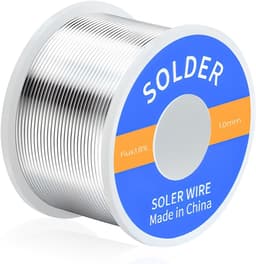
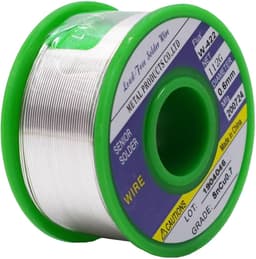
Choose 0.6 mm when pads sit close, when you tin thin strands, or when a narrow LED pad punishes a heavy hand. The owootecc reel lists 0.6 mm Sn99.3 Cu0.7 at about £14.99 with 4.5 from 2,363 UK reviews. The Yiapinn reel offers about 100 g at 0.6 mm for about £11.89, with 4.5 from 1,702 reviews shared across that brand. The stored weight is 99.8 g against a 100 g title. Fine wire feels slow on a large connector cup. Keep 0.8 mm for those jobs if you can hold two spools. A thinner gauge does not mean less fume.

0.8 mm as the hobby default

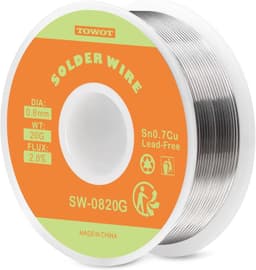
Several lead-free reels sit at 0.8 mm, including the TOWOT reel at 4.5 from 2,572 reviews and the Yiapinn 20 g reel at about £3.79. This gauge suits cable repair, header pins and ordinary through-hole kits. The leaded packs also claim 0.8 mm. The DXPETA pack, at 2.2 from 13 reviews, is a diameter match to avoid. If you are learning, 0.8 mm forgives a clumsy feed more than 0.6 mm, and it bridges sooner on a dense board. Pair it with the how to use solder wire steps before you blame the thickness. The Yiapinn 50 g reel is the same 0.8 mm alloy at about £6.39.

1.0 mm for larger joints

The GALAMAX reel is the 1.0 mm lead-free rosin-cored wire here: 100 g at about £9.99, with 4.6 from 165 UK reviews. Use it on a connector tag, a speaker terminal or a power lug. On fine pitch, one feed can bridge neighbouring pads. Larger wire needs more heat in the joint, not less care. The alloy line says lead-free, not Sn99.3 Cu0.7. That split is on lead-free solder for electronics.

Two diameters on one bench

Many repairers keep 0.8 mm for daily work and 0.6 mm for dense boards, or add 1.0 mm for power wiring. Label the spools so Sn99.3 Cu0.7 does not sit beside leaded 60/40. Grams, once the gauge is chosen, sit on the solder buying guide. One session can use 0.6 mm on a USB-C board and 0.8 mm on the cable lug. If you buy one reel for mixed through-hole kits, 0.8 mm lead-free is the compromise here. Add 0.6 mm later if that board bridges.

Common questions

What diameter should I use for through-hole PCBs?
0.8 mm is the default for ordinary through-hole pads and header pins. Move to 0.6 mm if you bridge, or if the connectors are dense. 1.0 mm is for larger lugs, not for a tight board. In this set the TOWOT and Yiapinn pocket reels are 0.8 mm lead-free Sn99.3 Cu0.7.
When is 1.0 mm too thick?
On fine surface-mount lands, tight integrated-circuit pitch, and small boards with pads close together. Use 0.6 mm or 0.8 mm there. The GALAMAX reel is the 1.0 mm row here, at about £9.99 for 100 g. One heavy feed from that gauge can bridge neighbours even when the alloy is sound.
Is 0.6 mm solder wire fragile?
The wire is thin and it feeds a lot of length if you squeeze, so it is easy to oversupply a pad. It is not a weaker alloy. Sn99.3 Cu0.7 at 0.6 mm is the same family of lead-free wire as the 0.8 mm reels. It needs a lighter hand, and it feels slow when the joint is a large cup.
Which diameter suits LED strips?
Often 0.6 mm or 0.8 mm, depending on the pad. Start lighter on a narrow pad so one feed does not flood the neighbour. A 1.0 mm reel is usually too much metal for a strip pad. The alloy and the fume rules stay the same whatever gauge you pick.
Can I use two diameters on one board?
Yes. That is common: 0.6 mm on dense pads and 0.8 mm on a strain-relief lug in the same session. Label the spools. If any leaded stock is still in the drawer, keep it apart and wash your hands. Ventilation does not change when you swap reels.
Which reels are 0.8 mm in this set?
The lead-free 0.8 mm rows are the Yiapinn 20 g reel, the TOWOT reel, the Yiapinn 50 g reel and the LXLX 20 g reel. The leaded XLTXWD six-pack and the DXPETA 60/40 pack also claim 0.8 mm. The DXPETA file is 2.2 from 13 reviews, so the gauge match is not a reason to buy it.

Related pages

Sources

Sources taken from the research digest. The digest also points at the stored amazon.co.uk listings of 20 October 2026. Those are the product rows, not an extra public article.

  1. HSE: INDG249 rosin flux fume (retrieved 21.10.2026)
  2. GOV.UK: RoHS compliance and guidance (retrieved 21.10.2026)
  3. GOV.UK: RoHS Regulations 2012, Great Britain (retrieved 21.10.2026)
  4. Water Regs UK: solders and fluxes (retrieved 21.10.2026)
  5. WaterSafe: lead-free solder (retrieved 21.10.2026)
  6. Warton Solder Products: solid solder wire (retrieved 21.10.2026)
  7. GOV.UK: General Product Safety Regulations 2005 (retrieved 21.10.2026)