Independent comparisons. We may earn from shop links. More info

Solder wire buying guide UK: alloy, diameter and spool size

Updated: 21 October 2026

You are on amazon.co.uk with a dozen nearly identical rosin-cored reels and no clear match for the joint on your bench. A solder wire buying guide for UK repair should narrow the choice before price: alloy for the job, millimetre diameter for the pad, flux you can live with, grams on the spool, and ventilation you control at home or in a shared workshop. The [solder comparison](/hub/soldering-and-welding/solder) holds nine listings with GBP prices and review counts. This page stays on that order of decisions so you can read the table without starting at the sticker.

You are on amazon.co.uk with a dozen nearly identical rosin-cored reels and no clear match for the joint on your bench.

Our top picks

On this page

Alloy first: lead-free, leaded and where to stop

Electronics repair on the GB market usually wants lead-free wire such as Sn99.3 Cu0.7. Lead-free does not mean fume-free: rosin in the core still makes fume that HSE links to occupational asthma if you solder often without local exhaust. Leaded 60/40 still appears in hobby packs because it melts on a low-wattage iron. It is the wrong default for drinking-water copper and for many products where UK RoHS restricts lead. Your school or client policy is the practical gate. Water Regs UK and WaterSafe point to lead-free processes on wholesome water. That is plumbing, not PCB wire. If a title only says lead-free, without Sn99.3 Cu0.7, wait until the bullets agree. None of the nine reels quotes a BS EN 29453 certificate. Buy a leaded pack only with lead handling, storage away from children, and hand washing.

Diameter and spool size before the star rating

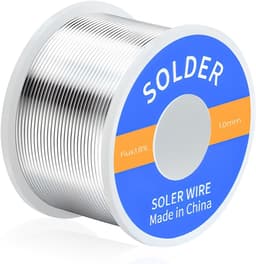
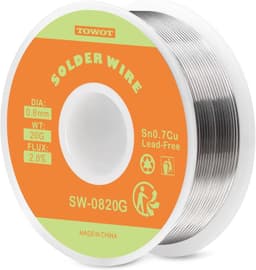
Diameter controls how much metal you deposit. For through-hole boards, 0.6 mm to 0.8 mm is the usual band: 0.6 mm bridges less on dense pads, and 0.8 mm is the forgiving default. The 1.0 mm reel suits chunkier joints and can bridge fine pitch. Thinner wire runs out faster on heavy lugs. Spool size is pence per gram. A reel under £4 is often 20 g to 25 g. About 50 g cuts reordering. A 100 g lead-free reel suits a club. The TOWOT title says 25 g and the stored field says 30 g, so confirm the live page. Eight tiny leaded rolls with poor reviews are false economy once cold joints get redone.

Flux core, residue and cleaning

Most electronics wire in this set is rosin-cored. Flux in the core activates when the joint is hot. A no-clean line can still leave a film and still make fume. Decide whether you will wipe with isopropyl alcohol, wash a production board, or accept a halo on hobby gear. If you inspect under magnification or sell refurbished kit, plan that clean before you buy the cheapest unknown brand. Extra paste is optional on a stubborn pad and it increases the fume. Beginners often add paste when the fault is a cold iron or a dirty tip. Feeding sits on the how to use solder wire page. Heavy paste on 0.8 mm pads is a common bridge.

Ventilation and UK rules at the bench

COSHH applies at work. At home, an open window and exhaust away from your face still help. Do not assume lead-free wire is safe to breathe because the reel mentions a RoHS-friendly alloy. HSE leaflet INDG249 is the UK note on rosin flux fume and why frequent hand soldering without ventilation is a poor plan. UK RoHS is why lead-free wire is the default when you document an electronics repair. Water rules are a separate stop for lead on drinking-water copper. A PCB reel is not plumbing solder. If you cannot ventilate, or the pipe must meet WaterSafe rules, that job belongs with a qualified person.

Common questions

What alloy do I need for electronics repair?
For most PCB and wire repair aligned with RoHS practice, choose lead-free wire that names Sn99.3 Cu0.7, or an equivalent tin-based alloy written on the listing. Match that string to your policy before you compare price. A title that only says lead-free is a weaker claim until the bullets agree. None of these nine reels includes a batch certificate in the captured fields.
How many grams should I buy?
Occasional fixes: 20 g to 25 g. Weekly hobby work: about 50 g. A club or a repair bench: 100 g of lead-free wire if the review file supports that listing. Compare pence per gram inside the same alloy and diameter. A 20 g reel at about £3.79 can be the right first buy without being the cheapest metal per gram.
Do I need extra flux with rosin-core wire?
Usually no, for a typical through-hole joint, if the tip is clean and hot enough for the alloy. Add paste only on a stubborn pad, and add ventilation with it. If the joint is dull, fix the tip and the heat before you open another tin of flux. Paste on a fine pad is an easy way to bridge.
What diameter should I use on circuit boards?
Start at 0.8 mm for general through-hole work. Move to 0.6 mm if you bridge pads. Use 1.0 mm for larger lugs, and keep that gauge off fine pitch. The solder wire diameter page matches those three sizes to the joints in this set. Diameter is a trade-off, not a quality score.
Is lead-free harder on a 25 W iron?
Often yes. Lead-free alloys want a clean, tinned bit and enough heat stored in the joint. An under-powered iron leaves a dull fillet even when the wire is a named Sn99.3 Cu0.7 reel. UK review notes in this set mention slow melt on a weak iron. Raise the heat and maintain the tip before you blame the spool.
Can I use this wire on drinking-water copper?
Only with materials and a process accepted for wholesome water. A random electronics reel is not that certificate. Do not use leaded hobby wire on drinking water. Water Regs UK guidance is the pointer, and installed pipe that must meet WaterSafe rules is a job for a qualified person. These nine listings are electronics wire.

Related pages

Sources

Sources taken from the research digest. The digest also points at the stored amazon.co.uk listings of 20 October 2026. Those are the product rows, not an extra public article.

  1. HSE: INDG249 rosin flux fume (retrieved 21.10.2026)
  2. GOV.UK: RoHS compliance and guidance (retrieved 21.10.2026)
  3. GOV.UK: RoHS Regulations 2012, Great Britain (retrieved 21.10.2026)
  4. Water Regs UK: solders and fluxes (retrieved 21.10.2026)
  5. WaterSafe: lead-free solder (retrieved 21.10.2026)
  6. Warton Solder Products: solid solder wire (retrieved 21.10.2026)
  7. GOV.UK: General Product Safety Regulations 2005 (retrieved 21.10.2026)