Independent comparisons. We may earn from shop links. More info

Lead-free solder wire for electronics repair

Updated: 21 October 2026

You may be holding a board that must stay RoHS-aligned for resale, a school brief that mentions hazardous substances, or a personal rule to keep lead off the bench. The reel in the basket can still fail to say what you think it says. Lead-free solder wire for electronics in the UK usually means a tin-based alloy with a small copper fraction, rosin in the core, and the same ventilation duty as older leaded wire. The [solder comparison](/hub/soldering-and-welding/solder) shows nine listings. Seven read as lead-free in the captured fields. Two are leaded packs. Do not mix those rows up.

You may be holding a board that must stay RoHS-aligned for resale, a school brief that mentions hazardous substances, or a personal rule to keep lead off the bench.

Our top picks

On this page

What lead-free means on a listing

Retail titles often name Sn99.3 Cu0.7, roughly 99.3% tin and 0.7% copper, a name suppliers relate to ISO 9453 and BS EN 29453. This capture has no batch certificate. Some listings only say lead-free. Treat that as the weaker claim until the title and the bullets agree. Leaded wire wets quickly on a weak iron, which is why 60/40 multi-roll packs persist. That ease is not a pass on health or compliance. The DXPETA pack is leaded 60/40 with poor stars, and the XLTXWD six-pack is leaded with one review. Neither belongs in a lead-free default kit.

A RoHS pointer for repairers

UK RoHS restricts lead in many electrical products placed on the GB market. GOV.UK guidance explains scope and exemptions. This page is not legal advice. If you refurbish kit for sale, or a client requires it, lead-free solder is the sensible default unless you know an exemption applies. Fixing your own vintage radio is a different case from supplying boards. A school should follow its policy and a COSHH assessment, not a star line.

Leaded packs in this batch

Two listings are leaded: the XLTXWD six-piece 0.8 mm set and the DXPETA eight-roll 60/40 pack, both about £8.39. Use them only where lead is permitted, label them away from lead-free stock, and wash your hands. Do not use them on drinking-water copper. WaterSafe and Water Regs UK point to lead-free processes for wholesome water. Leaded wire mainly widens the heat margin on a very small iron. If a lead-free fillet looks dull, improve tinning and heat before you drop the rule. Keep a separate sponge if an old leaded reel is still in the drawer.

Rosin fume on lead-free wire

Taking the lead out does not take the rosin fume out. HSE INDG249 describes that fume and the point of local exhaust for frequent hand soldering. A lead-free label is not permission to breathe the plume. Keep your head out of it. At home, keep sessions shorter, exhaust away from your face, and do not eat at the bench while residue is present. UK reviews mention slow melt on a weak iron and better flow when the bit is clean. That is technique and the tool, not proof that lead-free wire is unsuitable for electronics. It also does not qualify the reel for a water fitting.

Which reels in this set are lead-free

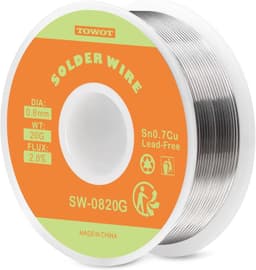
Wire that names Sn99.3 Cu0.7 in the 20 October 2026 capture is the Yiapinn 20 g, 50 g and 0.6 mm reels, the TOWOT reel, and the owootecc 0.6 mm reel. GALAMAX at 1.0 mm and LXLX at 20 g say lead-free with less detail. Confirm the millimetre on the solder wire diameter page. The top pick and the best value at 0.8 mm are the TOWOT reel and the Yiapinn 20 g reel. Who each suits is on best solder wire in this set. None of the nine listings has a certificate field, so photograph the label if you document a repair. Joint steps are on how to use solder wire.

Common questions

What does Sn99.3 Cu0.7 mean?
It is a common lead-free tin-copper name on electronics wire: about 99.3% tin and 0.7% copper. Suppliers relate it to ISO 9453 and BS EN 29453 naming. In this capture it is a listing claim, not a batch certificate. The TOWOT reel, the three Yiapinn reels and the owootecc reel use that string. GALAMAX and LXLX say lead-free without it.
Is leaded solder illegal?
Lead is restricted in many electrical products placed on the GB market under UK RoHS. Leaded wire is still sold for some hobby uses. Whether a given repair is in scope depends on the product and on whether you place equipment on the market. This page is not legal advice. GOV.UK RoHS guidance is the pointer for exemptions.
Can schools use 60/40 solder?
Only with a suitable COSHH assessment and a materials rule that allows lead. Many schools and makerspaces mandate lead-free wire instead. A cheap star line is not that assessment. If the institution has already chosen lead-free, a 60/40 multi-roll pack does not belong in the classroom kit.
Which listings in this set are lead-free?
Seven of the nine read as lead-free in the captured fields. Five of those name Sn99.3 Cu0.7: three Yiapinn reels, TOWOT and owootecc. GALAMAX and LXLX say lead-free with less alloy detail. The XLTXWD six-pack and the DXPETA 60/40 pack are leaded. Check the live title before you write the alloy into a repair note.
When is a leaded pack still acceptable?
In a hobby context where lead is explicitly allowed, the reel is labelled and stored apart from lead-free stock, and you wash your hands. It is not the default for a RoHS repair, a school without an assessment, or drinking-water copper. A lower melting point on a weak iron is not that permission.
Does RoHS apply to my repair?
It depends on whether you place electrical equipment on the GB market and on the product category. GOV.UK RoHS guidance sets out scope and exemptions. Repairing your own vintage set at home is not the same as supplying refurbished boards. If a client’s rule already says lead-free, follow that rule.

Related pages

Sources

Sources taken from the research digest. The digest also points at the stored amazon.co.uk listings of 20 October 2026. Those are the product rows, not an extra public article.

  1. HSE: INDG249 rosin flux fume (retrieved 21.10.2026)
  2. GOV.UK: RoHS compliance and guidance (retrieved 21.10.2026)
  3. GOV.UK: RoHS Regulations 2012, Great Britain (retrieved 21.10.2026)
  4. Water Regs UK: solders and fluxes (retrieved 21.10.2026)
  5. WaterSafe: lead-free solder (retrieved 21.10.2026)
  6. Warton Solder Products: solid solder wire (retrieved 21.10.2026)
  7. GOV.UK: General Product Safety Regulations 2005 (retrieved 21.10.2026)