Independent comparisons. We may earn from shop links. More info

Wire nib vs solid tip pyrography pens for UK buyers

Updated: 21 October 2026

Search results on amazon.co.uk blur two different tools: a slim pen whose fine wire loop heats, and a soldering-iron-shaped handle with screw-in metal points. Both can mark wood. The heat path, the weight in your hand and the review stories diverge enough that the wrong architecture wastes money. This page compares the two layouts so you can filter the [pyrography pen comparison](/hub/soldering-and-welding/pyrography-pen) by tool type. Prices and stars stay on the main table. The order of the decision is in the [buying guide](/hub/soldering-and-welding/pyrography-pen/sub/pyrography-pen-buying-guide). Figures here are seller claims and stored UK review themes, not a measured burn.

Search results on amazon.co.uk blur two different tools: a slim pen whose fine wire loop heats, and a soldering-iron-shaped handle with screw-in metal points. Both can mark wood.

Our top picks

On this page

Two different heat paths

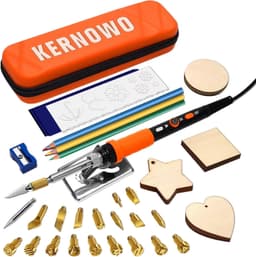
A solid-tip pen heats a metal point screwed into the end of the barrel. The handle is part of the thermal mass, so the tool feels heavier and slower to recover when you lift off the board. Kits often bundle twenty to seventy stamping tips, stencils and carbon paper. That suits a gift. It is a weaker match for portrait shading. A wire-nib station puts the electronics in a bench box and sends current through a short wire loop you shape or swap. Only the nib gets hot, which keeps the pen light and lets you change line weight by changing the loop. Listings commonly quote a wider band, often up to about 750 °C on seller copy, than a basic craft pen. Hybrid titles borrow both languages: soldering nibs in the box, pyrography in the name. Treat the components list as the truth when the photos look ambiguous.

Control and shading

Fine shading needs stable heat and a quick recovery when the tip touches cool wood. Wire-nib users in UK reviews often praise moving between a light sketch and a deeper fill without waiting for a chunky slug to reheat. Solid-tip pens can shade. Reviewers more often say that a long stroke fades at the edges, or that the highest dial setting chars before the middle of the stroke catches up. Speed matters as much as temperature. Consistent motion does more than extra pressure. A wire nib rewards that habit. A solid tip forgives less, because pressure can stall the heat. Dual-pen stations, usually in the wire-nib class, let you mount different nibs on two pens and swap hands while one cools. Most units still heat only one pen at a time. That outline-and-shader setup shows up in UK comments.

Cost and kits on amazon.co.uk

In this comparison the bands split roughly as follows. About £15 to £25 covers solid-tip pens and small kits. About £26 to £45 covers large accessory kits or an entry station. About £46 to £55 covers dual-pen wire-nib stations with twenty or more nibs. A seventy-piece solid-tip box can cost less than a thirty-nib wire station. The station buys the architecture, not the volume of cardboard. About £50 on a hybrid with two thick pens solves a different problem from about £31 on a wire-nib station with a UK plug stated. Compare tool type before you treat price as a mark of skill. A solid tip unscrews after it cools. A wire loop swaps with pliers. Gift boxes lean on stencils and letters. A wire station asks for a short learning curve.

What UK reviewers flag

Stored review themes repeat a few patterns. Solid-tip and hybrid rows attract comments that the tool is a soldering iron, not pyrography, when heat-up is slow or the packaging says soldering outright. Other buyers defend the same listing for signs, logos and casual crafts at a low price. Wire-nib rows gather praise for heat control and for replacing dearer brands, with reminders to tighten the nibs and to accept single-pen heating. Dead-on-arrival stories appear on both types. They are a returns issue, not a property of one architecture. Read the themes as a mismatch: art shading on a soldering-class kit disappoints, and a wire station is wasted money if you only wanted stamps. A warm solid tip tolerates a brass brush. A wire loop bends if you pry at carbon. Neither type removes the smoke.

Choose a row on the main comparison

Filter to a wire-nib station if you burn often, want shading headroom and can budget mid-price. The YIHUA 939-III is the top pick in the set on that architecture. The FIRElood LH20 is the lower wire-nib price. Filter to a solid-tip or hybrid kit if you need a gift box, letter stamps or a one-off project. The K KERNOWO kit is the accessory-rich example under £20. When reviews on a row split between soldering praise and pyrography criticism, assume hybrid behaviour and read the scenario notes on best pyrography pens before you check out. A dedicated tool still wins when either solder joints or art shading becomes the main job.

Common questions

Which type is better for detail?
Wire-nib stations generally give finer lines and a lighter pen. A solid tip can detail on softwood with practice, but heat lag shows up in reviews sooner.
Which heats up faster in practice?
Listings claim a short wait for ceramic cores on both types. UK comments more often praise wire stations for usable heat after a brief wait, while cheap solid tips are called slow to reach a working heat.
Why do reviews mention soldering irons?
Many kits share a soldering-iron body and soldering tips. Buyers who expected an art pen notice the label. Buyers who wanted a cheap iron notice the price.
Can a solid tip shade well?
Yes, with layered passes and patience. Upgrade stories say a station reduces the fight on a long gradient. A solid tip can still shade. It asks for slower strokes.
Is a station mandatory?
No for occasional stamps and name boards. It is the sensible buy if shading dominates the work you actually do.
What is the price difference on amazon.co.uk?
In this table, wire-nib stations often start near £30. Solid gift kits cluster under £25. Dual-pen wire stations sit nearer £46 to £55.
Can one tool do both soldering and shading?
Hybrid listings try. A dedicated tool still wins when either solder precision or art shading becomes the main task.

Related pages

Sources

Sources taken from the research digest. Listings were read from the stored amazon.co.uk display.

  1. Makers Nook: woodburning kits (retrieved 21.10.2026)
  2. Burn Savvy: wire-nib pyrography pen (retrieved 21.10.2026)
  3. Peter Child: technique and heat (retrieved 21.10.2026)
  4. Prima: pyrography starter tips (retrieved 21.10.2026)
  5. YIHUA 939-II on amazon.co.uk (retrieved 21.10.2026)
  6. HSE: electrical equipment (retrieved 21.10.2026)