Independent comparisons. We may earn from shop links. More info

Pyrography pen buying guide: tip, heat and UK plug

Updated: 21 October 2026

You open amazon.co.uk, type pyrography pen, and the results mix wood-burning stations, chunky soldering-iron kits and gift boxes with dozens of accessories. Before you click a row in the [pyrography pen comparison](/hub/soldering-and-welding/pyrography-pen), decide what architecture you are paying for, how heat should be controlled, and which extras matter on a UK mains supply. This guide is the decision tree. The main table ranks the listings once you know your direction. Prices, stars and plug lines below come from the stored amazon.co.uk fields, not from a workshop burn test.

You open amazon.co.uk, type pyrography pen, and the results mix wood-burning stations, chunky soldering-iron kits and gift boxes with dozens of accessories.

Our top picks

On this page

What you are actually buying

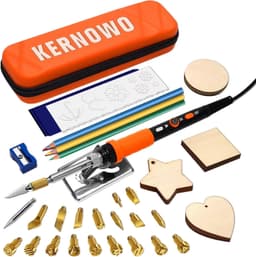
A pyrography pen burns lines into wood, leather, cork or gourds. On amazon.co.uk the category splits into three shapes. A solid-tip craft pen is a mains tool with screw-in points, often 15 to 80 W, usually in a kit under about £30. A wire-nib station separates the control box from a slim pen. Only the fine wire tip heats, which suits shading and quicker heat changes. Hybrid kits borrow soldering-iron ergonomics: a bench unit, a digital display and thicker handles that some UK reviewers praise for gifts and criticise for fine art. Occasional name stamping on softwood can stop at a solid-tip kit. Hour-long shading on birch ply usually feels less sluggish on a wire nib, at a higher price, and it still needs ventilation. Filter the main comparison by tool type after you choose the architecture.

Wire nib or solid point

Wire-nib stations feed heat through a short, replaceable wire loop. You swap nibs for lines, shaders and textures, and the pen stays light because the handle is not the heater. Tighten each nib before you draw. Solid-tip pens heat a screw-in metal slug at the end of the barrel. They are simpler, cheaper and common in 76-piece gift sets with stencils and carbon paper. Heat can lag when you lift and land strokes, and long interchangeable points may not get fully hot at the end. That complaint appears on several budget kits in the stored review notes. The side-by-side sits on wire nib vs solid tip. Portraits lean toward a wire nib. A first hobby box can stay with an adjustable solid tip.

Heat control and displays

Adjustable temperature matters more than peak wattage alone. Listings quote bands such as 200 to 500 °C on pens and 250 to 750 °C on stations. Those figures come from seller copy, not from a lab. You want a dial or display you can repeat from session to session, so a light sketch line on pine does not become a char trench when you pause. A digital readout helps if you cannot yet judge a dull red by eye. Two-step switches, 15 W and 30 W, appear on the cheapest kits. They separate leather from softwood in coarse steps, and they frustrate layered shades. Every row in this set claims adjustable heat. Read the maximum as a seller hint, next to UK comments about slow heat-up or a tip that glows on the top setting.

Budget bands on amazon.co.uk

Entry, about £15 to £25, covers compact pens and small kits, often solid-tip, with fewer reviews and simpler heat control. Mid, about £26 to £45, is where large accessory kits and single-pen stations sit. Upper mid, about £46 to £55, is where dual-pen wire-nib stations such as YIHUA appear, with twenty or more nibs and UK plug callouts. These are consumer mains tools for a home workshop, not industrial burners. A higher price is not automatically art-ready. A hybrid near £45 with two thick pens solves a different problem from a wire-nib station near £31. Match the spend to the architecture, not to the accessory count in the photo.

Checklist before you order

Confirm that the listing states a BS 1363 UK plug, or a clear 230 V UK supply, if you are not using a workshop transformer you already trust. Plan a pen stand and a clear desk zone. Never rest a hot tip on wood or on cable insulation. Read whether the box is pyrography-first or a soldering iron with a new title. UK reviews in the stored notes often split on that point. Wire nibs versus soldering tips predict the feel more than the lifestyle photo. At minimum you want a stand, a way to change tips, and scrap wood you supply yourself. Stencils and letter tips are gift bonuses, not a substitute for heat control. Ventilation belongs in every setup. Smoke and materials are covered in pyrography pen safety. If the plug line is silent, as it is on some budget rows, treat plug confirmation as an open question before you buy.

Common questions

Wire nib or solid tip for a first purchase?
Choose a solid tip if the budget is tight and the goal is stamped names, simple patterns or a gift with stencils. Choose a wire nib if you expect shading, fine lines or long sessions and can budget mid-price. Many buyers keep a solid-tip kit for gifts and add a station later.
How much should I spend on amazon.co.uk?
Under £20 buys entry kits with limited review depth. £30 to £40 can land a wire-nib station with many tips if you accept a smaller brand. Around £50 buys dual-pen YIHUA-class stations with stronger UK review files in this table. That is social proof, not a laboratory test.
Is a 70-piece kit better value than a station?
Piece count flatters the photos. A station with ten wire nibs you actually use beats forty stamp tips you never heat. Compare tool type on the main page before you count accessories.
Will a soldering iron kit work for art pyrography?
Some buyers make it work for logos and signs. Others mark the same listing as not pyrography. Expect slower heat and a heavier handle. If art shading is the goal, filter toward wire-nib stations.
Who needs a dual-pen station?
Dual pens help when you keep an outline nib in one handpiece and a shader in the other, so you are not waiting for a single tip to cool. Most units still heat only one pen at a time. Letterers and board makers mention this most in UK reviews.

Related pages

Sources

Sources taken from the research digest. Listings were read from the stored amazon.co.uk display.

  1. Makers Nook: woodburning kits (retrieved 21.10.2026)
  2. Burn Savvy: wire-nib pyrography pen (retrieved 21.10.2026)
  3. Peter Child: technique and heat (retrieved 21.10.2026)
  4. Prima: pyrography starter tips (retrieved 21.10.2026)
  5. YIHUA 939-II on amazon.co.uk (retrieved 21.10.2026)
  6. HSE: electrical equipment (retrieved 21.10.2026)