Independent comparisons. We may earn from shop links. More info

Flux core vs gas MIG: which wire to use

Updated: October 2026

You can buy another reel of self-shielded wire this weekend, or you can sort a bottle and a solid-wire spool, and the bead you want is the thing that should decide it. Flux core vs gas MIG is not a prize for one process. Outdoors, in a wind that blows a gas shield away, this E71T-GS wire is the practical choice. Indoors, on thin clean steel that has to look tidy, solid wire and the right gas usually win, with the extra cost of the bottle. There is a third process in between, gas-shielded flux-cored wire, which still needs gas. The ten gasless reels are on the [flux cored wire comparison](/hub/soldering-and-welding/flux-cored-wire). Peter F. wrote this on 16 October 2026 from UK supplier notes and the Health and Safety Executive. We did not run a comparison weld. A qualifying purchase can earn a commission at no extra cost to you.

You can buy another reel of self-shielded wire this weekend, or you can sort a bottle and a solid-wire spool, and the bead you want is the thing that should decide it. Flux core vs gas MIG is not a prize for one process.

Our top picks

HITBOX HITBOX 0.8 mm

Best overall

HITBOX HITBOX 0.8 mm
9.1/10about £14.99
YESWELDER YESWELDER 0.8 mm, 0.9 kg

Alternative

YESWELDER YESWELDER 0.8 mm, 0.9 kg
7.9/10about £13.99
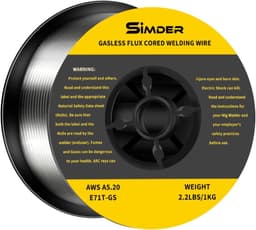
SSIMDER SSIMDER 0.8 mm

Best value

SSIMDER SSIMDER 0.8 mm
8.3/10about £12.34
On this page

Three wires, not two

Solid MIG wire is a plain steel strand. It needs an external shield, commonly an argon and carbon dioxide mix. Engweld’s UK wire guide talks about that bottle, often around an 80/20 argon/CO2 blend for general mild steel, and about a smoother bead than flux-cored wire. Polarity for solid wire is normally DCEP, torch positive. If you already own a gas MIG and the work is in a still garage, this is the wire the machine was set up to run. Gas-shielded flux-cored wire is a tube as well, but the core is not a full outdoor shield. Weldability SIF separates it from self-shielded wire: the gas-shielded family belongs in the workshop, because wind still ruins the gas. It is not what these amazon listings are selling. Self-shielded wire, the product in this category, generates the shield from the flux and leaves slag. Lincoln puts that family outdoors, where a gas shield would be blown off. Almost every spool here is sold as E71T-GS, which Lincoln’s usability note defines as a general single-pass class. BOC’s MIG note says self-shielded wire tolerates wind and has lower wire efficiency, about 65% in that note, because more of the fill is flux rather than metal. That 65% is BOC’s process figure, not a test of the HITBOX or YESWELDER reel. How to match class and diameter is on the buying guide.

Wind, slag, and thin sheet

Use self-shielded wire when the joint is outside or in a draught you cannot screen. A farm gate, a trailer side in the yard, or a bracket you cannot drag into the garage are the cases Engweld and the trade notes point at. The flux does not blow away the way a gas cup does. You drag the gun, chip the slag, and accept a bead that needs more dressing than a gas weld. Buyers in this set still report spatter balls and grinding even when they liked the strength. Solid wire fails the same outdoor job when a breeze strips the shield and the bead goes porous. Gas-shielded flux-cored wire has the same wind problem. Thin sheet is the other failure. Engweld notes that flux-cored wire can burn through thin metal. UK forum practice on car panels often moves to gas and 0.6 mm solid wire once the steel is under about 1 mm. None of the spools here is 0.6 mm. A YESWELDER review that preferred the wire with the gas left on is one Clarke owner’s impression. It does not prove the spool is dual-shield. For a visible indoor seam on clean 1 mm steel, solid wire and gas are the better buy, if you can keep the draught off the cup. Leads and rollers are on how to use flux cored wire.
HITBOX HITBOX 0.8 mm

Testsieger

HITBOX HITBOX 0.8 mm
9.1/10about £14.99

What you still pay for

A gasless spool looks cheap because the till only shows the reel. In the amazon.co.uk files a nominal 1 kg of 0.8 mm sits between about £12.34 and about £18.99, and a titled 4.5 kg YESWELDER is about £35.99 if it fits the door. A bottle is a different bill: hire or purchase, gas, a regulator, and the solid wire itself. If you already pay for a cylinder and you weld indoors every month, another gasless reel does not undercut that setup. The flux efficiency note from BOC means some of each kilogram is slag, not weld metal. If you weld twice a year on a driveway, bottle hire can cost more than several of these spools. Fume is not one of the savings. The Health and Safety Executive groups flux-cored arc welding with MIG for fume control, and the February 2019 bulletin says mild-steel fume can cause lung cancer whether or not you used a bottle. Indoors you still want local exhaust, with respiratory protection if the capture is incomplete. Outdoors you still want suitable RPE. Galvanised steel adds metal-fume fever on both processes. Stick welding is the third way out when you have no wire feeder you trust and the joint is thick enough for an electrode. It is a poor substitute for either wire on thin car skin.

Use gasless wire when

Use the self-shielded E71T-GS wire in this comparison when the work is single-pass mild steel, the wind or the missing bottle is the real constraint, and you can drag, chip slag, and control the fume. A farm repair, a trailer panel you cannot get into still air, or a first gasless machine that has no gas port are the fits. The HITBOX listing is the one that states DCEN and a single-pass range, if you are choosing inside the set. A seller line that says single and multi-pass, as on the YESWELDER file, does not change the GS class. Stay with solid wire and gas when the joint is indoors, the steel is thin and clean, and the bead has to be dressed lightly or painted. Stay with gas if you already own a working cylinder and a 0.6 mm or 0.8 mm solid spool that the machine feeds. Move to a classified wire, not a higher-rated GS spool, when the joint is structural or has to meet a procedure. Gas-shielded flux-cored wire is a workshop cored-wire choice with its own datasheet, not a halfway setting on these reels. If you only remember one line: outdoors or no bottle, this wire; indoors on thin tidy steel, solid wire and gas.

Common questions

Which process when the job is outside?
Self-shielded flux-cored wire, run as the manufacturer intends, without relying on a gas cup. Wind that you cannot screen will porosity a solid-wire bead and will also upset gas-shielded cored wire. You still chip slag, and you still wear suitable respiratory protection. The Health and Safety Executive does not treat outdoor welding as fume-free.
Which process when the bead has to be tidy indoors?
Solid wire with the correct shielding gas, in still air, on metal you have cleaned. Engweld’s comparison is aimed at that smoother finish. Flux-cored wire can make a strong hobby bead indoors, but the slag and the extra spatter are the wrong trade if appearance is the point and a bottle is already in the workshop. Keep the door shut so the gas shield stays on the puddle.
Does flux-cored wire penetrate more?
It often feels hotter and it can burn through thin sheet, which is the warning in UK trade guides, not a virtue on 1 mm steel. On thicker mild steel outdoors that heat helps fusion in a single pass. It is not a licence to stack passes on an E71T-GS wire, and it is not a measured penetration figure for these amazon spools. Test on the same thickness you intend to weld.
Is flux-cored cheaper once you own a bottle?
Usually not. The reel prices here are low because they replace the cylinder, not because they beat wire you have already paid to shield. If the bottle, regulator, and solid wire are in use every month, stay with them for indoor work. Flux-cored wire becomes the cheaper path when you would otherwise hire gas for a few outdoor jobs a year, and when you accept slag and a lower proportion of the reel becoming weld metal.
Can you run this E71T-GS spool with the gas turned on?
Do not plan on it. These listings are self-shielded wires, and the class is written to run without external gas, normally on DCEN. One YESWELDER reviewer preferred the arc with the gas left on. That is a single comment about a Clarke set, not a dual-shield approval. Gas plus the wrong polarity is a muddled setup. If you want gas, fit solid wire, set DCEP, and use the mix the welder manual names.
Does no bottle mean less fume?
No. Flux-cored arc welding is named alongside MIG in HSE’s welding fume guidance, and mild-steel fume is treated as capable of causing lung cancer. The missing cylinder removes a shield-gas cost. It does not remove the plume. Use extraction indoors and suitable RPE when the extraction is not enough, including outside.
When is stick simpler than either wire?
When you have no reliable wire feed, the steel is thick enough for an electrode, and you only need a short outdoor fillet. Stick avoids rollers, birdnests, and gas, at the cost of speed and of being clumsy on thin sheet. It does not replace either MIG process for car skin or for a long tidy seam. It also does not remove the fume controls.

Related pages

Sources

Public UK sources and the amazon.co.uk listings in this set. Shelf prices are the figures in those files, not a fresh scrape on 16 October 2026.

  1. HSE STSU1, February 2019, mild-steel welding fume (retrieved 16 October 2026)
  2. HSE, protect your workers from welding fume (retrieved 16 October 2026)
  3. HSE WL3, welding fume control (retrieved 16 October 2026)
  4. HSE, health risks of welding (retrieved 16 October 2026)
  5. Lincoln Electric, flux-cored usability designators (retrieved 16 October 2026)
  6. Lincoln Steelcore 71T-GS data sheet (retrieved 16 October 2026)
  7. BSI, BS EN ISO 17632:2015 (retrieved 16 October 2026)
  8. ESAB UK Coreshield 8 (retrieved 16 October 2026)