Independent comparisons. We may earn from shop links. More info

Flux core wire for car body repairs

Updated: October 2026

The sill looks thin, the MIG in the garage has no bottle fitted, and a gasless spool feels like the repair that gets the car through the week. Flux core wire on car bodywork can tack clean mild-steel brackets and thicker patches. It is a poor match for very thin panels, and it is the wrong product for chassis, brakes, fuel, and anything an insurer or a procedure treats as structure. You should leave this page knowing which jobs the E71T-GS class can touch, why 0.8 mm and slag fight paint, and when a bodyshop is the next call. The ten listings sit on the [flux cored wire comparison](/hub/soldering-and-welding/flux-cored-wire). Peter F. wrote this on 16 October 2026 from those listings, a UK welders’ forum, and Health and Safety Executive guidance. We did not repair a car. A qualifying purchase can earn a commission at no extra cost to you.

The sill looks thin, the MIG in the garage has no bottle fitted, and a gasless spool feels like the repair that gets the car through the week.

Our top picks

HITBOX HITBOX 0.8 mm

Best overall

HITBOX HITBOX 0.8 mm
9.1/10about £14.99
FEIFANKE FEIFANKE 1.0 mm

Alternative

FEIFANKE FEIFANKE 1.0 mm
6.9/10about £17.99
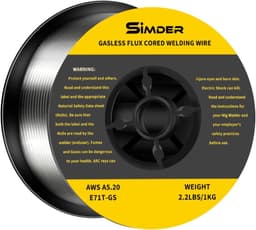
SSIMDER SSIMDER 0.8 mm

Best value

SSIMDER SSIMDER 0.8 mm
8.3/10about £12.34
On this page

Which car jobs this wire can touch

E71T-GS is a general single-pass wire for carbon steel and thin plate, not a body-shop system. Lincoln’s note on the GS designator is single pass, and published limits for this class sit around thin material up to about 5 mm, with one trade range near 0.8 mm to 4.8 mm. The HITBOX listing is the one in our set that says that band in its own words and mentions automotive sheet repair. A UK review on that file describes car-body use and calls the result strong for the money. That is one owner’s job, not a map of every panel on a modern car. Think brackets, a thicker patch on mild steel you can reach from both sides, a trailer hanger, or a bit of non-structural sheet you have already copied on scrap. Members on mig-welding.co.uk describe gasless work on car panels as possible with practice, 0.8 mm wire, short tacks, and metal cleaned back to bright steel. Several of the same voices say gas and 0.6 mm solid wire is easier once the panel is under about 1 mm, because flux-cored wire burns hot. That forum line is a rule of thumb, not a standard. Jacking points, chassis legs, seat-belt anchors, suspension mounts, and subframe repairs are outside this spool. A title that says auto body on the SSIMDER listing does not move those jobs into DIY. The bottle-versus-reel choice is on flux core vs gas MIG.

Thin sheet, 0.8 mm, and slag

Most reels in this comparison are 0.8 mm. There is no 0.6 mm spool on the list, and HITBOX buyers said so when they tried exhaust work and thin sheet. The FEIFANKE alternative in the table is 1.0 mm, which puts still more heat into a skin. On a panel around 1 mm, 0.8 mm flux-cored wire dumps heat into a small puddle. The usual failure is a hole, then a larger hole as you try to fill the first one. Forum practice, where people persist, is a series of short tacks with cooling time, not a continuous bead along a seam. You drag, you keep the stick-out steady, and you stop the moment the puddle sighs through. Set the machine on scrap cut from the same gauge, not on the car. A seller suggestion such as SSIMDER’s 80–100 A for 1.5 mm steel is already thicker than skin and must not be copied onto a wing. If your test coupon blows through at every setting that still fuses, the wire is too big for that panel. Slag is the next bodywork problem. You chip every tack before the next one overlaps it. A wire brush after chipping should show bare bead. Flux-cored beads also sit proud and need more grinding than a small gas weld before a skim of filler. If the panel is visible and you care about the paint edge, gas MIG on clean steel is the kinder process. Leads, rollers, and the scrap test are on how to use flux cored wire.
HITBOX HITBOX 0.8 mm

Testsieger

HITBOX HITBOX 0.8 mm
9.1/10about £14.99

Galvanised metal, paint, and fire

A lot of car steel is zinc-coated, seam-sealed, or painted on the inside. The Health and Safety Executive links metal fume fever especially to galvanised metal: a feverish, breathless feeling after the fume, sometimes delayed. Their motor-vehicle welding note treats sparks as a fire risk to trim, underseal, and fuel, and it expects local exhaust when coatings or galvanising are heated. The February 2019 fume bulletin still applies outdoors. Suitable respiratory protection remains part of the job when extraction cannot catch the plume, including on a driveway. Strip the coating back well beyond the weld, on both faces if you can reach them, until you see clean steel. Weld the bare metal, then restore corrosion protection afterwards. Do not weld through zinc and call the white fume normal. Do not weld through underseal. The haxiaoer three-pack’s better corrosion resistance line is a title claim with no test in the file, and E71T-GS is not a zinc-rich repair. Remove the carpet, the soundproofing, and the plastic nearby, or soak and shield them. Keep a suitable extinguisher where you can reach it. Have a second person watching the far side of the panel. Sealey’s gasless welder instructions say to disconnect the vehicle battery so the welding current does not travel through vehicle electronics. Put the earth clamp on clean metal close to the joint.

Leave it to a bodyshop when

Hand the job over when the panel is structural, when you cannot name the steel thickness, or when the first scrap test holes the coupon. Hand it over for brake pipes, fuel pipes, tanks, and filler necks. Hand it over for airbag mounts, pre-tensioners, and the metal around them. Hand it over for a welded jacking point or a chassis repair that an MOT tester or an insurer will look at. This page cannot promise an MOT outcome, and a forum photo of a patched wing is not an approval. Late-model cars often specify the process, the filler, and the corrosion treatment for a section. A gasless hobby spool does not satisfy that sheet of paper. Stainless exhaust trims are also the wrong metal: titles in this set that say stainless still describe mild-steel E71T-GS. A mild-steel tack on a stainless skin is a future crack. If galvanised fume has already left you shaky, stop for the day and get advice. For a mild-steel bracket you can reach, of a thickness your scrap test survived, with the coating gone, the battery off, and the slag chipped, the wire in this category is a possible tool. For the structure of the car, it is not. General buying order is on the buying guide.

Common questions

Can gasless wire weld a car panel?
It can tack clean mild steel that is thick enough to survive the heat, usually as short tacks rather than a long bead. UK forum welders treat panels under about 1 mm as easier with gas and a thinner solid wire. One HITBOX review describes car-body use. That supports possible on some panels, not suitable for every skin on the car. Structural panels are out of scope for this class.
Is 0.8 mm too thick for body sheet?
Often, yes, once the steel is around 1 mm or thinner. This comparison has no 0.6 mm reel, and buyers on the HITBOX file wanted that size for exhaust and thin work. Try 0.8 mm only on scrap of the same gauge. If every setting that fuses also blows a hole, stop. A different 0.8 mm brand will not behave like a 0.6 mm solid wire with gas. A 1.0 mm spool is thicker still.
Should exhaust repairs use this wire?
Only on mild-steel exhaust parts that are not a structural hanger and not stainless, and only if your scrap test at that thickness holds. Buyers who tried 0.8 mm on exhausts in this set asked for 0.6 mm because of the heat. Many replacement sections are thin. A stainless system needs stainless filler, which these E71T-GS spools are not.
What about galvanised or zinc-coated panels?
Grind the zinc back to bare steel beyond the weld, weld the clean metal, and coat it again afterwards. Heating galvanising produces fume that HSE links to metal fume fever, so use extraction or suitable RPE and do not treat a driveway as automatic protection. Do not read a seller line about galvanised plate as permission to weld the coating in place.
Will slag stop paint from staying on?
Yes, if you leave it. Chip and brush every tack until the bead is bare metal before filler or paint. Flux-cored wire is meant to leave that cap, and a glossy slag line will shed paint later. Expect more grinding than with a small gas weld. If the panel is on show, that dressing time is part of choosing gasless wire.
Are jacking points and chassis in scope?
No. A jacking point, a chassis leg, a seat-belt anchor, and similar mounts carry load and often follow a vehicle procedure. E71T-GS is a single-pass mild-steel class, and a hobby spool does not become structural because the title mentions auto body. Those repairs belong with a bodyshop that can follow the manufacturer’s method.
What should you do about the battery and fuel?
Disconnect the battery, or fit a proper circuit protector, before you attach the earth clamp, which is the warning in gasless welder instructions such as Sealey’s. Keep fuel pipes, tanks, and anything that smells of petrol out of the weld, and watch the hidden side of the panel for sparks in trim. If you cannot isolate fuel and electrics, do not strike the arc.

Related pages

Sources

Public UK sources and the amazon.co.uk listings in this set. Shelf prices are the figures in those files, not a fresh scrape on 16 October 2026.

  1. HSE STSU1, February 2019, mild-steel welding fume (retrieved 16 October 2026)
  2. HSE, protect your workers from welding fume (retrieved 16 October 2026)
  3. HSE WL3, welding fume control (retrieved 16 October 2026)
  4. HSE, health risks of welding (retrieved 16 October 2026)
  5. Lincoln Electric, flux-cored usability designators (retrieved 16 October 2026)
  6. Lincoln Steelcore 71T-GS data sheet (retrieved 16 October 2026)
  7. BSI, BS EN ISO 17632:2015 (retrieved 16 October 2026)
  8. ESAB UK Coreshield 8 (retrieved 16 October 2026)