Independent comparisons. We may earn from shop links. More info

How to use flux cored wire on a gasless MIG

Updated: October 2026

The spool is in the door, the last job on this machine was solid wire with the gas still connected, and the first trigger pull throws spatter or dumps a birdnest into the feed. How to use flux cored wire starts with polarity and the roller, not with a brand of E71T-GS. You should finish this page knowing which lead is positive, how tight the tension should be, whether you drag or push, and when to chip the slag. The [flux cored wire comparison](/hub/soldering-and-welding/flux-cored-wire) is the product grid if you have not chosen a reel. Peter F. wrote this on 16 October 2026 from manufacturer setup notes and the Health and Safety Executive, not from a weld we ran. A qualifying purchase can earn a commission at no extra cost to you.

The spool is in the door, the last job on this machine was solid wire with the gas still connected, and the first trigger pull throws spatter or dumps a birdnest into the feed.

Our top picks

HITBOX HITBOX 0.8 mm

Best overall

HITBOX HITBOX 0.8 mm
9.1/10about £14.99
Reboot Reboot 0.8 mm

Alternative

Reboot Reboot 0.8 mm
7.6/10about £14.15
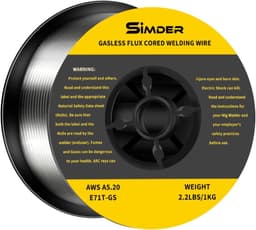
SSIMDER SSIMDER 0.8 mm

Best value

SSIMDER SSIMDER 0.8 mm
8.3/10about £12.34
On this page

Polarity before the first arc

Most self-shielded flux-cored wire runs DCEN: the torch is negative and the earth lead is positive. Sealey’s SuperMIG130 instructions put it that way for gasless work, and ESAB’s UK settings note says the same for most self-shielded wires, against DCEP for solid wire. If you leave the leads as they were for solid MIG, the arc spatters and no voltage tweak fully repairs it. In this comparison only the HITBOX listing states DCEN on the product page. The other nine do not, so you still set the machine from the welder manual and from that general rule, then confirm on scrap. Swap the leads at the front panel, or use the polarity changeover if the machine has one, before you thread the wire. On a vehicle, Sealey also says to disconnect the battery, because the welder current is a bad neighbour to vehicle electronics. Expect the first correct setup to sound harsher and to leave a slag cap. That is the process, as long as the spatter is a sprinkle rather than a shower that will not stick. If the machine has no way to put the torch on negative, stop and use a wire the manual allows. Diameter and stated mass are on the buying guide.

Getting the wire to the tip

Flux-cored wire is a tube. A smooth V-roll meant for solid wire flattens it or lets it slip, and then the slack piles up as a birdnest behind the roll. Fit a knurled roller in the 0.8 mm or 1.0 mm groove that matches the spool. Welding Direct’s gasless roller is sold on that basis: knurl, and less pressure so the tube is not crushed. You should be able to stop the wire with your fingers at the tip and have the drive slip, rather than stall the motor and grind a flat into the wire. Tighten only until the wire feeds without slipping, then stop. Match the contact tip to the diameter. Eight of these listings are 0.8 mm. The FEIFANKE single reel and the haxiaoer three-pack are 1.0 mm. A 0.8 mm wire in a worn 1.0 mm tip arcs inside the tip and sticks. Cut the wire end square, hold the gun straight for the first metre of feed, and keep the liner free of the dust a crushed flux tube leaves behind. SSIMDER reviews include thick spots that jammed a 0.035 inch nozzle. Change the tip and ease the roll before you condemn the brand. Rusty wire is a return. One Reboot buyer found the spool corroded and unusable.
HITBOX HITBOX 0.8 mm

Testsieger

HITBOX HITBOX 0.8 mm
9.1/10about £14.99

Drag, slag, and a scrap test

Drag the gun. A backhand angle, often described around 15 to 45 degrees, lets the slag stay behind the puddle instead of running ahead of it. Pushing, the way many people learn gas MIG, traps slag in the bead. Keep the stick-out a little longer than you would with solid wire, because the flux needs a moment to cover the puddle, and do not bury the nozzle in the spatter. The first pass on a GS wire is the pass. Lincoln’s designator means single pass. A seller bullet that says multi-pass does not make stacked runs a structural joint. Chip the slag before you look at the bead, and before any second tack that touches the first. A chipping hammer and a wire brush are part of the kit. On the HITBOX reviews, brown smoke and spatter balls had to be ground off even when the weld itself held. Prove it on scrap of the same thickness as the job. A SSIMDER seller line of 80–100 A for 1.5 mm steel is that listing’s suggestion, not your body-panel setting. Start in the middle of the machine’s gasless chart if it has one, run a short bead, chip it, and bend the coupon. If the wire stubs, increase feed slightly. If it burns back into the tip, reduce feed or increase the tip-to-work distance a little.

When to stop

Fume control is part of switching the machine on. The Health and Safety Executive says mild-steel welding fume can cause lung cancer, and flux-cored arc welding sits with MIG and stick on the processes that need control. Indoors, use local exhaust. HSE’s guidance on LEV expects a thorough examination at least every 14 months where that kit is relied on. If extraction does not catch the plume, add suitable respiratory protective equipment. Outdoors you still need that RPE. Galvanised or painted metal adds metal-fume fever risk. If you feel breathless, shivery, or flu-like after the job, stop and get medical help. Stop and call a competent welder for structural steel, anything that lifts or brakes, fuel lines, tanks, and airbag-adjacent metal, and for any weld a procedure or an insurer has to accept. Do not practise multi-pass structural joints on E71T-GS because a bullet said the wire could do them. Thin panels and galvanised coatings are on the car body page. If you are still deciding whether a bottle would be kinder, read flux core vs gas MIG.

Common questions

Which lead is positive for gasless wire?
The earth lead is positive and the torch is negative. That is DCEN, and it is what Sealey’s gasless instructions and ESAB’s note on most self-shielded wires describe. Solid wire is usually the other way round, electrode positive. Only the HITBOX listing in this set prints DCEN on the amazon.co.uk page, so check your welder manual as well as the spool.
What happens if you leave solid-wire polarity on?
You get spatter that voltage and wire-speed dials will not tidy up. The flux is not shielding the way the wire was drawn to shield. Swap to torch negative before you blame the brand or buy a second spool. A review that prefers the same wire with the gas left on is one person’s gas MIG habit, not evidence that E71T-GS is a dual-shield product.
Do you need a knurled roller?
Yes for this wire. The knurl grips the tube without the crushing a smooth roll causes when you over-tighten it. Use the groove that matches 0.8 mm or 1.0 mm. If you only own a solid-wire V-roll, fit the knurled roller before the first arc. Feeding carefully on the wrong roll still flats the wire.
How tight should the tension be?
Tight enough that the wire does not slip, and loose enough that you can stall the wire at the tip with your fingers and feel the roll slip. If the motor stalls, or the wire shows a flattened stripe, you are too tight and the next metre is a birdnest. Recheck after you change diameter, because a 1.0 mm tube needs a different groove from 0.8 mm.
Do you push or drag?
Drag, with the gun tilted back so the slag trails the puddle. Pushing is the gas-MIG habit and it folds slag into the bead. A working range often quoted for that drag is about 15 to 45 degrees. Watch the puddle on scrap and keep the slag behind it. If slag runs ahead, steepen the drag slightly and slow down.
When do you chip the slag?
After every pass, before you inspect the bead and before the next tack touches it. Flux-cored wire is supposed to leave that cap. Paint, a second pass, or a bolt hole drilled through leftover slag will fail even when the metal underneath fused. A wire brush after chipping shows whether you have porosity or just dirt.
What if the wire arrives rusty?
Return it. Corroded flux-cored wire feeds badly and sheds rust into the liner, and one Reboot buyer in this set found the reel unusable on arrival. Do not sand the outer layer and weld the rest. A split foil pack with bright wire is usable. A brown coil is not a bargain.
Where does a professional take over?
As soon as the metal is structural, carries a brake or a lift, holds fuel, or sits next to airbag components, or when a drawing specifies a weld procedure. Also stop if the space is confined, or if galvanised fume leaves you unwell. Hobby setup skill does not convert an E71T-GS spool into a coded filler. Buy the classified wire the job names, and have a competent person weld it.

Related pages

Sources

Public UK sources and the amazon.co.uk listings in this set. Shelf prices are the figures in those files, not a fresh scrape on 16 October 2026.

  1. HSE STSU1, February 2019, mild-steel welding fume (retrieved 16 October 2026)
  2. HSE, protect your workers from welding fume (retrieved 16 October 2026)
  3. HSE WL3, welding fume control (retrieved 16 October 2026)
  4. HSE, health risks of welding (retrieved 16 October 2026)
  5. Lincoln Electric, flux-cored usability designators (retrieved 16 October 2026)
  6. Lincoln Steelcore 71T-GS data sheet (retrieved 16 October 2026)
  7. BSI, BS EN ISO 17632:2015 (retrieved 16 October 2026)
  8. ESAB UK Coreshield 8 (retrieved 16 October 2026)