Welding fume garage ventilation: what an open door misses
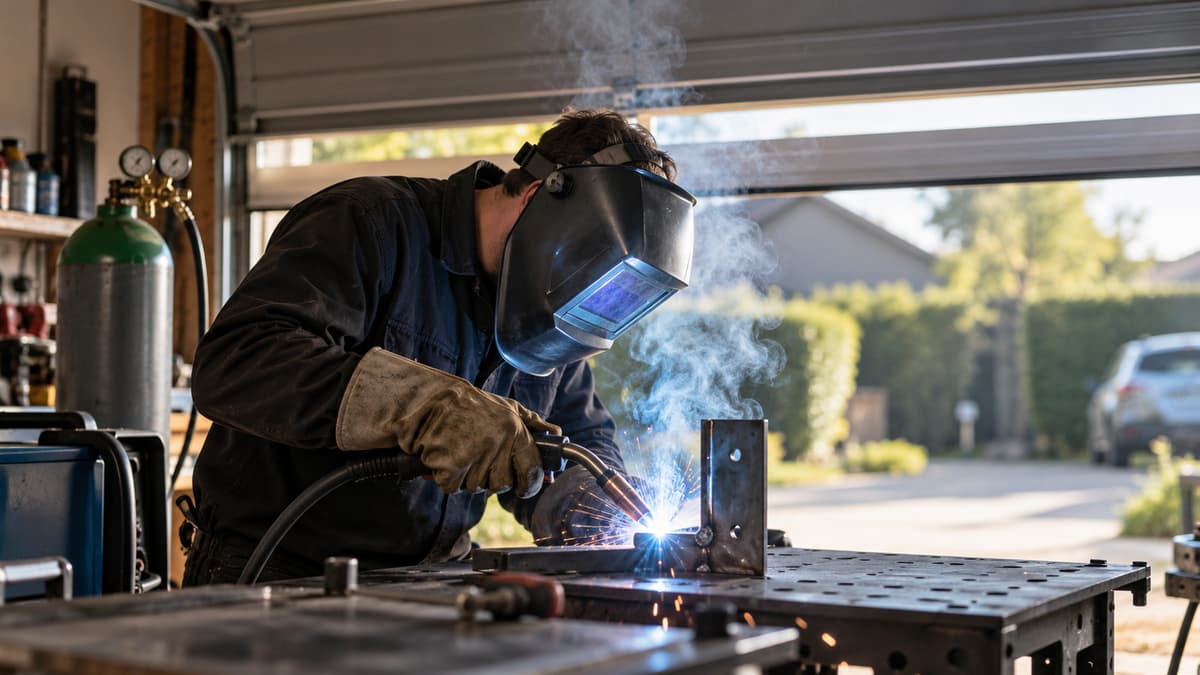
Welding fume garage ventilation is more than an open garage door. Mild steel fume still needs extraction indoors, and an argon bottle does not remove it.
On this page

You have the garage door up a hand's width, the MIG set crackling on a mild-steel bracket, and a blue-grey plume climbing past the visor. The bottle is doing its job on the weld. The air in the bay is a different problem. Welding fume garage ventilation is the control that has to sit beside the bottle, and a cracked door is a weak version of it.
The fume is the cloud from the arc, the wire, and the steel. The shielding gas keeps air off the pool. The Health and Safety Executive bulletin of February 2019 treats all welding fume, including mild steel, as needing control. Indoors, it expects engineering controls regardless of duration. Respiratory protection is for residual fume, and for welding outdoors.
A later controls page still describes a narrower workplace case. Sources are that bulletin, the controls page, WL3, WL2, and the examination page. Bottle figures come from the amazon.co.uk listing in the argon gas cylinder comparison, not a lab test of a garage or a mask. A qualifying purchase can earn a commission at no extra cost to you.
In short
From February 2019, indoor welding fume, including mild steel, needs engineering controls regardless of duration, with respiratory protection for residual fume and for outdoor work. The narrower case is someone welding less than once a week and for under an hour, with a respirator and good general ventilation. An open door only dilutes the bay. A disposable argon bottle only supplies gas.
Fume is not the shielding gas
You open the valve, the regulator hisses, the wire feeds, and a cloud rises off the joint. Argon, or an argon and carbon dioxide mix, floods the pool so the air does not spoil the bead. When the valve is shut, that job stops. The fume has already left the arc.
The fume comes from the consumable and the parent metal, and it stays in the bay until something moves it out. A sound bead can still leave your breathing zone full of that cloud. A tack and a ten-minute repair both make fume while the arc is lit.
WL2, the HSE sheet on welding in confined spaces, keeps the two hazards apart. Shielding gas can displace oxygen in a tank, a pipe, or a closed fabrication. Fume is the exposure from the weld itself. A home garage with the car inside is a different space from the one that sheet is written for. Argon is not fume control.
Mild steel is where the mix-up costs the most. The joint looks ordinary, and the cloud can seem like heat haze. The February 2019 bulletin included that fume with every other welding fume. A thin TIG pass can look almost clear beside MIG and still put fume into a single garage.
Flux-cored wire makes the same point from the other side. Take the bottle off the set and the plume is still there, because the flux does the shielding the gas used to do. The flux-cored wire comparison is about the consumable. Switching to gasless wire leaves the air decision on the bench.
What HSE changed for mild steel
The February 2019 bulletin closed a reading that put mild steel, and a short job, in a lighter box. All welding fume, including mild-steel welding fume, is in scope. Indoor work still needs engineering controls regardless of duration. A home garage is not left out, and this page will not offer a weekend exemption.
The controls page still describes someone welding less than once a week and for under an hour, where respiratory protection together with good general ventilation can meet a stated minimum. That sentence leaves the bulletin's indoor line in place, respirator included. Flattening the two pages into a short-job exemption is the reading the bulletin tightened. A door latched at ankle height is a poor stand-in for that general ventilation.
Mild steel welding fume HSE pages are written for welding at work. Where COSHH applies, local exhaust has a thorough examination at least every 14 months. A private Saturday job on your own trailer is not automatically that booking. If you weld as work, or you employ someone in the garage, that 14-month check is how extraction stays honest. A blog does not sign your COSHH assessment.
Garage ventilation and extraction
Welding fume garage ventilation fails in a familiar layout. The door is ajar, a desk fan points across the bench, and the internal door to the hall is open. The plume rises off the joint, curls under the helmet, then drifts towards the warm house. You smell the joint in the kitchen after the visor is up. The bay has been diluted, and the arc has not been captured.
WL3 is the HSE guidance on local exhaust for welding. LEV here is designed for the process and discharged outside, and the sheet warns against recirculated unfiltered air. A fan that blows the cloud into the bay, or a dust unit emptying back into the same room, fails that warning unless the air is cleaned of welding fume. The hood has to sit close to the arc. Other people and pets stay out until the smell has gone.
Is opening the garage door enough?
Open the garage door fully if it is part of the plan at all. A hand's width at the bottom leaves the top of the bay, where hot fume collects, almost closed. The plume still crosses your face before it reaches daylight. Wind on your back blows it further in, and wind on your face blows it towards the tumble dryer.
On the controls page, good general ventilation is paired with respiratory protection for that less-than-once-a-week, under-an-hour case. Shut the internal door for the arc and until you can no longer smell the joint. This page will not invent an air-change time. The test of a hood is whether the plume enters it during the weld, including a short tack, and then leaves the building.
Masks and other people in the room
Respiratory protection is the half of the bulletin a helmet advert tends to skip. It covers residual fume indoors, once engineering controls are in place, and fume outdoors. Wear it for the tack as well as the long bead. Taking it off between passes, while the plume is at chin height, spends the minute the control was there for.
A welding helmet and a welding mask protect your eyes and face from the arc. The welding helmet and welding mask comparisons stay on that optical job. This article does not review them. A dark lens leaves the air under the shell unfiltered. The bulletin's term is respiratory protective equipment, and this page will not invent a filter class for you.
Keep other people out for the arc and the clear-out. The person on the earth clamp is in open air at plume height, and a visor on your head does nothing for them. Welding on the drive still calls for that respirator and for distance. Outdoors, wind can push the plume into your face, and the bulletin still expects respiratory protection there. A decorator's dust mask is a different product from that equipment.
What a bottle comparison will not solve
A bigger cylinder or a known argon mix can improve the gas supply. The plume is still yours to remove. The top pick in the argon gas cylinder comparison is the SWP WG/1368, ASIN B00793QH94, a disposable argon/CO2 bottle listed at 60 litres and 1.28 kg, stored at £17.99, with 4.6 from 160 amazon.co.uk reviews. That top pick is for a short disposable session.
The listing never states the mix percentages or the outlet thread. Reviewers describe welding times of about 5 to 10, 10 to 15, and 20 minutes. One UK review said the fitting was smaller than their normal regulator. A second cartridge mid-job buys more arc time and more plume. When those 60 litres are gone, the fume question is where it started.
Flux-cored wire takes the disposable out of the basket and leaves the same ventilation job: discharge outside, without recirculated unfiltered air. Twenty minutes indoors in a month is close to that sporadic timing, and still inside the bulletin's indoor line, which pairs general ventilation with a respirator. The SWP price is a stored listing, and a live basket can move. Fume was not measured behind a shielding-gas bottle.
Common questions
Is mild-steel welding fume a real hazard?
Is argon the dangerous part of MIG welding?
Is opening the garage door enough when MIG welding?
Do I need a mask as well as extraction?
What about welding outdoors?
Does TIG fume count if I cannot see a cloud?
Does this apply at home, or only to employers?

Peter F. is the editor for DIY & tools at productscompared.co.uk. Comparisons in this category are checked against amazon.co.uk listings, review evidence and public UK sources.
Related articles
Gasless wire or a gas bottle
Flux-cored wire drops the bottle. It still makes fume, and outdoor wind is a different problem from a closed garage.

How to store a welding cylinder at home
Keep a welding cylinder upright, shut, and away from fuel. A ventilated store is not the same as extracting fume at the arc.
Argon purging and confined spaces
Argon used to purge a pipe or a tank can displace oxygen. That hazard sits apart from the fume the arc makes.