Independent comparisons. We may earn from shop links. More info

Surface socket vs flush socket

Updated: October 2026

When you need a new outlet on masonry, plasterboard or a utility-room wall, the first decision is not the brand. It is whether the box sits on the wall or inside it. In a surface socket vs flush socket comparison, both can accept the same UK 13 A plug. The difference is the enclosure, the building work and how far the finished accessory projects. Choose surface mounting when you cannot or should not chase the wall, or when visible trunking and later alterations matter. The [surface mounted socket comparison](/hub/sockets-and-extension-leads/surface-mounted-socket) covers complete surface products, not flush-only plates.

When you need a new outlet on masonry, plasterboard or a utility-room wall, the first decision is not the brand. It is whether the box sits on the wall or inside it.

Our top picks

On this page

Same plug, different box

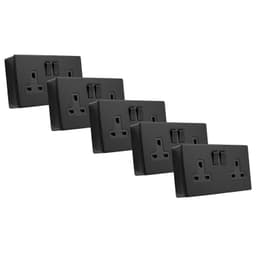
A surface socket fixes to a pattress or metal-clad box on the wall. The cable may arrive through trunking or a side knockout. A flush face fixes to a box set into the wall. Either may be a BS 1363 13 A socket. A flush faceplate may say it fits a standard back box, yet that box is not supplied and must already be recessed. A complete surface set should name a pattress or metal-clad enclosure. BS 4662 centres are about 60.3 mm for 1-gang and 120.6 mm for 2-gang. The CED listing prints 60.3 mm, which does not prove the face fits its 25 mm box. Gangs and depth are in the surface mounted socket buying guide.

When surface is the right mount

Surface mounting is the practical choice on hard blockwork where chasing would be dusty. If a cable route may change, opening a pattress is often simpler than making good a new chase. It can also avoid a cut into a wall whose role is uncertain. In a flat, a separating wall can have fire and acoustic functions. Surface mounting may reduce disturbance. It is not permission to ignore the cable route, fire stopping or the rules in your UK nation. A 25 mm pattress plus the face stands proud. In a dry garage, steel tolerates impacts better than light plastic, and it stays an indoor accessory unless an IP rating says otherwise. That case is in metal clad socket for a garage.
SHP SHP white 2-gang 25 mm

Testsieger

SHP SHP white 2-gang 25 mm
8.8/10about £6.00

When flush is the right mount

Flush mounting is normally preferable in a living room, bedroom or hallway where a projecting box would look intrusive. B&Q notes that a recessed accessory is less exposed to knocks. When a suitable back box and cable are already present, replacing the face can be straightforward. A new recess in masonry produces dust and needs care around hidden services. A plasterboard box depends on sound board and clearance behind it. Do not chase into structural, fire-resisting or separating construction. Making good can take longer than fitting the accessory. A shallow recessed box can be as awkward as a shallow pattress. The right screw spacing does not add depth. Choose flush mounting when the wall can safely take the recess and the finished appearance justifies the disruption.

Converting, and what does not transfer

A flush single can sometimes become a surface double with a purpose-made conversion pattress. B&Q and Wickes describe this as a way to gain a double without a wider recess. The circuit, the cable and the load still govern what can be connected. The conversion does not authorise a new circuit. Fixing centres may align while the mechanism fouls the back or the box is too shallow. The screwless SHPELEC five-pack is sold with 25 mm pattresses, yet two reviews say the face would not clip or fit the supplied box. A surface socket designed to stay exposed cannot simply be pushed into a chased hole. Surface trunking avoids chasing. A new circuit remains new electrical work. In England, Part P notification includes a new circuit and work in a special location. Wales has different published boundaries, and Scotland and Northern Ireland use their own systems.

Common questions

What is the actual difference between surface and flush sockets?
A surface socket uses a box fixed onto the face of the wall, while a flush socket uses a box recessed into it. Both may be UK 13 A accessories. The practical differences are projection, cable route, wall disruption, appearance and exposure to knocks.
When is a surface socket the better choice?
Choose surface mounting where chasing is undesirable, the wall construction should not be disturbed, or the cable will run in visible trunking. It is particularly practical in dry garages and utility spaces. Accept that the box projects and must be protected from impacts and moisture.
When is a flush socket the better choice?
Choose flush mounting in a finished room when the wall can safely accept a recess and a low-profile result matters. It is less exposed to everyday knocks, but creating the recess causes more dust and making good, and it may be unsuitable in special wall construction.
Will any UK faceplate fit a surface pattress?
No. Standard fixing centres may align, but the mechanism can still be too deep or clash with cable entries. Check the box depth, the intended accessory type and the manufacturer instructions. A matching screw spacing alone is not proof of a safe, comfortable fit.
Can I turn a flush single into a surface double?
A purpose-made conversion pattress can allow this where the existing circuit and cable are suitable. It changes the physical mounting, not the circuit capacity. The completed alteration still needs correct isolation, earthing, termination and testing.
Does surface trunking avoid Part P?
No. Trunking changes the cable route, not the legal classification of the electrical work. A new circuit remains a new circuit. Notification and building-control rules vary across the UK, so check the rules for your nation and use an electrician where the scope is uncertain.

Related pages

Sources

Public UK sources on BS 1363, socket boxes, and Part P. Listings checked in October 2026. Prices on amazon.co.uk move.

  1. BSI, BS 1363-2:2023 (retrieved 17 October 2026)
  2. The IET, socket-outlet protectors (retrieved 17 October 2026)
  3. BEAMA box bulletin (retrieved 17 October 2026)
  4. Approved Document P (retrieved 17 October 2026)
  5. GOV.WALES electrics (retrieved 17 October 2026)
  6. IET, Scotland and Northern Ireland (retrieved 17 October 2026)
  7. Electrical Safety First, bathrooms (retrieved 17 October 2026)
  8. Electrical2go, metal clad (retrieved 17 October 2026)