Independent comparisons. We may earn from shop links. More info

How to fit a surface mounted socket

Updated: October 2026

Knowing how to fit a surface mounted socket starts with whether the work is a straightforward replacement or a new electrical installation. A competent person may replace an existing accessory. Adding a circuit, working in a special location or finding damaged wiring changes the risk and the legal position. This guide gives the sequence from isolation to testing. It does not design a circuit or replace inspection by a qualified electrician. If you have not selected the accessory, use the [surface mounted socket comparison](/hub/sockets-and-extension-leads/surface-mounted-socket) to distinguish a complete pattress or metal-clad set from a flush-only faceplate. Never use the socket’s rocker switch as isolation.

Knowing how to fit a surface mounted socket starts with whether the work is a straightforward replacement or a new electrical installation. A competent person may replace an existing accessory.

Our top picks

On this page

Isolate and prove dead

Identify the correct circuit at the consumer unit, switch it off and keep control of the isolating device. Electrical Safety First describes securing the isolation, and the HSE requires conductors to be proved dead. Lock the breaker where suitable, and leave a warning. Use an approved voltage indicator, not a lamp or a non-contact pen. Prove it on a known live source, test the conductors, then prove it again. If you cannot identify the circuit, stop. Remove the existing face only after that sequence. Brown or older red normally connects to L, blue or older black to N, and the circuit protective conductor should be sleeved green/yellow. Mixed colours, heat damage, borrowed neutrals or more conductors than expected are reasons to stop.

Fix the surface box and bring the cable in

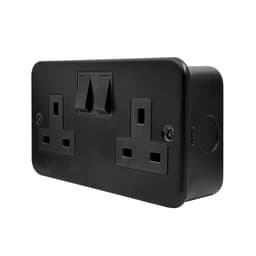
Hold the empty pattress or metal box level, check for hidden pipes and cables, and mark the fixing holes. Bring the cable through a designed entry. Plastic pattresses use moulded knockouts. Flameport warns that drilling the plastic can shatter it. Support the enclosure while you open the knockout. A metal knockout may need a grommet so the cable cannot rub on bare steel. If the mechanism will not sit without force, use a deeper box. If the wall could take either a projecting box or a chased recess, surface socket or flush socket compares the disruption, the appearance and the knock risk.
SHP SHP white 2-gang 25 mm

Testsieger

SHP SHP white 2-gang 25 mm
8.8/10about £6.00

Terminate the socket and earth a metal box

With the circuit still proved dead, sleeve any bare protective conductor green/yellow. Brown or red goes to L, blue or black to N, and the protective conductor goes to earth. Follow the manufacturer’s stripping lengths where they are supplied. A surface metal back box must be earthed. NICEIC guidance treats a fixing screw and one lug as enough only where continuity is reliable. Otherwise use a fly lead between the socket earth terminal and the box. Check that every conductor is fully inserted, that no insulation is trapped and that no copper is left exposed. A plug-in socket tester can flag some wiring errors. It cannot replace the tests required for altered wiring. Product checks sit in the surface mounted socket buying guide.

Where you stop and use an electrician

Stop for heat damage, brittle insulation, a socket that remains live after isolation, no reliable earth, signs of water or conductors you cannot identify. A new cable from the consumer unit is circuit design, not an accessory swap. Continuous heavy loads and uncertainty about RCD protection need assessment. A 13 A marking on the plate is not that assessment. Notification rules differ across the UK. In England, the IET summary of the 2013 Part P rules treats a new circuit, consumer-unit replacement and work in a special location as notifiable. Wales still includes extra points in kitchens, bathrooms and outdoors. Scotland does not use Part P. Northern Ireland has its own building-control framework. A like-for-like replacement on a healthy circuit is different from a new point. Non-notifiable does not mean unregulated. Bathrooms, outdoor points and uncertain garage supplies remain stop lines.

Common questions

Is switching off the socket rocker enough?
No. The rocker is a control, not safe isolation for work on the terminals. Isolate the relevant circuit at the consumer unit, prevent accidental re-energisation and prove dead with a suitable indicator that is proved before and after use.
How do I prove a socket circuit is dead?
Prove an approved voltage indicator on a known live source or proving unit, test the conductors at the accessory, then prove the indicator again. If you are not trained to access and identify those conductors safely, do not remove the faceplate. Use a qualified electrician.
Should I drill a plastic pattress for cable entry?
Use the moulded knockout intended for cable entry. Drilling can crack or shatter a plastic box, particularly around thin entry sections. Open the correct knockout while supporting the enclosure, and use a grommet or gland where the box design or the cable entry requires one.
Must a surface metal box be earthed?
Yes. A surface metal enclosure is an exposed-conductive-part and needs an effective earth connection. A fly lead between the socket and box earth terminals is appropriate where continuity through the fixing lug and screw cannot be reliably assured.
Is a like-for-like socket swap notifiable in England?
An ordinary like-for-like replacement is generally outside England’s notifiable categories, but the work still must be safe. A new circuit, a consumer-unit replacement or work in a special location changes the position. Wales, Scotland and Northern Ireland must be checked under their own rules.
When should I call an electrician?
Stop for a circuit that cannot be proved dead, damaged or overheated wiring, missing earth continuity, moisture, unexpected conductor arrangements or any new-circuit work. Seek professional design for sustained high loads, and confirm the rules for kitchens, bathrooms and outdoor locations in your UK nation.

Related pages

Sources

Public UK sources on BS 1363, socket boxes, and Part P. Listings checked in October 2026. Prices on amazon.co.uk move.

  1. BSI, BS 1363-2:2023 (retrieved 17 October 2026)
  2. The IET, socket-outlet protectors (retrieved 17 October 2026)
  3. BEAMA box bulletin (retrieved 17 October 2026)
  4. Approved Document P (retrieved 17 October 2026)
  5. GOV.WALES electrics (retrieved 17 October 2026)
  6. IET, Scotland and Northern Ireland (retrieved 17 October 2026)
  7. Electrical Safety First, bathrooms (retrieved 17 October 2026)
  8. Electrical2go, metal clad (retrieved 17 October 2026)