Independent comparisons. We may earn from shop links. More info

How to install a Kopp Nautic socket on fixed wiring

Updated: 23 October 2026

A Kopp surface box is on the bench and the circuit is not yet proved dead. To install a Kopp Nautic socket you need the terminal type, whether the gangs are linked, and a point to stop. These steps follow the amazon.co.uk listings in our [Kopp sockets comparison](/hub/sockets-and-extension-leads/kopp-sockets). They are not a new-circuit design. If the power might still be on, or the property might not use continental outlets, do not start. Plug type is the [buying guide](/hub/sockets-and-extension-leads/kopp-sockets/sub/kopp-sockets-buying-guide). Where the box should live is the [Kopp Nautic IP44 socket](/hub/sockets-and-extension-leads/kopp-sockets/sub/kopp-sockets-nautic-ip44) page. We did not wire these units. A qualifying purchase can earn a commission at no extra cost to you.

A Kopp surface box is on the bench and the circuit is not yet proved dead. To install a Kopp Nautic socket you need the terminal type, whether the gangs are linked, and a point to stop.

Our top picks

On this page

Before you take the insert out

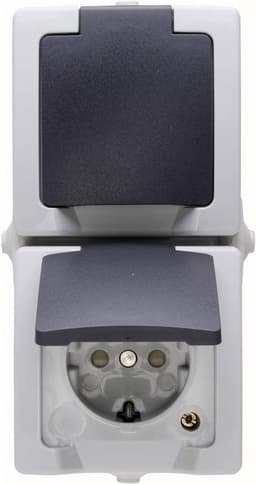
Switch off at the consumer unit and prove the conductors dead. BS 7671 still applies. The lid and the toggle are not isolation. The grey vertical double, the switch combination and the anthracite item type describe plug-in terminals up to 2.5 mm². The white horizontal double does not describe the terminal. The standard double, if that arrived, allows rigid conductors only and no strain relief. White Nautic fixing holes sit in deep pockets, and no torque is printed. Stop if the cable is larger than a stated 2.5 mm² limit. A new circuit or a bathroom zone you cannot place is a registered electrician’s work.

Wiring a surface Nautic insert

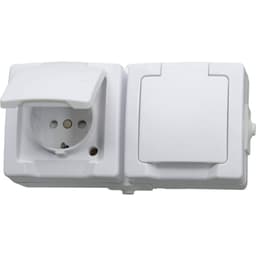
On the models that say so, the interior comes out, the conductors go into a plug-in terminal, and the interior goes back. The grey vertical double has no factory bridge in the reviews, so a loop needs link wires kept clear of the lid. Model 138556008 is one outlet and a toggle. One review in that file is a different two-rocker switch, so query the order if the insert does not match. The white horizontal double can be wired singly or looped. If a conductor pulls out, it is not terminated. The anthracite page mixes a double with no internal link and a 10 A switch bullet. Stop if the object in your hand is the other thing. If a locating pin snaps, replace the box.

The standard programme screws, if that is your box

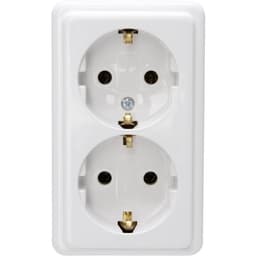
Model 102502002 is the surface double at about £5.26 with screw terminals, not a Nautic lid. One reviewer says the cable bridge sits at the wrong end of the diagram. Follow the moulding, and the earth-contact terminal rather than the 2-pin bullet. Rigid conductors, fixed mounting, no strain relief. Flexible cord does not belong here. If a screw head cams out, replace the screw.

Paris inserts, briefly

Paris inserts need their own frame, not a UK 86 mm plate. Model 923502087 says the cover for one to four gangs is ordered separately. Six-pack reviewers describe screwless terminals that release, and fixing screws that strip. A defective thread on the single is a reason to exchange the insert. IP20 is the wrong rating for a splash zone.

When to stop and leave it dead

Stop if the RCD trips as soon as you restore power. Unplug the load, then isolate again. Stop for sparking, hot plastic or browned insulation. A canopy review of the white Nautic double described that pattern after about two years. One report is not a failure rate. Stop too if a bridge is missing and you cannot tell line from neutral, or if a lid will not close. That is a registered electrician’s job.

Common questions

How do the plug-in terminals work?
On the Nautic listings that describe them, you remove the interior, push the conductors into a plug-in terminal rated up to 2.5 mm², and refit the interior. The white horizontal double does not print that description. If a conductor pulls straight back out, it is not terminated.
Do I need link wires on a Kopp double?
On the grey vertical Nautic and on the anthracite listing, reviewers say there is no factory link between the two outlets, so the fitter adds a bridge. Check the insert in your hand rather than assuming every double in the range is the same. The switch-and-socket model has only one outlet.
Can I use flex instead of fixed wiring?
Not on the standard programme double. The bullet says rigid conductors, fixed wall mounting, and no strain relief. The Nautic pages describe fixed surface mounting and, where stated, cable up to 2.5 mm². None of these is a trailing socket for a flex you happen to have.
Why are the fixing screws hard to reach?
On the white horizontal Nautic, reviewers say the fixing holes sit in deep pockets. A short screwdriver or the one that came with another accessory often will not square up. The anthracite reviews add a soft wall base, so the screw can pull through if you lean on it.
How do Paris screwless terminals release?
Reviewers of the six-pack say the terminal holds the conductor and can be released again. Our files do not print a lever diagram or a tool size, so use the release the insert actually has, and do not prise at the face with a blade. If the fixing screw strips, stop tightening it.
What must I switch off?
The circuit that feeds the socket, at the consumer unit, proved dead before you touch a conductor. The toggle on the Nautic switch-and-socket combination switches the load at the box. It is not the isolation for you to wire behind.
When does this need an electrician?
When you are adding a circuit, when you cannot confirm isolation, when the room is a bathroom zone you cannot judge, when the RCD trips and stays tripped, or when you find heat, sparking or burnt insulation. BS 7671 still governs the fixed installation. This page does not certify the work.

Related pages

Sources

Sources taken from the research digest. Listings were scored on 20 October 2026. This page did not run a lab test.

  1. Heinrich Kopp GmbH product catalogue (retrieved 20.10.2026)
  2. BSI — BS 1363 plugs and socket-outlets (retrieved 20.10.2026)
  3. Electrical Equipment (Safety) Regulations 2016, regulation 35 (retrieved 20.10.2026)
  4. Plugs and Sockets etc. (Safety) Regulations 1994 (retrieved 20.10.2026)
  5. IET Wiring Regulations (BS 7671) (retrieved 20.10.2026)
  6. IEC 60529 degrees of protection (IP code) (retrieved 20.10.2026)
  7. Electrical Safety First — finding an electrician (retrieved 20.10.2026)