Independent comparisons. We may earn from shop links. More info

8 way extension lead with USB

Updated: 23 October 2026

You want an 8 way extension lead with USB so phones and a tablet stop taking mains sockets from the monitor and the lamp. The ports in this amazon.co.uk set are 5 V extras, about 3.1 A to 3.6 A shared. They are not a second mains supply, and they are not laptop USB Power Delivery. The rows live on the [8 way extension lead comparison](/hub/sockets-and-extension-leads/extension-lead-8-way). Listings were used on 20 October 2026. We did not meter the USB ports. A qualifying purchase can earn a commission at no extra cost to you.

You want an 8 way extension lead with USB so phones and a tablet stop taking mains sockets from the monitor and the lamp. The ports in this amazon.co.uk set are 5 V extras, about 3.1 A to 3.6 A shared.

Our top picks

On this page

What the USB totals actually deliver

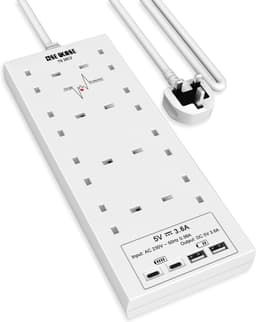
Every USB bar we kept states a shared budget. HANYCONY prints 3.1 A. At 5 V that is about 15.5 W for every phone plugged in at once. A single port may reach 2.4 A, or 3 A on USB-C, inside that share. SE UKASE prints 5 V at 3.6 A, also written as 17 W for the block, not per port. Two phones overnight can live in a 3.1 A pool. Four ports occupied will share and slow down.

USB-C on the bar is not laptop PD

A USB-C socket on these bars is still a 5 V charge port. HANYCONY’s black bullets say the ports do not support devices that need 14–22 V, including MacBook models. The laptop uses its own mains adaptor in an AC socket. SE UKASE mentions laptops in the title and then prints 5 V at 3.6 A total. A Power Delivery bar is a different product. If the ports you receive do not match the photos, that is a return, not a hidden fast-charge mode.

Eight AC sockets plus USB in this comparison

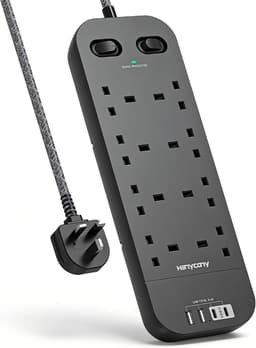
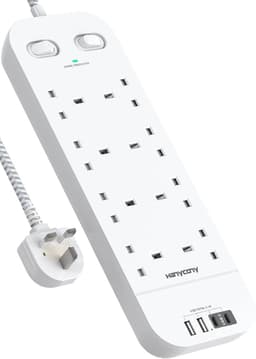
The black HANYCONY at £19.99 states Type G, 13 A, two zone switches, 1,800 J, and a 3.1 A USB total. The white listing disagrees with itself: Plug Type says Type C and Power Plug Type says Type G. Both share 2,042 reviews. SE UKASE at £16.99 states 17 W and has a Plug Type cell that says Type B. POWSAF prints 3.4 A rather than 13 A, and both plug cells say Type C. Leave that bar if you wanted a stated mains rating.

When USB on the bar is worth it

USB on the bar is worth it when two or three phones would otherwise take AC sockets you need for a monitor, a lamp, and a laptop brick. Start with the black HANYCONY if you want Type G and the 14–22 V warning in the same bullets. Open SE UKASE for the 17 W line after the live photo shows a UK plug. Skip USB if you already trust a mains brick, and use the plain Masterplug or Brennenstuhl. About 15 W to 18 W still comes from the 13 A fuse. Load stays on the how to use page. Joules stay on the surge page.

Common questions

How many phones can I charge from the USB ports?
Two phones on a 3.1 A, 5 V share is a realistic overnight case, because the pool is about 15.5 W. Four ports filled at once will split that pool, so each phone charges more slowly than it would on its own plug-in charger. The port count is not four separate 3 A supplies. SE UKASE’s 3.6 A line is the most the block claims in total, written as 17 W.
Will the USB-C port charge my laptop?
Not as USB Power Delivery, on the evidence of these listings. HANYCONY says the USB-C ports do not support devices that need 14–22 V, and names MacBook models. SE UKASE’s USB line is 5 V at 3.6 A total. Put the laptop’s own mains adaptor in an AC socket. A Belkin-style PD bar from another shop is a different specification, not a feature you can assume here.
What does 3.1 A shared at 5 V mean in practice?
It means the ports together have about 15.5 W to hand out. A single port may be allowed up to 2.4 A or 3 A in the HANYCONY bullets, and the others then get what remains. If you plug in one tablet and nothing else, that device can take more of the share. If you plug in four, nobody gets the maximum at the same time.
Do USB ports count as extra mains sockets?
No. They do not add to the eight AC outlets, and they do not raise the 13 A fuse. A headline that adds the ports and calls the bar a 12-way lead is counting holes, not current. Electrical Safety First’s extension-lead rules still apply to the mains side: one lead per wall socket, and no daisy-chain.
Why do some USB bars show Type B in the plug cell?
Because the specification table on amazon.co.uk is sometimes filled with a non-UK plug code. SE UKASE’s Plug Type cell says Type B. POWSAF’s cells say Type C. The white HANYCONY disagrees with itself. That is a stop-and-check against the live photographs, not a reason to fit a travel adaptor as a permanent fix. The black HANYCONY is the USB listing in this set that simply says Type G.
Which USB bar in this set fits a desk with a monitor?
Start with the black HANYCONY if you want Type G, zone switches, a 1,800 J claim, and a written warning that USB-C is not 14–22 V laptop charging, and if you accept that the 2,042 reviews are shared. Open SE UKASE if the 17 W total and a separate 373-review file matter more, and only after the plug photo is a UK 13 A plug. Leave POWSAF if you need a stated 13 A mains figure. The monitor and the laptop brick still use AC sockets.

Related pages

Sources

Sources taken from the research digest. Listings were scored on 19 October 2026. This page did not run a lab test.

  1. Electrical Safety First — Extension leads (retrieved 19.10.2026)
  2. Electrical Safety First — Plugs and fuses (retrieved 19.10.2026)
  3. Electrical Safety First — Appliance ratings (retrieved 19.10.2026)
  4. BEAMA — Extension lead safety check-list (retrieved 19.10.2026)
  5. BSI — BS 1363-2:2023 (retrieved 19.10.2026)
  6. OPSS — Tower power strip recall (retrieved 19.10.2026)
  7. Philips UK — What is a joule (retrieved 19.10.2026)
  8. Kent Fire and Rescue — Electricity safety (retrieved 19.10.2026)