Independent comparisons. We may earn from shop links. More info

8 way surge protected extension lead

Updated: 23 October 2026

You are comparing an 8 way surge protected extension lead because a PC or a television sits on the bar, and the joule numbers on amazon.co.uk do not agree. One listing says 125 J. Another says 2,100 J. A third says surge and never gives a number. Joules do not change the 13 A fuse, or the RCD that may already sit in your consumer unit. Prices and rows are on the [8 way extension lead comparison](/hub/sockets-and-extension-leads/extension-lead-8-way). Listings were read on 20 October 2026. We did not fire surges at the bars. A qualifying purchase can earn a commission at no extra cost to you.

You are comparing an 8 way surge protected extension lead because a PC or a television sits on the bar, and the joule numbers on amazon.co.uk do not agree. One listing says 125 J. Another says 2,100 J.

Our top picks

On this page

What joules measure

A joule rating is the energy the surge parts are meant to absorb from a short spike. Philips describes a higher figure as more headroom before those parts fail, not as a guarantee against lightning, and not as a watt rating. 1,800 J does not mean 1,800 W of ordinary load. Printed claims here are 125 J on Pro Elec, 1,200 J on SE UKASE, 1,800 J on HANYCONY, and 2,100 J on TOPREK. Those are amazon.co.uk claims, not measurements we made. Every bar still passes through a 13 A fuse.

Surge, fuse, and RCD

Surge parts are for a short spike. The 13 A fuse is for too much current for too long. An RCD is for shock protection if current leaks to earth. None of these bars claim an RCD in the housing. The 4.5 kA figure on the Pro Elec bullets is a peak surge current, not a continuous rating of 4,500 A. The 1 m Pro Elec page prints 4,000 A in a current cell. Read 13 A, where the listing states it, as the running limit.

Joule claims on 8 way bars in this comparison

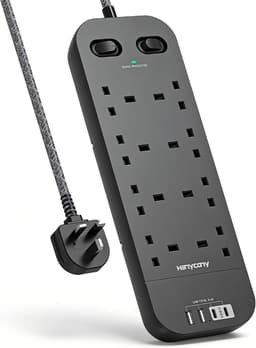
Pro Elec prints 125 J at £16.99 for the 5 m bar, with an LED indicator and both plug fields Type G. HANYCONY prints 1,800 J at £19.99, and the black and white pages share 2,042 reviews. SE UKASE prints 1,200 J at £16.99, with a Plug Type cell that says Type B. TOPREK prints 2,100 J at £28.99. A higher number is not more load. Masterplug’s surge cell repeats 13 A, which is the fuse. Brennenstuhl has no joule figure. POWSAF says surge protector and gives no joules. A missing number is a weaker claim than 125 J.

When to buy surge and when to skip it

Buy a joule-rated bar when a PC or a television is the reason, and when you can see a number. More joules can mean more headroom. They are not a reason to plug in a heater. If the indicator goes out, treat the spike absorption as spent. The sockets may still pass power, and the 13 A fuse is unchanged. Skip the premium for a lamp and a router. The Brennenstuhl and the Masterplug are the plain options. The load rules still apply. The buying guide is the order of the other checks.

Common questions

What does a joule rating on an extension lead mean?
It is the energy the surge parts are claimed to absorb from a short voltage spike. Philips describes a higher figure as more headroom before those parts fail, not as a guarantee against lightning. A joule rating is not the wattage of the bar and not the 13 A fuse. The figures in this set are listing claims from 125 J to 2,100 J.
Is 125 J enough for a PC and a monitor?
It is the figure Pro Elec prints, with an LED indicator, and it is a real number you can compare. It is a smaller claim than 1,200 J, 1,800 J, or 2,100 J on the other bars here. Enough is not something this page can prove without a lab. If you want the larger printed claim and you accept the price, TOPREK states 2,100 J. The PC and the monitor still share the 13 A fuse with everything else on the bar.
Does surge protection let me run more watts?
No. The fuse still limits the running current, typically 13 A, whether or not surge parts are fitted. Kent Fire and Rescue’s everyday ceiling is about 13 A or 3,000 W for what runs at the same time. A 2,100 J claim does not add a kettle, a heater, or a second lead.
What is the difference between surge protection and the 13 A fuse?
Surge parts are meant to absorb a brief spike. The fuse opens when current stays too high, which protects the cable from an overload. You can have a working fuse and spent surge parts, or a blown fuse and intact surge parts. Masterplug’s table puts 13 A in a surge cell. That cell is the fuse, and the bullets do not claim joules.
Do I still need an RCD if the bar says surge protected?
Yes, if the circuit needs shock protection. An RCD detects leakage to earth. Surge parts do not do that job, and none of these listings claim an RCD inside the bar. Electrical Safety First treats an RCD in the consumer unit, or an RCD plug where that is the right product, as separate from both the fuse and from surge absorption.
What does a surge indicator light tell me?
On the Pro Elec and HANYCONY listings it is there to show the surge circuit is still being presented as working. If the light is out, treat the spike absorption as no longer available even if the sockets still pass power. The light is not a load meter, and it does not tell you the 13 A fuse is healthy. A power light on a plain Masterplug is only a power light.

Related pages

Sources

Sources taken from the research digest. Listings were scored on 19 October 2026. This page did not run a lab test.

  1. Electrical Safety First — Extension leads (retrieved 19.10.2026)
  2. Electrical Safety First — Plugs and fuses (retrieved 19.10.2026)
  3. Electrical Safety First — Appliance ratings (retrieved 19.10.2026)
  4. BEAMA — Extension lead safety check-list (retrieved 19.10.2026)
  5. BSI — BS 1363-2:2023 (retrieved 19.10.2026)
  6. OPSS — Tower power strip recall (retrieved 19.10.2026)
  7. Philips UK — What is a joule (retrieved 19.10.2026)
  8. Kent Fire and Rescue — Electricity safety (retrieved 19.10.2026)