Independent comparisons. We may earn from shop links. More info

How to use a 3 way extension lead: load and placement

Updated: 23 October 2026

The bar is already behind the television, three plugs are in, and you are not sure whether the router, the lamp and the set-top box are still inside one fuse. How to use a 3 way extension lead is mostly that sum, plus where the flex lies and when you unplug. Peter F., the DIY & tools editor, used the amazon.co.uk listings in this category and public UK safety guidance, checked 20 October 2026. We did not test a lead in a lab. A qualifying purchase can earn a commission at no extra cost to you. Model-by-model detail stays on the [3 way extension lead comparison](/hub/sockets-and-extension-leads/3-way-extension-lead).

The bar is already behind the television, three plugs are in, and you are not sure whether the router, the lamp and the set-top box are still inside one fuse.

Our top picks

On this page

Before you plug in

The plug should be a UK Type G with a BS 1362 fuse, normally 13 A, and the sheath should be intact. If a socket will not grip, stop. Plug the extension into the wall socket itself. Electrical Safety First says one extension per wall socket, and no daisy-chain. The three sockets look independent, and they are not.

Adding appliances without overload

Electrical Safety First says not to exceed 13 A in total. A lamp, a router and a charger are nowhere near that. A 3,000 W kettle is already most of a 13 A circuit at about 230 V. London Fire Brigade says not to put a kettle, a toaster and a microwave on the same extension. Markings are on the 3 way extension lead buying guide.
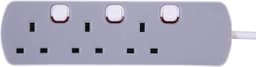
Etykir Etykir 0.5 m bar

Testsieger

Etykir Etykir 0.5 m bar
7.2/10about £9.99

Switches and standby

A rocker on each socket lets the router stay on while the lamp goes off. One master switch, as on Etykir or the Hulker cube, kills everything, including the router. With no switch, as on Status, you pull the plug or use the appliance's own switch. Which layout you should have bought is on the switched or unswitched 3 way extension lead page.

Placement and trip hazards

Run the flex along the skirting, not across a doorway, under a rug, or through a door. Half a metre is enough on the same side of the unit. If the flex strains the plug, unplug it rather than adding a second extension. The 0.5 m versus 1 m choice is on the short 3 way extension lead page. None of these bars is an outdoor lead.

When to unplug, return, or call someone

Unplug, and leave it unplugged, if you smell hot plastic, see scorch marks, hear arcing, or the plug is too hot to hold. A new BS 1362 fuse is only for an undamaged lead whose fuse has opened. Call a registered electrician if the wall socket is scorched, or if the breaker trips with no clear overload.

Common questions

How do I add up the load on three sockets?
Read the wattage on each appliance and add them. A lamp, a router and a charger are usually well under 100 W together. Compare that with the lead's marking, and with about 3,000 W as a rule of thumb for a 13 A plug at 230 V. If the listing also shows 2,500 W or 10 A, use the lower figure. Do not add 13 A three times. The sockets are in parallel on one fuse, not on three supplies.
Can I plug one extension into another?
No. Electrical Safety First says one extension per wall socket and tells you not to daisy-chain. A shortfall in length is a reason to move the cluster or to buy one lead that actually reaches, not to plug a second bar into the first. The same rule covers a cube adapter with a trailing lead stuck in the front. You still have two connections where one fuse was meant to protect one flex.
Is it safe to leave a router on all day on a switched lead?
Yes, if the lead is undamaged, the total load stays inside 13 A or the lower mark on that product, and the flex is not covered. Use a per-socket switch to leave the router on and turn the lamp off. A master switch will drop the router as well. An unswitched bar simply leaves everything live, which is fine for that always-on cluster and useless if you wanted the lamp off without pulling its plug.
What if the plug feels hot?
Unplug it and do not put it back. A plug that is too hot to hold, hot plastic smell, scorch marks or arcing are stop signs from Electrical Safety First. Let it cool, then look for damage. A warm adaptor under a heavy continuous load can be an early warning rather than a normal running temperature. If the wall socket is the part that scorched, or the breaker trips with no obvious cause, that is a registered electrician, not a new fuse in the same plug.
Can I use a 3-way lead for a kettle?
Do not put a kettle on these leads, and do not combine a kettle with a toaster or a microwave. London Fire Brigade names that mix specifically. A kettle is often around 3 kW, which is the whole of a 13 A circuit before anything else is added. Some product pages list kettles among compatible devices. That line does not change the fuse. Plug the kettle into the wall socket on its own.
When should I replace the fuse?
Replace it when it has blown, the lead and plug show no heat damage, and you fit a BS 1362 fuse of the same rating, normally 13 A. If the fuse blows again at once, unplug and stop. Do not fit a larger fuse, and do not wrap foil across the old one. Scorch marks, a melted shutter or a hot smell mean the lead is finished, not that it needs a fresh fuse. If you are not confident opening a plug, retire the lead.

Related pages

Sources

Sources taken from the research digest. Listings were scored on 20 October 2026. This page did not run a lab test.

  1. Electrical Safety First — Extension leads (retrieved 20.10.2026)
  2. Electrical Safety First — Plugs and fuses (retrieved 20.10.2026)
  3. Electrical Safety First — Overloading sockets (retrieved 20.10.2026)
  4. Electrical Safety First — Garden (retrieved 20.10.2026)
  5. London Fire Brigade — Cables, fuses and leads (retrieved 20.10.2026)
  6. BEAMA — Extension lead safety checklist (retrieved 20.10.2026)
  7. Legislation.gov.uk — ESQCR 2002 regulation 27 (retrieved 20.10.2026)
  8. Scottish Fire and Rescue Service — Electrical safety (retrieved 20.10.2026)