Independent comparisons. We may earn from shop links. Our editors compare products independently. Some links go to shops, and we may earn a commission. More info
Top pick: Beebombs seed balls, about 2 m² – About £9.99 for a stated 2 m² scatter sow, with 4.2 from 7,133 reviews, the strongest combination of stars and review volume in this set. Best value: Damavand 20 g meadow mix – About £3.99 for 20 g, with several species named, if you price the area from the packet weight and accept the shared reviews. Updated October 2026.
Flower meadow seeds on amazon.co.uk are small packets, larger gram bags, or clay seed balls for bare soil, a border, or a pot. Most buyers are choosing between a colourful pictorial mix for this summer and a perennial or mix they will cut once a year. An honest species list, a gram weight that matches the stated coverage, and a clear flowers-only or flowers-plus-grass line do.
The Royal Horticultural Society suggests about 2 g per square metre for a pure flower mix, on weed-free ground in full sun. If you want a lawn, start with [grass seed](/hub/seeds-and-plants/grass-seed).
A British list and a colour mix are set out in [native or pictorial mixes](/hub/seeds-and-plants/flower-meadow-seeds/sub/flower-meadow-seeds-native-or-pictorial).
A pictorial mix, such as cornflower, cosmos, poppy, and calendula, is garden colour. A perennial line, or a claim of 50% annual and 50% perennial, is a claim about plants in year two.
Flower meadow seeds on amazon.co.uk are small packets, larger gram bags, or clay seed balls for bare soil, a border, or a pot.
Flower meadow seeds on amazon.co.uk are small packets, larger gram bags, or clay seed balls for bare soil, a border, or a pot. Most buyers are choosing between a colourful pictorial mix for this summer and a perennial or mix they will cut once a year. An honest species list, a gram weight that matches the stated coverage, and a clear flowers-only or flowers-plus-grass line do.
The Royal Horticultural Society suggests about 2 g per square metre for a pure flower mix, on weed-free ground in full sun. If you want a lawn, start with [grass seed](/hub/seeds-and-plants/grass-seed).
A British list and a colour mix are set out in [native or pictorial mixes](/hub/seeds-and-plants/flower-meadow-seeds/sub/flower-meadow-seeds-native-or-pictorial).
A pictorial mix, such as cornflower, cosmos, poppy, and calendula, is garden colour. A perennial line, or a claim of 50% annual and 50% perennial, is a claim about plants in year two.
Flower meadow seeds on amazon.co.uk are small packets, larger gram bags, or clay seed balls for bare soil, a border, or a pot. Most buyers are choosing between a colourful pictorial mix for this summer and a perennial or mix they will cut once a year. An honest species list, a gram weight that matches the stated coverage, and a clear flowers-only or flowers-plus-grass line do. The Royal Horticultural Society suggests about 2 g per square metre for a pure flower mix, on weed-free ground in full sun. If you want a lawn, start with grass seed.
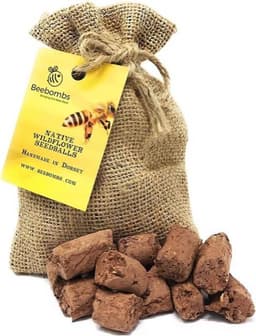
Beebombs offers a low-effort format for about 2 m² of open ground, pots or planters, priced at £9.99. The clay seed balls claim 18 British wildflower species and can be scattered rather than weighed at a grams-per-square-metre rate. A 4.2 rating from 7,133 reviews is the strongest combination of stars and review volume in this set, which makes it our top pick for a small, convenient sow rather than a germination winner. The product page does not name the 18 species, and the 130 g weight includes clay rather than representing pure seed. Reviews also raise quantity and timing concerns, including one count of roughly ten pellets. Choose the convenience and giftable format, but use a conventional named seed mix when species control or value per gram matters more.
Pros
Simple scatter format
Suitable for pots and about 2 m²
Largest review pool among the joint-highest ratings
Cons
Species are not named
Weight includes clay
Review reports question pellet quantity
Best for: A small patch, planter or gift where convenience matters most.
Less suitable: Large areas or buyers who need a verified, named species mix.
The bullets say the seed balls work in planters and pots, and that one pack covers roughly 2 m².
When does the listing say to scatter them?
The planting period says any time of year, with sun, water, and time. One review says the label allowed up to two years, and another said summer was the wrong moment.
Are the 18 species named?
The bullets say 18 British wildflower seeds and mention the RHS Perfect for Pollinators list. The raw file does not name the 18.
At £3.50 for about 200 seeds, Meldon's packet is an inexpensive route to a 60 cm cornflower display in a border or sunny patch. It is not a meadow mixture: the product is one annual species offered in several flower colours. The sowing directions are more specific than many listings, telling you to scatter thinly, avoid covering the seed and firm it in. Its 4.2 score comes from 119 reviews, with reports ranging from easy colour to no germination or flowers unlike the advertised selection. The listing also gives different sowing periods in separate fields, so follow the packet supplied rather than combining every online line. Choose it for cornflowers, not for species diversity or a perennial meadow.
Pros
Lowest price in the comparison
Clear single-species purpose
Useful sowing directions
Cons
Not a multi-species meadow mix
Mixed germination reports
Sowing-period information varies
Best for: A cornflower patch or adding cornflowers to a planned mix.
Less suitable: Anyone expecting a complete meadow mixture or perennial diversity.
The title is a cornflower polka-dot mix for meadows, fields, and gardens. It is one annual, not a list of meadow species.
How does the listing say to sow?
Sow where they are to flower, in March to April or September. Do not cover the seed. Firm it in. Best results are claimed in well-drained full sun.
What do the reviews add?
Some report easy colour or a lot of seed. Others report no germination, or a result unlike the advertised selection. Several were written before any flower.
At £3.99 for 20 g, this is the lowest-cost multi-species meadow packet in the comparison and a practical way to try a small patch without buying a bulk bag. The listing names poppy, cosmos, cornflower, clover, chicory, linum and borage, while claiming an annual and perennial split. Its 4.1 rating comes from 1,031 reviews shared with other pack sizes, so it does not prove how this specific 20 g packet performs. More importantly, the stated 1–2 g per square metre rate conflicts with the coverage table. A UK reviewer also reported more grass than flowers despite the no-grass title. It is our best-value option on price and stated variety, provided you calculate the area from the packet weight rather than trusting every coverage line.
Pros
Low £3.99 entry price
Several flower species are named
Small pack limits waste on a trial patch
Cons
Sow-rate and coverage figures conflict
Reviews are shared across multiple sizes
A review disputes the no-grass claim
Best for: A low-cost first sow on a small prepared patch.
Less suitable: Anyone who needs independently verified coverage or a guaranteed grass-free result.
This Damavand listing offers a nominal 100 g bag for £11.99 and claims coverage of up to 25 m². The arithmetic is difficult to reconcile: the same page says 1–2 g per square metre, while 100 g over 25 m² equals 4 g per square metre. The item-weight field also says 90 g rather than the 100 g in the title. A 4.1 score from 1,031 reviews looks reassuring, but that review pool is shared with two other Damavand sizes in this comparison. The organic wording is unsupported by a control-body number in the available listing data. Consider it only if a larger bag matters more to you than precise weight and coverage documentation.
Pros
Larger nominal pack for a broader patch
Annual and perennial mix claimed
No-grass mix claimed
Cons
Title and item weight disagree
Coverage conflicts with the stated sow rate
No organic control-body number shown
Best for: A medium-sized trial where you can weigh your own sowing portions.
Less suitable: Buyers who need an exact 100 g pack or clearly evidenced organic status.
The 40 g pack costs £6.99 and sits between Damavand's smallest and largest options, making it convenient for a modest garden patch. Its title says 10 m², yet the stated rate of 1–2 g per square metre would put 40 g nearer 20 m² at the upper rate. The mix claims annuals and perennials with no grass, and the listing names several familiar meadow and pictorial flowers. However, its 4.1 rating and 1,031 reviews are shared with the 20 g and 100 g variants, rather than isolating this pack. Height also varies between a 70 cm attribute and a 30 cm to 1 m statement. It can work as a mid-sized buy, but only if you measure the seed yourself and treat the area claim cautiously.
Pros
Useful middle pack size
Several species are named
Full and partial sun are listed
Cons
Coverage and sow-rate figures disagree
Height information is inconsistent
Review pool is shared with other sizes
Best for: A modest patch where you will calculate coverage from grams per square metre.
Less suitable: A precisely planned 10 m² sow that depends on the title figure.
This compact Damavand packet costs £3.59 and contains roughly 5–6 g, with 500 seeds claimed in the title. Its 30–50 cm height promise and container wording make it look suited to pots and small borders. However, the named list includes morning glory, zinnia, sweet pea, California poppy and cosmos, so this is better understood as a pictorial garden mix than a British native meadow. One reviewer also estimated a much lower seed count than expected, while the listing itself gives both 5 g and 6 g weights. Organic appears as a material feature without a displayed control-body number. It is an affordable small-space experiment, but neither the dwarf height nor the seed count should be treated as guaranteed.
Pros
Low price for a small sow
Containers are explicitly mentioned
Several species are named
Cons
Weight figures disagree
A review questions the seed count
Not a British-native mix
Best for: A small pictorial container or border where varied garden annuals are welcome.
Less suitable: A native meadow project or a planting that depends on a strict dwarf height.
A bullet says the seeds can go in borders, containers, and beds. Indoor and outdoor are both on the usage line.
How much seed is in the bag?
The title says 500 seeds. A bullet says 5 g. Item weight is 6 g and the unit count is 5 g. One review, expecting about 1,000 seeds, estimated nearer 200.
Is the organic line documented?
Material features say GMO Free, Organic. No registration number is in the raw file.
Empathy's Mini Meadow costs £6 and states coverage of 3 m², giving small-bed and container gardeners a clearer area target than many bags. Its 4.0 rating is backed by 6,324 reviews, though stars alone cannot separate preparation failures from seed performance. Sampled reviews include a successful July display after an April sow and a balcony-pot result, but also an allotment that produced weeds only. The listing's three-metre height field appears to repeat the coverage figure, so it should not guide plant placement. Organic is shown as a material feature without a control-body number in the available data. This is a sensible compact pack when the 3 m² format fits, but the listing still leaves the species and true height unclear.
Pros
Clear 3 m² title claim
Low £6 price
Large review pool
Cons
Species are not listed
Height field is erroneous
Organic claim lacks a displayed control-body number
Best for: A small sunny patch or balcony container close to 3 m².
Less suitable: A larger meadow or planting plan that needs known species and heights.
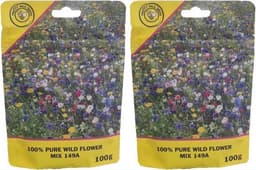
Pretty Wild Mix 149a supplies two 100 g bags for £21.98, making it the largest and most expensive option in this comparison. With a stated sow rate of 1–2 g per square metre, each bag could theoretically cover about 50–100 m², although the listing prints no direct coverage figure. It claims more than 25 species and no grass, but does not name the species on the page. The title uses the word certified without showing a lot reference or official seed label in the available data. A UK reviewer also says the packet contained non-native species and that the list was absent online. The bulk format may suit a large pictorial sow, but confirm the packet's species and certification details before opening both bags.
Pros
Large 200 g total pack
Clear 1–2 g per square metre rate
More than 25 species claimed
Cons
No online species list
No direct coverage figure
Certification wording is not documented
Best for: A large flower-only sow after checking the physical packet details.
Less suitable: Small gardens or buyers requiring a verified British-native mix.
The title is Mix 149a, 100 g, pack of 2. Item weight is 200 g and number of items is 2. The bullets say the details apply to each unit.
Are the species listed?
The listing says over 25 species and no grass. It does not name them. A UK review says many species on the packet were not native and that the list was missing from the product page.
What does certified mean here?
The word is in the title. The raw file does not show a lot reference or an official seed label.
For £6.69, this 50 g packet gives you a longer named species list than most listings in the comparison. It claims more than 20 annuals and perennials and identifies plants including cornflower, California poppy, clover, cosmos and corn cockle. That transparency helps you judge the style of display, although the listing does not state a sow rate, coverage area or sunlight requirement. Reviews behind the 4.0 score are mixed, with reports ranging from eventual flowers after a slow start to little or no germination. One reviewer also found dill in the seed. Because corn cockle is harmful if eaten, this is a mix to assess carefully where children or pets use the garden.
Pros
More species are named than on many rival listings
Reasonable price for a 50 g pack
Annual and perennial mix claimed
Cons
No sow rate or coverage figure
Mixed germination reports
Contains corn cockle according to the listing
Best for: Gardeners who want a named pictorial mix and can set their own sow rate.
Less suitable: Households concerned about corn cockle or buyers needing exact coverage guidance.
This £12.99 Damavand bag is listed at 100 g and is aimed at a larger sow than the brand's smaller packets. The product page undermines that straightforward proposition by also referring to 10 g and coverage of 10–20 m². It gives two different height expectations as well: 90 cm in one field and 1–1.5 m in a bullet. The 4.0 rating from 755 reviews is shared with the brand's 50 g nectar mix, so it is not a clean measure of this bag. UK origin is stated, but the species are not named. This is difficult to recommend unless you can confirm the received weight and packet instructions before sowing.
Pros
100 g item weight is listed
UK country of origin is stated
Annual and perennial mix claimed
Cons
The listing also says 10 g
Height claims conflict
Species are not named
Best for: A larger garden sow where you can verify the physical packet on arrival.
Less suitable: Anyone relying on the online coverage, height or species information.
The 50 g nectar mix costs £7.59 and, unlike several alternatives, prints a usable sow rate of 2 g per square metre. On that basis, the bag would cover about 25 m², although the listing does not state that area directly. It claims a grass-free wildflower mix for partial sun and gives a 70 cm height. The main limitation is that no flower species are named, leaving you unable to check whether the mix suits a native-meadow aim or a particular garden. Its 4.0 score from 755 reviews is also shared with a 100 g Damavand listing. It is a workable measured sow for a pictorial patch, but not a transparent botanical choice.
Pros
Clear 2 g per square metre sow rate
Useful 50 g pack size
No-grass nectar mix claimed
Cons
No species list
No direct coverage figure
Reviews are shared with another product
Best for: A measured flower-only sow where species origin is not the deciding factor.
Less suitable: A native planting plan or anyone wanting a named flower list.
This 20 g mix is sold around a dwarf-meadow promise, with a listed height of 65 cm and broad sun tolerance. In practice, several UK reviewers say the plants were not dwarf, with poppies reaching about a metre in one account. The listing gives neither a current GBP price nor a sow rate, so it is impossible to make a fair value or coverage comparison from the available data. A 4.0 rating from 116 reviews provides some feedback, but far less volume than the leading listings here. One review also reports that corn cockle dominated the result, while the product page does not provide a species list. Treat it as an experimental flower mix rather than a dependable low-height meadow.
Pros
Small 20 g trial pack
Full sun and partial shade are listed
Low-moisture care claim
Cons
No GBP price or sow rate available
Reviews dispute the dwarf claim
No species list
Best for: A trial patch where extra height would not cause a problem.
Less suitable: Front borders, sightlines or containers that require reliably short plants.
No GBP price line is in the raw file, so the price is n/a.
Do reviews support the dwarf claim?
Several UK reviews say the plants were not dwarf, including poppies near a metre. One reviewer on rich clay did not mind the extra height.
What did a reviewer say about corn cockle?
One review says most of the flowers were corn cockle and calls the plants unsuitable for children and pets, citing the RHS harm note. The listing itself does not name the species.
How we compared
Twelve flower meadow seed listings on amazon.co.uk were compared from the display file, with reviews through early October 2026. The job, the species list against slogan words, grams against the coverage line, the site, and the price after the area sum were weighted to 100. There was no growing trial. A star rating is the amazon.co.uk customer score. Where several Damavand sizes share one review text, that pool is counted once, not as separate trials.
1
Job the packet is for
25%
First-summer colour, a patch you will cut for years, a patio pot, and a gift are different packets. A pictorial mix, a perennial claim, seed balls, a dwarf line, and a single species are not interchangeable.
2
Species list versus slogans
25%
No grass, native, 100% wild flower, dwarf, certified, and organic are claims. A named list can be checked. A title word without a list, or without an organic control-body number, is not treated as verified.
3
Grams and coverage
20%
The packet rate is the figure used. If the title weight and a coverage bullet disagree, that conflict is scored, and the area is not taken from the slogan.
4
Site and safety
15%
A standard mix is for full sun and unfed, bare ground. Corn cockle on a list, or in a review, is recorded because the RHS lists it as harmful if eaten.
5
Price after the area maths
15%
GBP prices are the amazon.co.uk figures in the display file. A low shelf price ranks only after the grams and the stated rate give a usable area.
Independent review
Last updated: October 2026
8 sources checked
Flower meadow seeds buying guide
Start with the job, then with whether the listing names the species. Grams, the coverage line, the site, and the price come after those two checks. The notes below follow that order for these 12 amazon.co.uk listings. We did not grow the seed.
What are flower meadow seeds?
Flower meadow seeds on amazon.co.uk are a small packet, a larger gram bag, or clay seed balls. UK buyers are usually choosing among four jobs: colour this summer, a patch they will cut for years, a patio pot, or a gift. Those are different packets. A pictorial mix, such as cornflower, cosmos, California poppy, and calendula, is garden colour. A perennial line, or a claim of 50% annual and 50% perennial, is a claim about plants in year two.
Best for
A first sow on a small, bare, sunny bed
A pot, a gift, or about 2–3 m² of open ground
A cornflower patch where one species is the point
Not ideal for
Seed scattered into a living lawn
A shade bed, or soil you plan to feed
A verified organic or certified-native label
Mistakes to avoid
1
Sowing into turf or feeding the soil
The RHS says seed sown into turf rarely survives, and that a meadow patch should not be fertilised. Shade and a living lawn are the wrong brief for a standard mix. Bare, weed-free ground in full sun is the site these packets are written for.
2
Trusting dwarf, no-grass, organic, or native as verified
Those words are claims. Reviews on the Garden Lawncare Guy listing reject the dwarf height. A Damavand review reports more grass than flowers under a no-grass title. No raw file shows an organic control-body number. UK seed can mean only that the seller is in the UK.
3
Sowing thicker because two coverage lines disagree
If a title says 100 g and a bullet says 10 g, or a table uses a heavier rate than 1–2 g per square metre, that is a conflict. The RHS rate for a pure flower mix is about 2 g per square metre. Judging the patch in May is also early. Many of these listings talk about flowers from June or July onwards.
What to weigh up
Species list versus the slogan
High
The first check is what the packet is for, and whether you can see the plants. Pictorial mixes in this set name, or imply, cornflower, cosmos, California poppy, and similar garden annuals. The Damavand 20 g and 10 m² listings name poppy, cosmos, cornflower, clover, chicory, linum, and borage, and they claim a 50/50 annual and perennial split. The 50 g premium mix names more than 20 plants, including corn cockle.
Grams, coverage, and the price that follows
High
The second check is whether the weight and the area line are the same fact. The RHS figure to hold in mind is about 2 g per square metre for flowers only. Damavand’s 20 g, 100 g, and 10 m² listings all say 1–2 g per square metre, and each also prints a coverage line that does not match that rate. The 100 g title has an item weight of 90 g and a claim of up to 25 m², which is 4 g per square metre if you use 100 g. The 10 m² title is a 40 g pack. At 2 g per square metre, 40 g is nearer 20 m².
Which option suits you?
Three typical situations, each with a recommendation from this comparison.
🌱
A first bare sunny bed
You have a small prepared patch and you want a low first spend, with a few flower names on the listing. The Damavand 20 g mix is about £3.99 and names poppy, cosmos, cornflower, clover, chicory, linum, and borage. The 4.1 score is from 1,031 reviews shared with other sizes, and the coverage lines disagree.
You want something to scatter on open ground, in a planter, or to give. Beebombs are about £9.99 for a stated area of about 2 m², with 4.2 from 7,133 reviews. The listing claims 18 British wildflowers and does not name them. The 130 g weight includes clay.
You want one annual for a border or a sunny patch. Meldon is about £3.50 for about 200 cornflower seeds, listed at 60 cm. It is not a multi-species meadow. The 4.2 score is from 119 reviews, with mixed germination reports.
Which flower meadow seeds are the top pick in this set?
The top pick is Beebombs seed balls at about £9.99, for about 2 m², a pot, or a gift. amazon.co.uk shows 4.2 from 7,133 reviews, the largest pool among the joint-highest star lines here. The listing claims 18 British wildflower species and does not name them. The 130 g weight includes clay. This is a listing comparison. We did not grow the seed, and the stars are not a germination trial.
How much do flower meadow seeds cost on amazon.co.uk?
In this set, priced packs run from about £3.50 to £21.98. Under £7 are Meldon, two small Damavand packs, Empathy’s 3 m² pack at about £6.00, and two further Damavand bags at about £6.69 and £6.99. Beebombs is about £9.99. Two Damavand 100 g listings are about £11.99 and £12.99. Pretty Wild, two 100 g bags, is about £21.98. One listing has no GBP price. These are the display-file figures, not a shop survey.
What should you check on a flower meadow seed packet?
Check the job first: colour this summer, a patch you will cut for years, a pot, or a gift. Then read any species list against words such as native, no grass, dwarf, certified, and organic. None of these raw files shows an organic control-body number. Match the gram weight to the coverage line. If they disagree, use the grams and about 2 g per square metre for a pure flower mix. Price the pack only after that area sum works.
How thick should you sow flower meadow seeds?
The Royal Horticultural Society gives about 2 g per square metre for a pure flower mix and about 5 g per square metre when grass is included. Sow in March to April or September, on weed-free ground, in full sun. Do not fertilise or bury the seed. Several listings here print a table that fights the rate in the bullets. The Damavand 20 g page says 1–2 g per square metre and also a heavier table.
What is the difference between a native mix and a pictorial mix?
A pictorial mix is garden colour, such as cornflower, cosmos, California poppy, and calendula. A native or British mix, in Royal Horticultural Society wording, means UK natives plus plants introduced before 1500. UK seed on a title can mean only that the seller is in the UK. Seed balls, a dwarf line, and cornflower on its own are separate products. None of these twelve titles is a yellow-rattle packet.
Are these flower meadow seeds safe around children and pets?
Do not treat any mix here as safe to eat. The RHS lists corn cockle, Agrostemma githago, as harmful if eaten by people, dogs, and poultry. The Damavand 50 g premium listing names corn cockle. A review of the Garden Lawncare Guy packet reports it, and that listing does not name the species. This page is not veterinary advice. If children or pets may eat a stand that lists corn cockle, ask a qualified person before you sow.
Can you sow flower meadow seeds into a lawn?
The RHS says seed sown into turf rarely survives. A standard mix wants bare, weed-free ground in full sun, without fertiliser. Shade and a living lawn are the wrong brief. None of these twelve packets is a yellow-rattle product. Some meadow guides use yellow rattle where grass is already established, sown by November, and that plant is not assumed to be in these mixes. If the aim is a green lawn, this comparison is the wrong shelf.
Do higher star ratings mean the seed germinates better?
Stars on this page are amazon.co.uk customer scores, between 4.0 and 4.2. Beebombs is 4.2 from 7,133 reviews and Empathy is 4.0 from 6,324. Three Damavand sizes share 4.1 from 1,031 and the same review text. Two more share 4.0 from 755 and the same text. A shared pool is not separate trials. Meldon is also 4.2, from 119 reviews, and it is one species. We did not run a germination test.
Our verdict
In this set of 12 amazon.co.uk listings, the top pick for a small scatter sow is Beebombs at about £9.99. It claims about 2 m², pots, and 18 British wildflowers, with 4.2 from 7,133 reviews, the largest pool among the joint-highest star lines. The species are not named, and the weight includes clay. The best value is the Damavand 20 g mix at about £3.99, the lowest-cost multi-species packet here, with several flowers named. Its 4.1 from 1,031 reviews is shared with other sizes, and the sow rate fights the coverage table. Stars between 4.0 and 4.2 are not a germination trial. We did not grow the seed.
Best overall
Beebombs seed balls, about 2 m²
About £9.99 for a stated 2 m² scatter sow, with 4.2 from 7,133 reviews, the strongest combination of stars and review volume in this set.
Peter F. is the editor for DIY & tools at productscompared.co.uk. Comparisons in this category are checked against amazon.co.uk listings, review evidence and public UK sources.
Updated: October 2026
8 sources checked
Guides to flower meadow seed mixes
Guides on what to look for, how to use a product, and common mistakes.
RHS, Plantlife, RSPB and legislation.gov.uk, read with the amazon.co.uk listings in the display file (reviews through early October 2026). Shelf prices and star lines are those listing figures. This page did not grow the seed.
This page contains affiliate links to amazon.co.uk. If you buy through them, we may earn a commission at no extra cost to you. Prices, stars and review counts are the amazon.co.uk figures in the display file, with reviews through early October 2026. We did not grow these seeds.