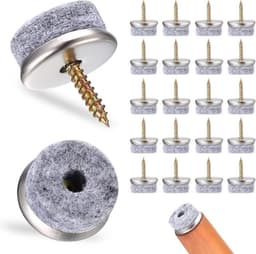
Independent comparisons. We may earn from shop links. More info

Screw-in felt pads versus stick-on on a dining chair

Updated: 22 October 2026

The felt discs are on the kitchen floor again, and the chairs are bare. Screw in felt pads vs stick on is a screw that stays on a chair you drag, or a peel-off pad when you cannot drill. This page takes both sides. It does not rank the screw brands. Those cards live on the [screw-in felt pads comparison](/hub/screws-and-accessories/screw-in-felt-pads). Peter F. updated this on 22 October 2026 from UK trade notes and the listings in this set. Those notes are commentary, not a timed lab test. A qualifying purchase can earn a commission at no extra cost to you.

The felt discs are on the kitchen floor again, and the chairs are bare. Screw in felt pads vs stick on is a screw that stays on a chair you drag, or a peel-off pad when you cannot drill. This page takes both sides.

Our top picks

X-Protector X-Protector 20 mm

Best overall

X-Protector X-Protector 20 mm
8.9/10about £12.91
Glarks Glarks mixed sizes

Alternative

Glarks Glarks mixed sizes
7.6/10about £10.99
wugongshan wugongshan 22 mm

Best value

wugongshan wugongshan 22 mm
7.4/10about £6.98
On this page

Why stick-on pads lose dining chairs

A dining chair is pulled sideways every time someone sits. Furnica calls that shear and says a self-adhesive pad lets go, while a screw holds. One Step Beyond, a UK flooring firm, says the adhesive fails on a busy wooden dining chair. Livedale still sells stick-on pads and says a mechanical glide is more secure if the furniture moves very often. If the foot is solid wood and you can drill, the screw is the hold. Measuring is the how to choose screw-in felt pads page.

When a stick-on pad is the one you can fit

A stick-on pad is what you can fit when the leg cannot take a wood screw, or when you must not drill. A hollow metal tube has no timber for a thread. A rental rule against holes leaves adhesive you check and replace when a corner lifts. A sideboard that never moves puts little sideways load on the glue. Livedale’s note is to use a clean, dry foot and a pad that sits inside the wood. Glue that is fine on a cold sideboard can be the wrong choice on a heated floor.
X-Protector X-Protector 20 mm

Testsieger

X-Protector X-Protector 20 mm
8.9/10about £12.91

Heat, metal, and the glue

Contract Flooring Journal, quoting Stroolmount, calls self-adhesive felt a short-term option because the glue does not hold on a heated floor. Furnica describes the same ageing. If the foot is solid wood you will drill, choose the screw. A hollow tube still cannot take a wood screw. The Journal’s line is that metal legs may be stuck with adhesive you watch. Amtico warns that rubber-backed mats can stain luxury vinyl, so a rubber cap is a poor stand-in on LVT.

Felt still wears, whichever way it is fixed

One Step Beyond says a worn pad full of grit acts like a sanding block. Bona says felt suits hard floors, harder glides suit carpet, and dirt defeats the pad. The fixing decides whether the pad is still there. The felt face decides whether the chair scratches the laminate. For a wooden dining chair you can drill, choose the screw. For a hollow metal leg, or a home where you must not drill, choose stick-on and check it. For underfloor heating plus wood you can drill, choose the screw. SIMALA’s saved reviews mix stick-on and screw comments, so that count is not a verdict on stick-on pads. The driving sequence is how to fit screw-in felt pads.

Common questions

Are screw-in pads always better than stick-on pads?
They are the better hold when a wooden chair is dragged every day and the foot can take a pilot hole. They are the wrong product when the leg is hollow metal, or when you are not allowed to drill. Furnica and One Step Beyond describe stick-on pads shearing off dining chairs. Livedale still sells stick-on pads and says a mechanical glide is more secure if the furniture moves very often. A daily kitchen chair usually cannot keep a clean adhesive pad.
Why do stick-on pads fall off dining chairs?
The chair is pulled sideways at every meal, often with someone sitting down. Furnica calls that shear and talks about adhesive failing within weeks. One Step Beyond calls adhesive failure the common experience on a busy wooden dining chair. UK reviews in this set describe stick-on pads ending up on the floor. A clean, dry foot and a pad inside the wood, Livedale’s own note, gives the glue a fair chance. It does not remove the sideways load.
Can you use stick-on pads on a hollow metal leg?
Yes. A hollow tube cannot take a wood screw, so adhesive is the fixing that remains, and you watch it. Contract Flooring Journal, quoting Stroolmount, says metal legs may be stuck and replaced when an edge lifts. On luxury vinyl, keep to felt. Amtico warns that rubber-backed mats can stain LVT.
Do stick-on pads fail on underfloor heating?
Trade commentary says the glue gives up on a heated floor. Contract Flooring Journal, quoting Stroolmount, calls self-adhesive felt a short-term option for that reason and points to a screw-in glide where the leg can take a screw. Furnica says adhesive ages on underfloor heating. If the foot is solid wood and you can drill, fit a screw. If the leg is metal, you still cannot switch to a woodscrew. You stick, and you check.
Will a screw damage a chair you might sell?
A screw leaves a hole in the foot. That mark stays if you sell the chair later. A stick-on pad leaves the timber unmarked, and on a chair that is dragged it is the pad the trade pages say falls off. If the chair is antique, or the leg has already been repaired, skip the drill and ask a restorer. For an ordinary wooden dining chair you expect to keep, the hole is the cost of a fixing that survives the sideways pull.
What about a rental where you must not drill?
Use a stick-on pad on a clean dry foot, sitting inside the wood, and replace it when a corner lifts. A screw breaches a no-holes rule even if it would hold better. If the chairs are dragged every day, expect to renew the pads more often than on a sideboard. When you own the furniture, or the agreement allows a hole, the comparison is where you pick a screw pack.

Related pages

Sources

Public UK sources from the research digest, used for this page in October 2026. Prices, stars and review counts are the amazon.co.uk lines in the display file. There is no laboratory test. The 2 mm pilot and PZ2 note belongs to the Keay listing only. A shared review count is not a test of one pack.

  1. Consumer Rights Act 2015, section 9 (retrieved 22 October 2026)
  2. Consumer Rights Act 2015, section 11 (retrieved 22 October 2026)
  3. Quick-Step laminate scratch FAQ (retrieved 22 October 2026)
  4. Amtico cleaning and maintenance FAQ (retrieved 22 October 2026)
  5. Karndean FAQ (retrieved 22 October 2026)
  6. Bona UK, protect floors from furniture (retrieved 22 October 2026)
  7. Contract Flooring Journal, adhesive versus screw-in (retrieved 22 October 2026)
  8. Keay Vital Parts 20 mm screw-in felt pads (retrieved 22 October 2026)