Independent comparisons. We may earn from shop links. More info

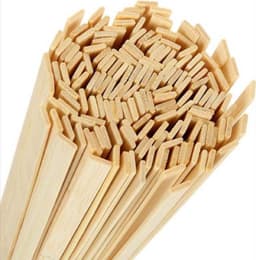
How to use flat wood strips: support, cut and glue

Updated: 22 October 2026

The tutorial you found is about a biscuit slot. That will not tell you how to use flat wood strips that are already 2 mm, 3 mm or 6 mm thick. Check the length, support the cut, smooth the end, then glue or pin, and collect the dust. If you needed a 4 mm oval slot, buy a biscuit instead. The steps are for the four packs on the [flat dowel comparison](/hub/screws-and-accessories/flat-dowel). Peter F., the DIY & tools editor, did not run a workshop trial. A qualifying purchase can earn a commission at no extra cost to you. No listing states a glue time or a load.

The tutorial you found is about a biscuit slot. That will not tell you how to use flat wood strips that are already 2 mm, 3 mm or 6 mm thick.

Our top picks

On this page

Check the piece before you cut

Measure the stick against the dimension line, not only the title. On B0FH3K9M7G the title and the dimensions agree on about 300 mm of 6 × 25 mm pine. On B0GHR2RBMX the title 3 × 25 × 150 mm agrees with 15.2 cm. On B0G4QJW1D6 the title says 150 mm and the dimensions say 30.5 cm. Tess, reviewing in the United Kingdom on 1 October 2026, wrote that a 150 mm order arrived at about 300 mm. Mark the real length before you cut. SENENQU’s length field matches a 400 mm title. Sort that pack first, because a twisted 2 mm stick tears under a knife. The flat dowel buying guide sets the size conflict out in full.

Cut and smooth the end

Support the piece on a scrap and cut from the face you will see. For 2 mm bamboo, a sharp knife and a straight edge beats scissors. Harv, on 8 February 2024, compared the bamboo with lolly sticks scissors could cut. The 6 mm pine can take a fine saw if it is clamped. Sand the end. MRS H J WILSON, on 27 March 2024, reported splintered bamboo. Discard those. The bamboo strips for model making page stays on that sort. Test a scrap before you paint. No coating is named.

Glue, pins or a pre-drilled screw

A 2 mm stick is a glue-and-hold piece. A screw will split it, and no fastener size is printed. One review in the shared Coowayze text mentions pre-drilling before screws. If you screw 6 mm pine, drill a clearance hole first and keep it away from the end. Furnica names PVA for a biscuit because the wafer is expected to swell in the slot. Do not copy that onto these pine strips. Nothing in the captures says Coowayze pine swells like compressed beech, and no cure time is stated. Dry-fit, then clamp or weight a 2 mm or 3 mm piece so it does not spring off. The strip does not centre itself in a cutter groove.

Dust, and the point where a jointer takes over

Do not sweep the dust or blow it. The Coowayze field says pine. The SENENQU field says Wood while the bullets say bamboo, so this page will not assign bamboo a hardwood or softwood limit. Bag the dust. Stop if the job is a biscuit joint. DIY Doctor’s router method is for a real slot, not a slat glued to a face. A 2 mm strip will not fill a 4 mm slot. The flat dowel versus biscuit page is the exit. Call a joiner for a stair, a bed, or sanding done as an employee. These listings state no load.

Common questions

How do you cut a 2 mm or 3 mm strip without a ragged end?
Support the strip on a scrap so the offcut cannot flap, and cut with a sharp knife against a straight edge, or with a fine saw on the 3 mm pine if the piece is held down. Cutting in mid-air tears the end. Sand the cut lightly afterwards. On the SENENQU pack, discard sticks that are already splintered or skewed, because a damaged 2 mm strip will not cut cleanly even on a scrap.
Can you paint or stain these unfinished strips?
The SENENQU bullets say the strips can be painted, stained, glued and cut. The listing’s own questions about paint have no answer paragraph, so there is no stated brand or number of coats. The Coowayze listings do not name a finish. Test a scrap. Do not treat a bullet as a finish specification.
Should you pre-drill before a screw?
Yes if you are screwing the thicker pine. One review in the shared Coowayze text mentions pre-drilling before screws, and a 6 mm slat splits easily at the end. No screw size is printed. A 2 mm bamboo strip is a glue job. A screw in that section is more likely to split it than to hold it.
What glue is stated for a biscuit, and does that sentence apply here?
Furnica names PVA for a biscuit, and describes the wafer swelling in the slot. That sentence is about compressed beech biscuits, not about these pine or bamboo strips. Do not assume the Coowayze pine swells the same way. No cure time is stated on the four listings. Dry-fit, then hold a thin strip until the glue you chose has grabbed.
What should you do with the sanding dust?
Do not sweep it or blow it. The Health and Safety Executive publishes eight-hour workplace limits of 5 mg/m³ for softwood dust and 3 mg/m³ for hardwood dust. A mixture takes the lower figure. Those limits bind employers under COSHH. A home bench is not that assessment. HSE sheet WD7, for powered sanders at work, calls for dust class M or H extraction. The pine is described as pine. The bamboo material field does not set a species limit.
When is the job no longer a home how-to?
When the piece is a fitted kitchen, a stair, a bed, or a mitre in a finished top, or when someone is sanding as an employee. COSHH and the HSE sanding sheet are written for workplaces. These listings state no load and no toy test. A concealed 4 mm slot is a jointer job, not a craft-strip job.

Related pages

Sources

Public sources from the research digest, used for this page in October 2026. Prices, stars and review counts are the amazon.co.uk figures stored with the four listings, not a live check.

  1. Lamello system brochure (retrieved 22 October 2026)
  2. Trend UK BSC/MIX/1000 jointing biscuits (retrieved 22 October 2026)
  3. Axminster Lamello biscuits (retrieved 22 October 2026)
  4. Furnica, biscuit versus wooden dowel (retrieved 22 October 2026)
  5. HSE wood dust (retrieved 22 October 2026)
  6. HSE WD7 wood dust extraction (retrieved 22 October 2026)
  7. Consumer Rights Act 2015, section 11 (retrieved 22 October 2026)
  8. DIY Doctor, cutting biscuit joints (retrieved 22 October 2026)