How to use a dowel jig so the joint actually closes
You have an 18 mm shelf, a drill, and a jig that will put the holes in the wrong place if the depth is wrong or the gauge moves. This is how to use a dowel jig so the pin does not bottom out and the two faces meet. The sequence that fails least often is: set the depth, drill one side, transfer the pattern, clamp whatever the reviews say will wander, then dry-fit before glue. Which jig to buy is on the [dowel jig comparison](/hub/screws-and-accessories/dowel-jig) and the [dowel jig buying guide](/hub/screws-and-accessories/dowel-jig/sub/dowel-jig-buying-guide). The worked depths below are Wolfcraft’s, for their gauge, not a British Standard.
You have an 18 mm shelf, a drill, and a jig that will put the holes in the wrong place if the depth is wrong or the gauge moves. This is how to use a dowel jig so the pin does not bottom out and the two faces meet.
You have an 18 mm shelf, a drill, and a jig that will put the holes in the wrong place if the depth is wrong or the gauge moves. This is how to use a dowel jig so the pin does not bottom out and the two faces meet. The sequence that fails least often is: set the depth, drill one side, transfer the pattern, clamp whatever the reviews say will wander, then dry-fit before glue. Which jig to buy is on the dowel jig comparison and the dowel jig buying guide. The worked depths below are Wolfcraft’s, for their gauge, not a British Standard.
Our top picks
| Badge | Product | Type | Centring | Bits in box | Note | Price | Offer |
|---|---|---|---|---|---|---|---|
| Best overall |  Wolfcraft Wolfcraft Dowelmaster 4640000 | Handheld gauge | Stop pin and guide bushes. Hard to hold. | No | 8.6 | about £12.96 | View offer |
| Best value |  Wolfcraft Wolfcraft Dowelmaster set 4645000 | Cased set | Offset fence. Reviews say it slips. | Yes, plus six centre points | 7.8 | about £28.30 | View offer |
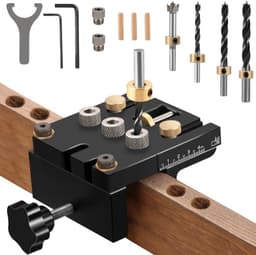
| Alternative |  Idong Idong 3-in-1, 6/8/10/15 mm | 3-in-1 block | Edge clamp. Face use weaker. | Yes. Reviews: collars loosen. | 6.8 | about £31.99 | View offer |


On this page
Set depth before the first hole
Drill one side and transfer
Hold the jig still
If it will not close
Common questions
What order do I drill?
How deep for 18 mm board and a 40 mm dowel?
Do I glue the first dowels before the second holes?
Why will the joint not close?
When do I stop and get a joiner?
Related pages
Sources
Public UK sources from the research digest, used for this page in October 2026. Prices, stars and review counts are the amazon.co.uk listings stored for this comparison. HSE wood-dust limits apply as workplace exposure figures. They are not a certificate for a domestic jig.
- Wolfcraft Dowelmaster (retrieved 22 October 2026)
- Wolfcraft universal dowel set (retrieved 22 October 2026)
- HSE wood dust (retrieved 22 October 2026)
- HSE WD0, wood dust (retrieved 22 October 2026)
- HSE cutting and sanding wood (retrieved 22 October 2026)
- Consumer Rights Act 2015, section 22 (retrieved 22 October 2026)
- UK Workshop, dowel jig thread (retrieved 22 October 2026)
- amazon.co.uk, Wolfcraft Dowelmaster 4640000 (retrieved 22 October 2026)