Independent comparisons. We may earn from shop links. More info

Mitre box vs mitre saw: which do you need?

Updated: October 2026

The mitre box vs mitre saw decision comes down to fit and volume. Choose a hand mitre box when the trim sits securely in its channel and you have relatively few cuts. Choose or hire a powered mitre saw when the section will not fit, or when many repeated cuts justify a larger tool. A slotted plastic box with a hand saw is not a powered mitre saw, even when a marketplace label says otherwise. The [mitre box comparison](/hub/saw-accessories/mitre-box) covers hand guides only. Prices and hire figures were recorded on 16 October 2026. This is not a lab test. A qualifying purchase through our links can earn a commission at no extra cost to you.

The mitre box vs mitre saw decision comes down to fit and volume. Choose a hand mitre box when the trim sits securely in its channel and you have relatively few cuts.

Our top picks

On this page

They are not the same tool

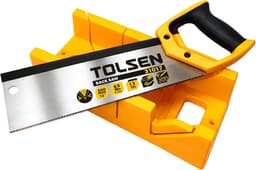
A mitre box is a passive guide. You move a hand saw through fixed slots, commonly at 90 and 45 degrees. Accuracy depends on the work fitting, the box being secured, the slots staying unworn and the saw staying upright. The hand sets here were listed between about £5.12 and about £21.99. A powered mitre saw is a bench machine with a motor-driven circular blade. The head pivots, and sliding models can cross-cut wider boards. It needs more space and the manufacturer’s guarding instructions. The EUIOOVM and Magicbox hand sets may appear under “Mitre Saws”, but they remain a hand saw and a slotted guide. A powered listing states motor, blade diameter, supply and cutting capacities.

When a hand box is enough

A hand box is enough for occasional architrave, dado, narrow skirting, beading and repair trim when each piece fits. Practical DIY suggests a mitre block for ordinary architrave. MyToolShed describes a sharp tenon saw and a decent box for occasional small work. For one room, hand cutting can be the quicker job. The Tolsen states a 100 mm channel. A 90 mm board that sits squarely may be a hand-box job. A 110 mm board is not, however few the cuts. Larger manual boxes exist outside this set, around 180 mm and 230 mm, so “too big for Tolsen” is not automatically a powered saw. Out-of-square internal corners can still be scribed. That joint is in the mitre box for skirting and coving guide. Channel and saw choice are in the mitre box buying guide.

When board size or volume wins

Move past a small hand box when the board is too tall, when many doorways multiply the cuts, or when repeatability matters more than a quiet bench. Practical DIY points to a manual or powered mitre saw, including hire, for larger architrave or numerous openings. One door can still be a hand job. Several rooms of broad skirting are where small variations accumulate. Do not lift the board above the walls of a plastic box. A powered saw’s blade diameter, slide and cross-cut figures still have to cover the profile. It also needs room for long stock on both sides. The best mitre box picks name a clamping box for trim that fits and a mini block for beading. Neither replaces machinery once the piece will not enter the channel.

Hiring a powered mitre saw

Hiring suits a concentrated project when you do not want to store a powered saw. Plan the measurements and likely recuts before the hire starts. Parker Hire is one UK example, not a national price. Its page stated £42 for the first day excluding VAT, £14 for an extra day and £70 for a week for a 110 V mitre saw with a 200 mm blade and telescopic arm, from its Leicester operation when researched. Confirm rates, deposit, blade and accessories with the hirer. That 110 V figure is site equipment, not a normal UK 230 V BS 1363 plug. Ask whether the transformer and leads are included. In a workplace, HSE’s PUWER overview requires suitable equipment and adequate information, instruction and training. At home, follow the manufacturer and the hirer. A larger manual box remains the quieter middle route if the board fits it.

Common questions

Is a mitre box the same as a mitre saw?
No. A mitre box is a slotted hand guide used with a separate or supplied hand saw. A powered mitre saw uses a motor-driven circular blade on a pivoting head. Marketplace categories sometimes call hand sets “mitre saws”, so check for a motor, blade diameter and power specification.
Is one room of architrave enough reason to buy a powered saw?
Usually not by itself. If the architrave fits a suitable box and the cuts are few, a secured guide and sharp hand saw can be sufficient. A powered saw becomes more compelling when the section is too large, there are many openings or you expect substantial future work.
What if my skirting is taller than 100 mm?
Do not force it into the Tolsen’s stated 100 mm channel or balance it above the guide. Look for a larger manual box with a verified internal capacity, or compare hiring and buying a powered saw whose capacity table covers your board in the required orientation.
Can I hire a mitre saw?
Yes, depending on local availability. Parker Hire’s researched example was £42 for one day excluding VAT for a 110 V, 200 mm machine, but that is one Leicester-based supplier rather than a UK-wide price. Confirm voltage, transformer, deposit, accessories and current charges before booking.
Are internal corners still scribed with a powered saw?
They often can be. A powered saw changes how quickly you make the initial cut, but it does not make an out-of-square wall square. Scribing one skirting board to the moulded face of another can still produce a more forgiving internal joint than two fixed 45-degree mitres.
What changes if I use the saw at work?
Work equipment falls under workplace safety duties, including suitability and adequate information, instruction and training under PUWER. Your employer’s risk controls and the machine instructions apply. Do not carry a domestic DIY assumption into a workplace or operate hired equipment without the required authorisation and competence.

Related pages

Sources

Public UK sources and amazon.co.uk listings used for this comparison, checked on 16 October 2026.

  1. B&Q: How to fit skirting board (retrieved 16 October 2026)
  2. Wickes: How to fit coving (retrieved 16 October 2026)
  3. Toolstation: How to fit coving (retrieved 16 October 2026)
  4. Checkatrade: How to fit skirting boards (retrieved 16 October 2026)
  5. HSE: PUWER overview (retrieved 16 October 2026)
  6. HSE: INDG291 (retrieved 16 October 2026)
  7. Consumer Rights Act 2015 (retrieved 16 October 2026)
  8. amazon.co.uk mitre box listings (retrieved 16 October 2026)