Independent comparisons. We may earn from shop links. More info

Mitre box buying guide

Updated: October 2026

A length of skirting, architrave or beading is already in the house, and the channel inside a mitre box is still a guess. This mitre box buying guide is the order to follow before you sort amazon.co.uk by stars: measure the moulding, match the internal opening, then choose the angles and the saw. The [mitre box comparison](/hub/saw-accessories/mitre-box) lines twelve listings up in one table. Prices, review counts and stated sizes are from those listings on 16 October 2026. This is not a lab cut. A qualifying purchase through our links can earn a commission at no extra cost to you.

A length of skirting, architrave or beading is already in the house, and the channel inside a mitre box is still a guess.

Our top picks

On this page

Measure the piece, not the star line

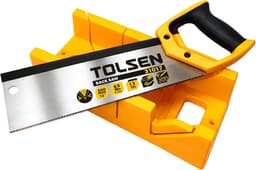
Put a tape on the moulding before you read the star line. The numbers that have to fit are the internal width and the internal depth. A printed 300 mm is the length of many boxes along the bench. Practical DIY, writing about architrave, says most mitre blocks take a section up to about 12 cm. That figure is that page’s wording, a rule of thumb, not a British Standard. Tolsen states a 100 mm internal channel. Hanpex states 100 mm by 53 mm, at about £13.99, with no saw. Rolson prints an outside size of 300 x 130 x 80 mm, and one amazon.co.uk review puts the inside at about 6.5 cm. Draper’s listing disagrees with itself on size, and reviewers use that block for small trim. A 4.3-star block with 5,022 reviews can still be the wrong purchase for house skirting.

Angles you will actually cut

A square cut uses the 90° slots. A mitre on a square corner uses 45°. A 22.5° slot is for an eighth of a turn, or a bay that is not a single right angle. Stanley, Rolson and Tolsen include 22.5° as well as 45° and 90°. The Draper mini is 45° and 90° only. If the wall is out of square, a careful 45° still leaves a gap. Buying a box does not pull a settled wall back to 90°. Which face meets an internal corner, and how coving sits in the box, is the skirting and coving guide. Hanpex lists 45°, 90° and 135°. Check which face meets the saw before you treat 135° as a stand-in for 22.5°.

Saw in the set, or your own

Tolsen includes a 13 TPI saw at about £15.90, and the box has screw holes. Hanpex at about £13.99 leaves the saw to you. Draper at about £5.12 is the block alone. A tenon saw has a stiff back, which helps the blade stay in a slot on a full-size box. A junior hacksaw matches a mini block and is a poor partner for a wide skirting cut. On Stanley and on Tolsen, reviewers often keep the box and replace the saw. Ignore volts or 4,500 rpm on a hand box. Stanley and Rolson both carry that clash, while the photos show a plastic guide and a hand saw. How you fix the box, and how you keep the kerf on the waste side, is how to use a mitre box.

What these listings show

Stanley shows clamping, with pegs and a lip, and slots at 22.5°, 45° and 90°. It does not state a 100 mm throat. If you already own a fine tenon saw, Hanpex avoids a second blade. If you own no saw and the board is within 100 mm, Tolsen is the listing that prints the channel. The best mitre box page names a job for each of the stronger listings. HSE guidance in INDG291 says damaged work equipment should come out of use. A slot wider than the blade has stopped steering the cut.

Common questions

What do I measure before I buy?
Measure the width and the thickness of the moulding, then set those two numbers against the internal channel. A 300 mm print is commonly the length of the plastic along the bench. Tolsen states 100 mm inside. Hanpex states 100 mm by 53 mm. If the listing only gives an outside size, as Rolson does at 300 x 130 x 80 mm, look for a review that measured the throat. One Rolson review puts that inside at about 6.5 cm.
Do I need 22.5°?
You need a 22.5° slot when the joint is an eighth-turn, or a bay that is not a single 45° mitre. Stanley, Rolson, and Tolsen include that slot. The Draper mini stops at 45° and 90°. For a rectangular bead or a simple square corner, those two angles cover the cuts you will make.
Should the saw be in the box?
Choose a set when you do not already own a fine tenon saw, and when reviews do not reject the blade that comes with it. Tolsen includes a 13 TPI saw at about £15.90. Hanpex at about £13.99 and Draper at about £5.12 leave the saw to you. On the larger sets, reviewers often keep the box and replace the saw. A 150 mm hacksaw belongs with a mini block.
Why does the listing mention volts or rpm?
The specification table on some hand boxes has been filled with fields meant for powered tools. Stanley and Rolson both show this clash, including a 4,500 rpm line, while the product in the photos is a plastic guide and a hand saw. Read the title, the photos, and the saw type, and treat volts and rpm as a listing error.
When is a plastic slot already too worn to trust?
When the slot is wider than the blade, the plastic has stopped steering the saw, and the angle wanders even if the pencil line was careful. HSE INDG291 says damaged equipment should not stay in use. Screw holes and a clamp hold a sound box still. They do not close a slot that has opened up.

Related pages

Sources

Public UK sources and amazon.co.uk listings used for this comparison, checked on 16 October 2026.

  1. B&Q: How to fit skirting board (retrieved 16 October 2026)
  2. Wickes: How to fit coving (retrieved 16 October 2026)
  3. Toolstation: How to fit coving (retrieved 16 October 2026)
  4. Checkatrade: How to fit skirting boards (retrieved 16 October 2026)
  5. HSE: PUWER overview (retrieved 16 October 2026)
  6. HSE: INDG291 (retrieved 16 October 2026)
  7. Consumer Rights Act 2015 (retrieved 16 October 2026)
  8. amazon.co.uk mitre box listings (retrieved 16 October 2026)