Independent comparisons. We may earn from shop links. More info

Mitre box for skirting and coving

Updated: October 2026

Using a mitre box for skirting and coving is mainly an exercise in orientation. Skirting presents its front face to the saw. Coving sits as it will sit between wall and ceiling, with the wall edge at the top. A fixed 45-degree cut closes neatly only when the corner and the profile suit it. Measure the material, label the faces and make a test cut before you shorten a full length. The [mitre box comparison](/hub/saw-accessories/mitre-box) covers the guides. Orientation points are from public UK fitting guides, and channel figures from amazon.co.uk listings checked on 16 October 2026. This is not a lab cut. A qualifying purchase through our links can earn a commission at no extra cost to you.

Using a mitre box for skirting and coving is mainly an exercise in orientation. Skirting presents its front face to the saw. Coving sits as it will sit between wall and ceiling, with the wall edge at the top.

Our top picks

On this page

Skirting: external mitre, internal scribe

An external corner, such as a chimney breast, brings two visible faces together with opposing mitres. B&Q’s fitting guidance tells you to fix the box and saw into the front face of the skirting. A left-hand piece and a right-hand piece are mirror images, so keep a labelled offcut for each direction. An internal corner is different. Two 45-degree cuts meet only if the walls are truly square. Checkatrade describes both mitring and scribing. Scribing is usually more forgiving: one board runs square into the corner and the other follows its moulded face. Practise on a short waste piece. A tall board perched above a shallow channel is not held just because its lower edge touches the base. Fixing and waste-side marking are in how to use a mitre box.

Coving: keep the wall edge at the top

Coving must be cut in its installed orientation. Wickes tells you to put the wall edge at the top of the mitre box, so the section sits at an angle rather than flat. Mark the wall and ceiling edges on a practice piece before it goes in. Viewed from the back, an unlabelled profile is easy to turn the wrong way. Wickes’s visual rule: an internal corner leaves the longest face along the wall edge, and an external corner leaves the shortest. Toolstation publishes separate left- and right-piece slot directions. Dry-fit both test pieces at the spring angle. Large or strongly sprung coving needs a purpose-made coving box if a flat-slot guide cannot support the profile.

Check whether the box can hold the piece

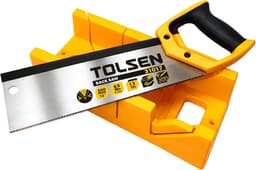
Measure the material in its cutting orientation. The Tolsen listing states a 100 mm channel, the clearest full-size figure in this set. Hanpex states 100 × 53 mm. A board close to 100 mm can still bind if the moulding is proud or the timber bows. One Rolson review reports about 6.5 cm inside, and another says 98 mm skirting did not fit. Outside size and category rank do not overturn that. Mini boxes are the wrong scale for room trim. The Draper 48677 and the Viganoc, HAUTMEC, BPTZYLN and Novastream junior sets suit beading or craft strips. For coving, measure a short offcut while it rests wall-edge-up. If the contact points will not sit firmly, use a purpose-made coving box. Channel, fixing and saw choice are in the mitre box buying guide.

When the box is the wrong tool

A basic box is the wrong tool when the material will not sit fully, or when worn slots cannot hold the angle. Do not cut the walls down or balance the board above them. A few cuts in one simple room can suit a secured hand box. Several rooms or wide sections make capacity and repeatability the decision, which is mitre box vs mitre saw. A powered saw does not identify the finished face, and an internal corner can still suit a scribe. Call a joiner when the moulding is expensive, the corners are badly out of square, or you cannot secure the work without a hand near the blade. Wear eye protection and suitable dust protection, and work from a stable bench.

Common questions

Does a 45-degree cut close an internal skirting corner?
Only when the two walls form a sufficiently accurate 90-degree corner and the boards are oriented correctly. Many rooms do not. A scribed joint is often more tolerant: one board ends square in the corner and the other is cut to follow its moulded face, reducing the visible effect of an imperfect angle.
Which face of skirting goes towards the saw?
The front, finished face goes towards the saw, following B&Q and Checkatrade fitting guidance. Label the back, room direction and waste side before placing the board in the box. This prevents a mirrored cut that looks correct in the guide but points the wrong way at the wall.
Which way does coving sit in a mitre box?
Place coving in its installed orientation, with the wall edge at the top of the box, as Wickes advises. For an internal corner the wall face is longest; for an external corner it is shortest. Mark both contact edges on a test piece and follow a published left and right cutting diagram.
Will the Tolsen take my skirting?
The Tolsen states a 100 mm channel, so measure the skirting in the exact orientation in which it will be cut. A board near the limit may still bind because of its moulding or bow. If it exceeds 100 mm, choose a larger guide or another cutting method.
Can I cut coving in the Draper mini box?
Only very small trim that sits securely within its capacity would be appropriate. The Draper 48677 is intended for mini sections such as beading, not ordinary room coving. Coving must be supported at its spring angle, so a purpose-made coving box is the better choice when the profile is substantial.
When should I call a joiner?
Call a joiner when the profile needs unfamiliar compound cuts, the corners are markedly out of square, the moulding is expensive or your guide cannot hold it securely. Professional help is also appropriate if you cannot arrange a stable cutting position with your hands safely clear of the blade.

Related pages

Sources

Public UK sources and amazon.co.uk listings used for this comparison, checked on 16 October 2026.

  1. B&Q: How to fit skirting board (retrieved 16 October 2026)
  2. Wickes: How to fit coving (retrieved 16 October 2026)
  3. Toolstation: How to fit coving (retrieved 16 October 2026)
  4. Checkatrade: How to fit skirting boards (retrieved 16 October 2026)
  5. HSE: PUWER overview (retrieved 16 October 2026)
  6. HSE: INDG291 (retrieved 16 October 2026)
  7. Consumer Rights Act 2015 (retrieved 16 October 2026)
  8. amazon.co.uk mitre box listings (retrieved 16 October 2026)