Independent comparisons. We may earn from shop links. More info

How to set up a circular saw guide rail

Updated: October 2026

The rail is out of the box and the board is on the trestles. Wait before the real cut. How to set up a circular saw guide rail means the first pass happens on scrap, with the blade you intend to keep, on a board that is held and supported. The sequence is the splinter strip, blade depth, stopping the rail moving, then supporting the board. This page does not rank rails. That lives on the [circular saw guide rail comparison](/hub/saw-accessories/circular-saw-guide-rail). If you have not bought yet, read the [buying guide](/hub/saw-accessories/circular-saw-guide-rail/sub/circular-saw-guide-rail-buying-guide) first. Listings were checked on 15 October 2026. A qualifying purchase can earn a commission at no extra cost to you.

The rail is out of the box and the board is on the trestles. Wait before the real cut.

Our top picks

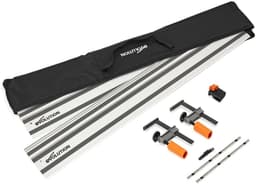
Evolution Evolution ST2800-G2 2.8 m

Best overall

Evolution Evolution ST2800-G2 2.8 m
8.5/10about £90.27
BORA BORA NGX 96 in clamp edge

Alternative

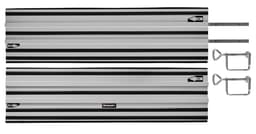
BORA BORA NGX 96 in clamp edge
6.2/10about £80.00
On this page

Trim the strip, or skip that step on a clamp edge

Put the saw on the rail and feel for side play. On a Festool-style track, UK Workshop members set the adjustment cams so the saw slides freely with no wobble before they touch the strip. A sloppy fit trims a wavy edge. Check the box against the included-components line so you know whether clamps and connectors are there. If the rail has a rubber or foam splinter strip, trim it first. Clamp the rail to scrap, set the blade to cut through, and run the saw the whole length. The blade cuts the strip to the kerf, which then holds the surface fibres and shows where the cut falls. UK reviewers of the Einhell rail describe that first pass. Evolution reviewers note the foam strip can peel, so press it down before you trim. Use the blade you will keep. A different body thickness or set recuts the strip, and some people keep one rail per blade. A clamp edge such as the BORA NGX lists the clamp edge only, so there is nothing to trim. Measure from the blade to the edge of the shoe and offset the rail by that amount. Expect a bare edge on laminate. The track rail vs clamp edge page explains why.

Set the depth for the rail you are actually on

A trimmed strip at the wrong depth still leaves a partial cut. The rail lifts the saw by its own thickness, so a bare-board depth is too shallow on the track. BuildWiz UK's rule of thumb is to add the rail's thickness to the material and allow a few millimetres for the blade to clear the underside. Treat that as one site's working figure, not a setting for every saw. Many plunge saws have a depth scale marked with rail, which already allows for the track. Use it if yours has one. On a plain circular saw against a clamp edge, the shoe sits on the board, so set the depth as you normally would. Do not copy a number from a US manual. Festool's American documentation gives depths for its own saws, and they are not a guide for the saw on your bench. Test on an offcut of the same board.

Stop the rail moving

A rail that creeps at the start is a common reason for a ruined edge. Rubber grip strips on a clean, matt board are often enough for a short crosscut. They are less reliable on glossy faces, and an Einhell reviewer notes the rail walks when the grip strips are dusty. Wipe the underside and the board before you position it. Clamp when the face is glossy, the cut is long, or the board is narrow. BuildWiz UK's advice is to keep clamps out of the shoe's path. The Evolution kits include two track clamps. The Einhell included line does not list any, and some reviewers who received clamps called them bent. The BORA's clamp is the guide itself, so tighten it and check the bar has not shifted. If the rail is in two pieces, sight the join. Lay a known straight edge along it and feel for a step. A bump kicks the saw off line. Then do a dry slide with the blade stopped, so you know the saw clears the clamps and the join.

Support the board, then cut

A board that sags will close on the blade, and an offcut that drops before the cut finishes tears the last fibres and can pull the saw. Support both sides of the line. TrackSaw.net's method note is to plan where the offcut goes before the last fibres part. That is practice, not a UK rule. Use the dust port if your saw has one, and keep the guard working as the manual describes. HSE rules written for bench saws, such as riving-knife distances, do not translate into track-saw settings. Follow your saw's own instructions. On a 1.4 m kit across a worktop offcut, support both ends of the worktop and the offcut, clamp outside the shoe's path, sight the join, then cut in one steady pass. Full 8x4 sheets need more support, which the guide rail for 8x4 sheets page covers. If the worktop is already fitted, or you cannot support a long heavy top, that is the point to call a professional fitter.

Common questions

Do I trim the splinter strip before cutting a worktop?
Yes. Make the first pass on scrap with the rail clamped and the blade set to cut through, so the saw trims the strip exactly to the kerf. The trimmed edge then shows where the cut falls and supports the surface fibres. Use the blade you intend to keep, because a different blade can recut the strip.
What if my guide is a clamp edge with no splinter strip?
There is nothing to trim. The BORA NGX listing includes only the clamp edge. Measure the distance from your blade to the edge of the saw shoe and offset the guide by that amount from your pencil line. Expect a bare edge on laminate or veneer, because no strip holds down the fibres.
How deep should the blade be when using a guide rail?
Deep enough to clear the material plus the rail's own thickness. BuildWiz UK's rule of thumb adds the rail thickness and a few millimetres of clearance. Many plunge saws have a with-rail depth scale that already allows for this. Do not copy depths from a US manual. Test on an offcut of the same board.
Why does my guide rail move when I start the saw?
Grip strips lose hold on glossy faces and when they are dusty, as Einhell reviewers report. Wipe the underside of the rail and the board, and clamp the rail on a glossy, long or narrow cut. Place clamps out of the shoe's path, then do a dry slide with the blade stopped before the real cut.
What should I do if the saw bumps at the joint?
Stop and check the join before cutting. Lay a known straight edge along the joined sections and feel for a step. Loosen and retighten the connectors so both sections sit flat and in line. UK reviews of two-piece rails report bumps and loose connectors, so check the join on every setup.
When should I get a professional instead?
When the worktop is already fitted and must be cut in place, or when you cannot safely support a long, heavy top on both sides of the line. A trimming pass on scrap and a crosscut on a supported offcut are home DIY. A fitted top leaves little room for a second attempt.

Related pages

Sources

Public UK sources used for this comparison. Listing prices, stars, and review counts are from amazon.co.uk extracts dated 15 October 2026.

  1. BuildWiz UK — circular saw guide rails (retrieved 15 October 2026)
  2. Evolution Power Tools UK — G2 tracks (retrieved 15 October 2026)
  3. Toolstation — Evolution ST1400-G2 guide rail (retrieved 15 October 2026)
  4. HSE — Safe use of work equipment (L22, PUWER 1998) (retrieved 15 October 2026)
  5. HSE — Circular saw benches (WIS16) (retrieved 15 October 2026)
  6. HSE — Wood dust (WIS23) (retrieved 15 October 2026)
  7. Consumer Rights Act 2015 (retrieved 15 October 2026)
  8. Which? — faulty products and the 30-day right to reject (retrieved 15 October 2026)