Circular saw guide rail or freehand: when the cut needs one
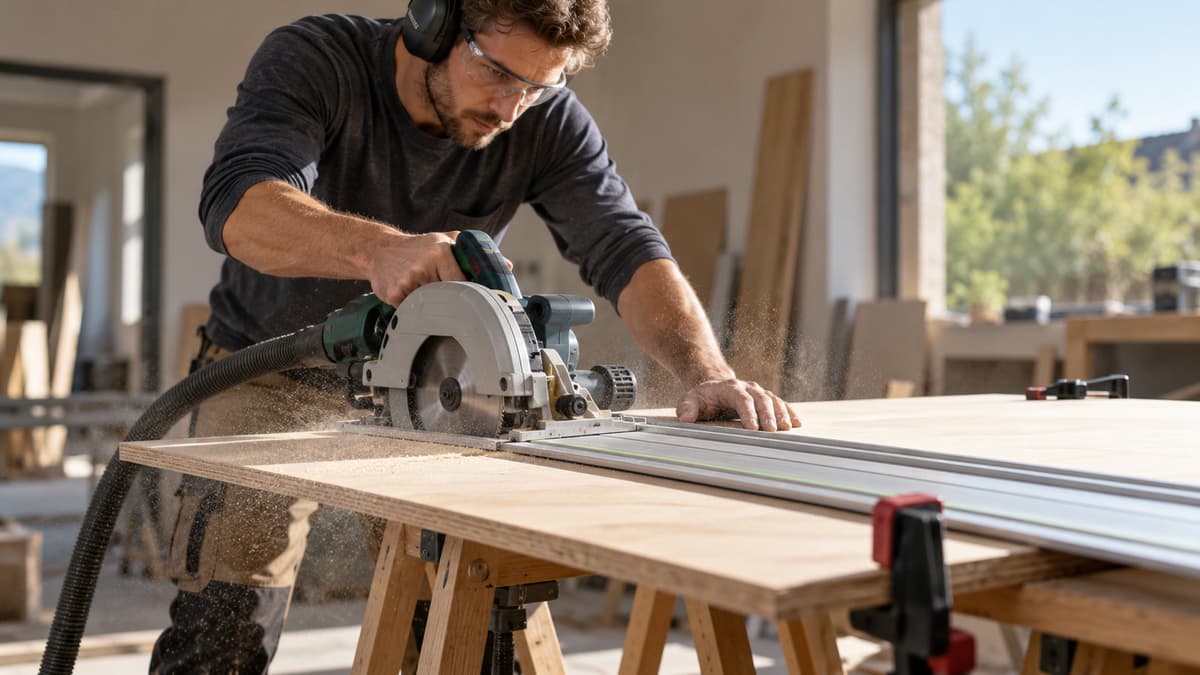
Freehand, grinder disc or guide rail? See which cuts a 125 mm disc can handle, when a long straight cut needs a rail, and what UK reviews say about the edge.
On this page

You have just cut a sheet of plywood or furniture board, and the edge wanders, chips at the top face and needs sandpaper before it looks acceptable. Whether you should use a circular saw guide rail or freehand comes down to one question: does this edge have to be straight and clean, or only close enough? A 125 mm disc on an angle grinder, or a circular saw along a pencil line, will handle rough work. It will not give you a furniture edge along a full sheet, because the missing part is a fence.
In short
Use a 125 mm wood-cutting disc or a freehand saw for nicks, notches, outcuts and edges that will be hidden or trimmed again. When the cut is long, straight and on show, you need a fence or a guide rail on a circular saw. A better disc does not replace that guide.
Cuts a 125 mm disc can do
A wood-cutting disc on an angle grinder earns its place in small, awkward jobs: corners, a notch in a batten, a recess the circular saw base will not sit in, and offcuts for the skip. One UK reviewer in this hub said a grinder wood disc got closer to an edge than their circular saw could, which is why the 125 mm wood-cutting disc comparison exists. They also missed the saw's guide, and the edge came out a bit rough.
A grinder has no base plate and no fence, so the line depends on your wrists. Over 100 mm that is manageable. Over a metre, the wobble shows. A long pencil line across a sheet is the moment to stop. Disc cuts also throw fine dust, so keep them short.
Cuts that need a fence or a guide rail
A cut needs a fence or a rail when it is long, it has to be straight, and the edge will be seen or has to meet another part. Ripping plywood, cutting a worktop or shelf to width, trimming a door, or cutting cabinet panels all sit in this group. A 1 mm wander is visible, and a 3 mm one leaves a gap you cannot hide.
A guide rail changes who controls the line. The rail is clamped to the sheet, the saw's base plate runs in its groove, and you push the saw forward instead of steering it. Many rails carry a foam or rubber splinter strip that presses the surface fibres down where the teeth exit, which cuts tear-out on veneered and melamine boards. The strip does not make a blunt blade cut cleanly.
A standard 8x4 sheet is 2,440 mm long, and the saw needs support before the blade meets the board and after it leaves. A single 1,400 mm section will crosscut a sheet, but it will not carry a full-length rip. The top pick in our circular saw guide rail comparison is a 2.8 m kit made from two 1,400 mm sections: the only length kept in that set that still covers a 2,440 mm sheet with run-on at both ends. If you only cut a few studs a year, a speed square does the job for less.
What about a clamped straight edge or a laser?
A clamped straight edge can give a straight cut on occasional jobs if it is truly straight and both ends are clamped. It has no groove and no splinter strip, so you get straightness more easily than a clean face. A laser line only shows where the cut should go. One UK reviewer used a laser level to mark laminate because they did not own a jigsaw. That is improvising, not a method for a long straight cut.
What the UK reviews in this set show
These products are compared from amazon.co.uk listings and UK reviews, not from a lab test. On the grinder side, the Fresilkora reviewer got closer to an edge than a circular saw, missed the saw's guide, and found the edge rougher. A Chersun reviewer who cut furniture board said the edges needed sanding afterwards. HAWCUT reviews describe fine crosscuts on a saw with a base plate. A cleaner blade improves the surface. Straightness still comes from whatever guides it.
The 2.8 m Evolution ST2800-G2 sits at 4.3 stars from 388 amazon.co.uk reviews at £90.27, and UK reviewers describe full 8x4 rips with it. The same reviews report a joint about 1 mm high, a carry bag that splits when lifted, a missing connector, and a foam strip that peels. Fit is the bigger risk. One Makita track saw sat on the rail but was not held on a bevel, an Erbauer ERB690CSW fitted but its track-lock knob did not catch, and a Bosch GKS 190 and a Bosch UniversalCirc 18V-53 were refused. A rail only helps if your saw sits in it.
Saw bench rules are not a grinder method
Advice about fences and push-sticks comes from a different machine. The Health and Safety Executive's information sheet WIS16 covers saw benches, where the blade stays put and you feed timber past it. On that machine the fence, the guard and a push-stick keep the cut controlled and your hands away from the blade. None of that turns a hand-held angle grinder into a guided saw. Clamping a strip of timber to a board and running a grinder along it does not give you a saw's base plate and guard.
A saw bench moves the material past a fixed blade. A guide rail keeps the sheet still and moves the saw. Both can keep a cut straight, and they are different machines with different safety rules. This article is not a guide to running either one. If you are tempted to fit a toothed saw blade to a grinder to get a saw-like cut, read what the UK safety alert says before you do. The answer to a rough edge is a guided saw, not a more aggressive grinder.
Choosing a guide rail without overbuying
Start with the exact model number on the saw's base plate and search the rail's UK reviews for it. Brand lists in a title are a starting point, and reviews in this set include saws from listed brands that still did not fit. If your saw is not mentioned, plan for a possible return. A single 1.4 m section may cover crosscuts and door trims. A full 8x4 rip needs roughly 2.8 m. Joined sections bring a joint, and the 1 mm step reported on the Evolution kit is something to check on day one.
A rail without clamps or connectors is not ready to use. The Evolution ST2800-G2 listing names two clamps, two self-aligning connector bars, a 3 mm hex key, an end stop and a 1,430 mm carry bag, at a listed weight of 4.7 kg. Check the box on arrival, because one UK review reported a connector missing. Pair the rail with a sharp blade. Scorching, heavy pushing and chipping often point to the blade, not the rail. The 165 x 20 mm saw blade comparison covers common compact-saw sizes in this hub.
Where to go next in this hub
Check saw fit and length on the guide rail comparison before price. Keep the disc comparison for short cuts where a rough edge is acceptable. For square cuts in mouldings or battens, a mitre box gives a guided cut without a power tool. It will not help with sheet material.
This page draws on amazon.co.uk listings and UK reviews for products in this hub, plus HSE guidance on saw benches. We did not lab-test any rail, disc or saw. Prices and ratings are as listed when we checked in October 2026 and can change. If you buy through our links, we may earn a commission on qualifying purchases at no extra cost to you.
Common questions
Can an angle grinder with a wood disc replace a circular saw guide rail?
When is freehand good enough on a circular saw?
How long a guide rail do I need for an 8x4 sheet?
Will a guide rail fit any circular saw?
Does a guide rail stop tear-out on plywood?
Is a saw bench the same as a guide rail?
Can I use a laser line or a straight edge instead of a rail?

Peter F. is the editor for DIY & tools at productscompared.co.uk. Comparisons in this category are checked against amazon.co.uk listings, review evidence and public UK sources.
Related articles

Blunt circular saw blade signs: scorch, push and chips
A rail keeps the line straight, but a blunt blade still scorches and chips. How to read the signs before you blame the guide.
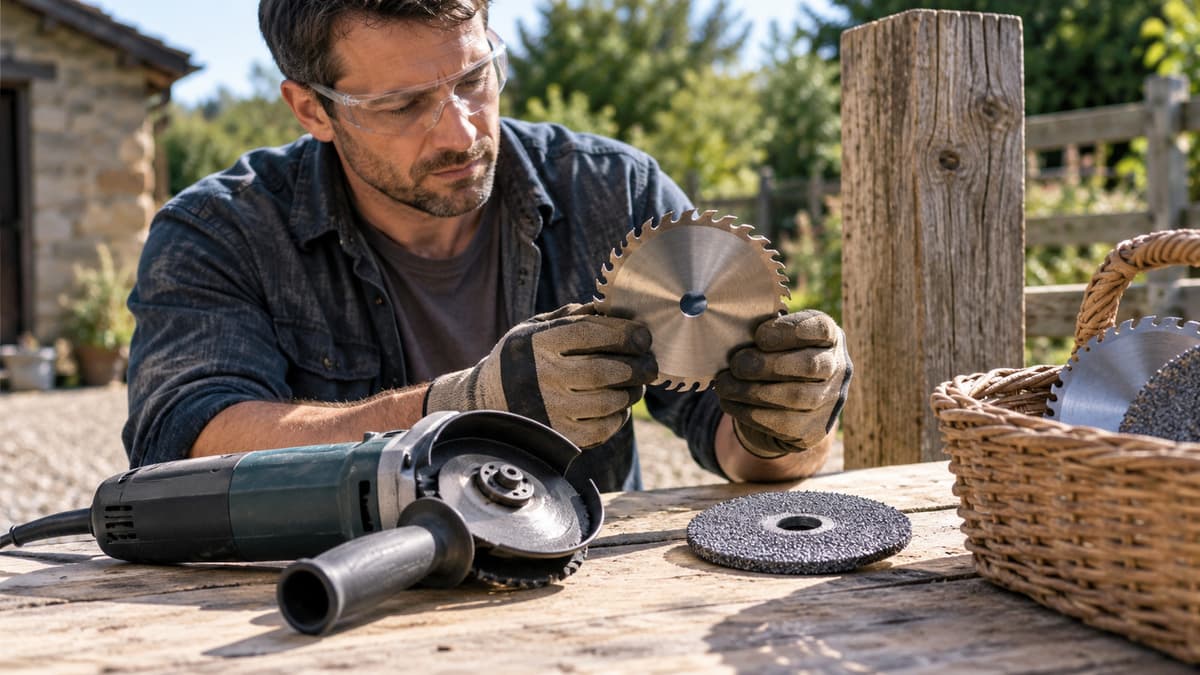
Toothed saw blade on an angle grinder: what the UK alert says
Thinking of a toothed blade on a grinder to get a cleaner edge? Read what the UK safety alert says first.

Wood dust from an angle grinder: why short cuts still count
Short grinder cuts in wood still throw fine dust. What that means for the quick nicks and outcuts a disc is good at.