Wood dust from an angle grinder: why short cuts still count

Wood dust from an angle grinder is high-energy dust, even on a two-minute cut. UK limits, FFP3 masks, M class extraction and safe clean-up in plain English.
On this page
You need to trim one batten, so you fit a 125 mm wood disc, lean over the workbench in the garage and cut. It takes ninety seconds. Then you notice the haze hanging under the light and the film settling on the car. That cloud is the point of this guide: wood dust from an angle grinder is high-energy, fine dust, and a short cut does not make it low risk.
In short
The Health and Safety Executive groups grinders with other high-energy tools that release large amounts of fine dust quickly, so even a brief cut counts. The UK workplace limits are 3 mg/m³ for hardwood dust and 5 mg/m³ for softwood, and exposure must be kept as low as reasonably practicable. At home, copy the trade controls: extraction, an FFP3 mask, airflow, and no dry sweeping.
Why a short cut still counts
A grinder spins a 125 mm disc at very high speed. HSE's construction dust guidance (CIS36) names grinders alongside cut-off saws and sanders as high-energy tools: they throw a plume into the air around your face. A hand saw drops most of its sawdust on the floor. The finest part of a grinder plume stays in the room after you can no longer see it.
Exposure limits are averaged over a working day, so a few minutes can look harmless. The trouble is concentration. In a garage with the door shut, the dust from those ninety seconds stays in the air while you measure and mark the next cut.
HSE's page on cutting and sanding wood states that carpenters and joiners are four times more likely than other UK workers to get asthma, and it classes hardwood dust as a cause of nasal cancer. Wood dust can also cause dermatitis. Those figures describe people who cut wood for a living. They are not your personal risk from one weekend, but a habit of "only one cut" is how regular exposure builds up.
Nobody has published a measured dust level for a specific 125 mm disc sold on amazon.co.uk. Control the dust by default.
The limits, and who they bind
HSE's information sheet WIS23 sets the workplace exposure limit at 5 mg/m³ for softwood dust and 3 mg/m³ for hardwood dust, both averaged over eight hours. A mix of the two, common in a real workshop, takes the 3 mg/m³ limit for the lot. Because wood dust can cause asthma and hardwood dust can cause cancer, exposure also has to be reduced as low as is reasonably practicable.
Those limits sit under the Control of Substances Hazardous to Health Regulations (COSHH). COSHH wood dust duties fall on employers and the self-employed: a joiner, kitchen fitter or handyman on a customer's job has to assess the risk and make the controls work. A householder putting up shelves in their own house is not bound in the same legal sense.
A home cut is often the tighter space: smaller rooms, no extractor, the door shut, and dust left where children and pets pick it up. Use HSE's trade controls as the baseline, and treat oak, beech, sapele and most board products as the hardwood case.
Extraction and masks in plain language
HSE's construction guidance follows a clear order. First reduce the dust at the source, then capture what is left, and only then rely on a mask. For a grinder, use on-tool extraction where the tool allows it, and wear respiratory protective equipment on top. A mask on its own is the last line.
On-tool extraction and M class
L class suits low-hazard dust, M class is for medium-hazard dust including wood, and H class covers the most hazardous material. HSE construction guidance names M class extraction, or H class, for wood dust. A high-filtration unit catches the fine fraction that a cheap shop vacuum may blow back out through its exhaust.
Many angle grinders have no extraction shroud for wood, and a metal or stone guard may not fit a wood disc. A nozzle near the cut captures less than a shroud. The mask and the airflow then carry more of the load. For a long job, a tool with proper extraction is the better choice.
FFP3 and fit
For high-dust tasks, HSE guidance points to an FFP3 disposable mask or an equivalent reusable respirator. A paper nuisance mask or cloth covering is not respiratory protective equipment. The mask has to suit your face, and you need to be clean-shaven where the seal sits. Workers should be face-fit tested. At home, cover the mask and breathe in sharply: it should pull in towards your face. Throw a disposable mask away when breathing gets hard, it is damaged, or the maker's shift is over.
Grit rims and sheet materials
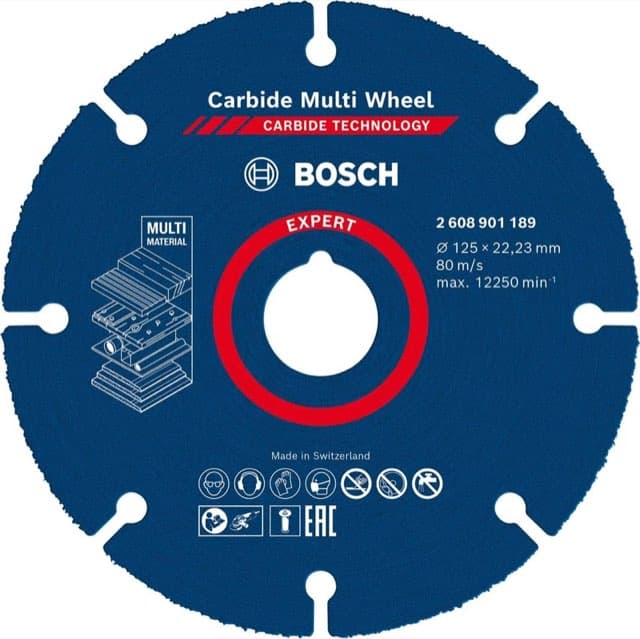
Many 125 mm wood discs sold on amazon.co.uk use a toothless carbide grit rim rather than saw teeth. Our 125 mm wood cutting disc comparison puts the Bosch Expert Carbide Multi Wheel at the top on our editorial score. Its listing describes a grit 80 carbide rim, and its bullets say it cuts wood with embedded screws and nails, plastic pipes, laminate and drywall.
A toothed blade removes wood in chips. A grit rim abrades it in very small pieces, so finer dust is a reasoned expectation, not a lab result for these discs. We have not tested them. Treat a UK review on the UK listing as the only review evidence that counts, and plan as if a grit disc is a fine-dust tool. HSE's abrasive-dust sheet (SR21) is a separate point: the rim sheds some of its own material, and a hidden screw adds metal particles to the plume.
MDF and other boards
MDF dust counts as wood dust under HSE guidance. Fibres may include hardwood, so use the 3 mg/m³ limit, and expect very fine particles. Chipboard, plywood and laminated worktops raise the same concern, including the binder and the surface layer. Sheet material indoors, cut with a grinder, is the dustiest combination in this guide.
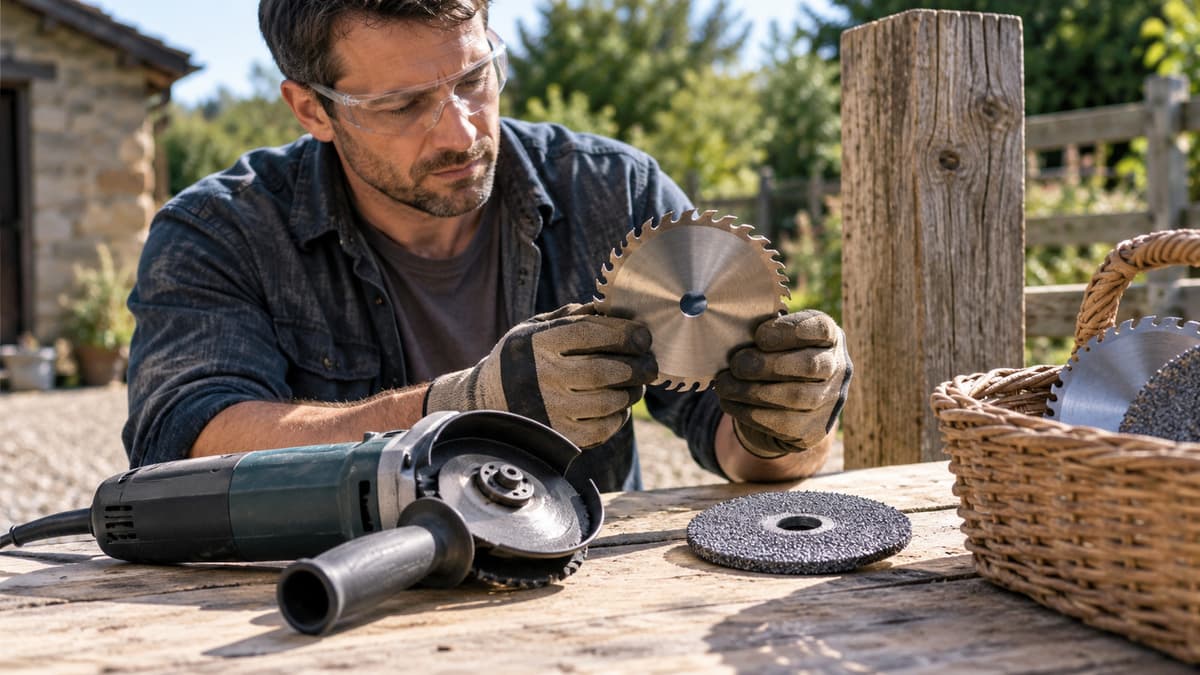
Our guide to a toothed saw blade on an angle grinder explains why the toothless rim exists: it removes the kickback hazard of a tooth, at the cost of finer dust.
What to do with the dust afterwards
Most people protect themselves during the cut and then undo it with a brush. HSE advises against dry sweeping and against blowing dust off with compressed air, because both put the finest particles straight back into the air. Once the disc stops, the dust on the bench, the floor and your clothes is still there.
Use a vacuum instead, ideally the same M class extractor you used during the cut. A household vacuum without suitable filtration can push fine dust out of its exhaust. A damp cloth picks dust off shelves and keeps it out of the air. Keep the mask on while you clean.
Vacuum dusty clothing or change out of it, and wash work clothes separately. Do not eat, drink or smoke in the cutting area, and wash your hands and face before you do. Empty the extractor with its bag or liner, seal it, and put it in general waste rather than tipping the drum over an open bin.
A routine for your next cut
- Move the cut outside if you can. If you have to cut indoors, open doors and windows and keep children and pets out of the room.
- Check the disc and the guard fit together. Our guide to choosing a 115mm or 125mm angle grinder disc covers how to read the label and the tool before you buy.
- Set up extraction close to the cut. Use on-tool extraction if the grinder supports it, or place an M class nozzle near the dust exit.
- Put on an FFP3 mask and check the seal. Add eye protection and hearing protection.
- Clean up with a vacuum or a damp cloth. Keep the mask on, and change or vacuum your clothes before you go back into the house.
Ripping MDF sheets for a day needs a circular saw or plunge saw with proper extraction. For one-off trims, the routine above is enough. Our guide to the cost of a 125mm wood cutting disc works out what you pay per disc.
This draws on public HSE guidance (the cutting and sanding wood page, WIS23, CIS36, WD0 and SR21) and on amazon.co.uk listings checked in October 2026. We did not measure dust in a lab or test these discs. A qualifying purchase through our links may earn a commission at no extra cost to you.
Common questions
Is wood dust from an angle grinder dangerous on a short cut?
What is the UK workplace limit for hardwood dust?
Does COSHH apply if I am cutting wood at home?
What kind of mask should I wear for cutting wood?
Does MDF dust count as wood dust?
Is a carbide grit disc dustier than a toothed saw blade?
Can I sweep up wood dust with a brush?
Do I need M class extraction for occasional DIY?

Peter F. is the editor for DIY & tools at productscompared.co.uk. Comparisons in this category are checked against amazon.co.uk listings, review evidence and public UK sources.
Related articles
Toothed saw blade on an angle grinder: what the UK alert says
Why a chainsaw-style or toothed blade on a grinder draws safety warnings, and what a toothless carbide rim changes.

125mm wood cutting disc price: what you pay per disc
Single discs, multipacks and carbide rims compared by the price you actually pay per disc on amazon.co.uk.

115mm or 125mm angle grinder disc: how to tell which fits
Read the guard, the spindle and the label before you buy, because a listing that says 115–125 mm is not a fit check.