Independent comparisons. We may earn from shop links. More info

Bandsaw blade TPI for the thickness you actually cut

Updated: 22 October 2026

You fitted a 14 TPI loop, then pushed it into oak about 20 mm thick and the blade dulled and left a burnt face. Bandsaw blade TPI is teeth per inch, and a higher number is not a better blade. It is a match to thickness. Fewer teeth clear thick timber. More teeth suit thin sheet, plywood, and plastic. Width and the buying order are on the [buying guide](/hub/saw-accessories/band-saw-blade/sub/band-saw-blade-buying-guide). The shelf is the [band saw blade comparison](/hub/saw-accessories/band-saw-blade). The charts below are UK sellers’ rules of thumb, not a lab cut. A qualifying purchase can earn us a commission.

You fitted a 14 TPI loop, then pushed it into oak about 20 mm thick and the blade dulled and left a burnt face. Bandsaw blade TPI is teeth per inch, and a higher number is not a better blade. It is a match to thickness.

Our top picks

On this page

TPI is teeth per inch, not a quality score

Count the points along one inch and you have the TPI. The gullet carries the chip. If it is too small, the dust packs, the steel heats, and the teeth go blunt. Saws UK’s rule of thumb is at least three teeth in the cut. Three teeth in a 6 mm strip is a fine pitch. Three teeth in 30 mm of ash is a coarse one. A 14 TPI regular tooth does not become a rip blade because the listing says hardwood.

What UK sellers suggest for solid wood

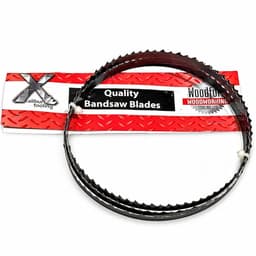
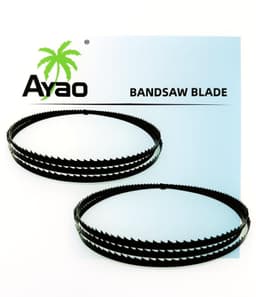
Axminster treats 6 TPI as the general wood pitch: crosscutting up to about 150 mm and ripping up to about 50 mm, with 3 and 4 TPI for a deep rip. NLS Tools suggests 6 TPI at about 12–20 mm and 4 TPI at 20–30 mm. A 20 mm oak board lands on 6 TPI there, not on 14 TPI. The 4 TPI Xcalibur single, 1400 mm by 6 mm at £14.35, is the coarse option in that band, 4.7 from five reviews. The AYAO two-pack is the 6 TPI loop with the large sample.

10 and 14 TPI are for thinner work

Axminster aims 10 TPI at plywood and a slower cut in solid wood under about 50 mm, and 14 TPI at thin stock and plastics. Plywood wants the smaller tooth because a coarse tooth breaks the face veneer. The Xcalibur 14 TPI two-pack, £24.99, 4.0 from 24 reviews, drew one comment that the blade dulled quickly in oak about 20 mm thick. That thickness sits in NLS’s 6 TPI band. The Xiansini pack at £8.99 and the Vidsmow pack at £10.99 are the 10 TPI shelf for ply. Which listing suits the whole job is on the best bandsaw blade page.

Which pitches are actually on this shelf

The 4 TPI blade is the Xcalibur 1400 mm by 6 mm single, B0CM2722C2. The 6 TPI blades are the AYAO two-pack at 6.5 mm, the Xcalibur 3/8 inch single at 1400 mm, and the Xcalibur 3380 mm by 13 mm single. Mechioo, Tweozek, Xiansini, and Vidsmow are 10 TPI at 1400 mm. The dedicated 14 TPI wood pack is the Xcalibur two-pack at 6.5 mm. The TASP sets mix a 3.2 mm 14 TPI blade with wider 6 TPI blades, only at 1425 mm or 1575 mm. The Starrett pack is 18 TPI at 733 mm, a cordless metal blade, not a fix for thick timber. If 14 TPI meets 20 mm oak, order the coarser blade.

Common questions

What is TPI?
TPI is teeth per inch along the blade. A 6 TPI blade has six points in each inch, and a 14 TPI blade has fourteen, with a smaller gullet between them. The number describes the chip the gullet can carry. It does not describe the steel, the weld, or the length. Two 6 TPI blades can still differ in width, from 6 mm to 13 mm, and in whether the tooth is a skip pattern or a regular one.
How many teeth should be in the wood?
Saws UK’s rule of thumb is at least three teeth in the cut at once, and they talk about a maximum around 18. Three teeth across a thin ply offcut means a fine blade. Three teeth across a 30 mm board means a coarse blade. Fewer than three and the tooth can grab. Many more than the gullet can clear, and the cut burns. It is a rule of thumb from that seller, not a setting stamped on your saw.
When do I want 4 TPI?
When the solid timber is thick enough that a 6 TPI gullet fills. NLS suggests 4 TPI at about 20–30 mm, and Axminster points 3 and 4 TPI skip tooth at deep ripping. In this set that blade is the Xcalibur 1400 mm by 6 mm single at £14.35, with five reviews. It is a poor choice for plywood, where the coarse tooth breaks the face. It still has to be 1400 mm to fit the common bench saws.
Why did 14 TPI dull in oak?
One reviewer of the Xcalibur 14 TPI two-pack said the blade dulled quickly in oak about 20 mm thick. That thickness sits in NLS’s 6 TPI band. The gullets on a 14 TPI blade are small, so they pack, heat, and rub the tooth away. Axminster aims 14 TPI at thin stock and plastics. The comment is one review, not a lab result, and it is enough to keep that pack off furniture oak.
Is 10 TPI better for plywood?
It is the better match for plywood and for a slower cut in thinner solid wood. Axminster’s note puts 10 TPI on ply and on solid wood under about 50 mm when you are not ripping hard and fast. The Xiansini and Vidsmow two-packs are 10 TPI at 1400 mm. They are not an upgrade for the 20 mm oak that dulled a 14 TPI blade. Check the weld, because a fine pitch does not fix a lumpy joint.

Related pages

Sources

Public UK sources used for this comparison. Shelf prices are amazon.co.uk listings from 19 October 2026.

  1. HSE WIS31: woodworking bandsaws (retrieved 19.10.2026)
  2. HSE: narrow band saws (retrieved 19.10.2026)
  3. HSE: PUWER overview (retrieved 19.10.2026)
  4. Saws UK: blades buying guide (retrieved 19.10.2026)
  5. Axminster: bandsaw blade guide (retrieved 19.10.2026)
  6. NLS Tools: blade selection (retrieved 19.10.2026)
  7. Screwfix: Starrett UNZ13A187333 (retrieved 19.10.2026)
  8. Consumer Rights Act 2015 (retrieved 19.10.2026)