Independent comparisons. We may earn from shop links. More info

How to choose a bandsaw blade: length, width, teeth

Updated: 22 October 2026

You are stood at the bench with a dull loop in one hand and a basket of replacements that all look similar. The saw is already yours. How to choose a bandsaw blade is a sequence, not a brand hunt: length from the manual, then width for the tightest curve you cut, then teeth for the thickness, then carbon or bi-metal. The [band saw blade comparison](/hub/saw-accessories/band-saw-blade) puts twelve amazon.co.uk listings side by side, from £8.99 to £29.99 on 19 October 2026. This page does not rank those listings. Prices are shelf prices, no lab cut was made, and a qualifying purchase can earn us a commission.

You are stood at the bench with a dull loop in one hand and a basket of replacements that all look similar. The saw is already yours.

Our top picks

On this page

Read the length off the saw

The length is the loop around both wheels, in millimetres, from the manual. In this set that number is 1400 mm, 1425 mm, 1575 mm, 3380 mm, or 733 mm. About 1400 mm is the common UK bench size, named on listings for Scheppach, Axminster, Charnwood, Draper, and Einhell. An 8 inch label is not a length. A 1425 mm, 1575 mm, 3380 mm, or 733 mm loop will not tension on a 1400 mm bench saw. If the manual and the old blade disagree, trust the manual.

Pick the width for the tightest curve

Width is the front-to-back measure of the blade, not the thickness of the steel. A wider blade tracks a straight rip. A narrower blade turns a tighter radius. This shelf runs from about 3.2 mm to 13 mm. Axminster’s chart puts a 6 mm blade at about a 19 mm minimum radius and a 13 mm blade at about 63 mm. Saws UK’s chart puts a 1/4 inch blade at about a 5/8 inch radius and a 3/8 inch blade at about 1 1/2 inches. The charts do not agree, so test the curve in scrap. A three-width pack only helps when every blade is the length your saw takes.
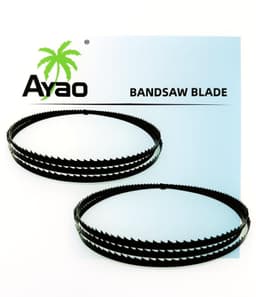
AYAO AYAO 1400 mm 6 TPI two-pack

Testsieger

AYAO AYAO 1400 mm 6 TPI two-pack
8.9/10about £17.99

Match the teeth to the thickness

Finer is not a better blade. Pack the gullet and the blade heats, burns, and dulls. Saws UK’s rule of thumb is at least three teeth in the cut, and roughly 6–8 TPI as general purpose. Axminster treats 6 TPI as everyday wood: crosscutting up to about 150 mm and ripping up to about 50 mm. NLS Tools suggests about 6 TPI at 12–20 mm and 4 TPI at 20–30 mm. For mixed wood, start at 6 TPI, move to 10 TPI for plywood, and use 14 TPI for thin stock and plastics. The full pitch argument is on the bandsaw blade TPI page.

Carbon for the bench saw

A bench saw at wood speed wants a carbon flex-back loop, the ordinary blade from £8.99 to £22.99 here. Bi-metal belongs on a slower metal saw, in this set the 733 mm 18 TPI pack. A carbon title that also says metal and wood is still a carbon bench blade unless length and pitch say otherwise. Steel type is on the wood or metal bandsaw blade page. Before you pay, the title length must match the manual, including 1400 mm against 1425 mm. Width has to suit the tightest curve. TPI has to suit the thickest solid timber. A two-pack that arrives as one rusty blade is a Consumer Rights Act problem. On work equipment, HSE sheet WIS31 applies.

Common questions

What length does my saw take?
Read the manual, or the specification plate, for the blade length in millimetres. In this amazon.co.uk set the bench wood lengths are 1400 mm, 1425 mm, and 1575 mm, plus a 3380 mm workshop loop and a 733 mm cordless loop. Measuring a coiled old blade is a check, not a substitute, because a kink changes the reading. If the manual says 1400 mm, a 1425 mm set will not tension on those wheels.
Is 1400 mm the same as every 8 inch saw?
No. About 1400 mm is a common UK bench length, and several listings name Scheppach, Axminster, Charnwood, Draper, Einhell, Fox, and Lumberjack models around that size. Other saws sold as 8 inch or 9 inch take 1425 mm or 1575 mm. One Vidsmow bullet says most 8 inch saws that take 1400 mm by 1/4 inch, and it does not say all of them. Match the manual.
How wide a blade do I need for curves?
Use the narrowest blade your tightest real curve needs, and keep a wider blade for straight cuts. Axminster’s chart is about 19 mm minimum radius on a 6 mm blade and about 63 mm on a 13 mm blade. Saws UK’s chart is about 5/8 inch on a 1/4 inch blade and about 1 1/2 inches on a 3/8 inch blade. The two charts disagree, so treat both as guides and test in scrap.
Is 6 TPI enough for mixed wood?
For most bench-saw firewood, furniture oak, and softwood up to the Axminster bands, 6 TPI is the starting pitch: crosscutting up to about 150 mm and ripping up to about 50 mm. NLS puts 6 TPI at roughly 12–20 mm and 4 TPI at 20–30 mm. If the cut burns in thick stock, the gullets are full and a coarser blade is the next try, not a finer one.
When is 14 TPI the wrong blade?
It is the wrong blade when the timber is thick enough to pack the small gullets. Axminster aims 14 TPI and finer at thin stock and plastics. A review of one 14 TPI pack said it dulled quickly in oak about 20 mm thick. Use it for thin sheet and plastic, and move to 6 TPI or 4 TPI for solid furniture timber.

Related pages

Sources

Public UK sources used for this comparison. Shelf prices are amazon.co.uk listings from 19 October 2026.

  1. HSE WIS31: woodworking bandsaws (retrieved 19.10.2026)
  2. HSE: narrow band saws (retrieved 19.10.2026)
  3. HSE: PUWER overview (retrieved 19.10.2026)
  4. Saws UK: blades buying guide (retrieved 19.10.2026)
  5. Axminster: bandsaw blade guide (retrieved 19.10.2026)
  6. NLS Tools: blade selection (retrieved 19.10.2026)
  7. Screwfix: Starrett UNZ13A187333 (retrieved 19.10.2026)
  8. Consumer Rights Act 2015 (retrieved 19.10.2026)