Independent comparisons. We may earn from shop links. More info

Wet stone grinder buying guide

Updated: October 2026

Buying a water-cooled sharpener is less about finding the largest motor and more about matching a complete system to the tools on your bench. This wet stone grinder buying guide explains how wheel size, support rigidity, jigs and maintenance affect the edge you can produce. For current models and prices, start with the [wet stone grinder comparison](/hub/sanders/wet-stone-grinder). Separate a compact occasional-use machine from a full-size sharpening system, and notice when a cheap package still needs costly accessories. A qualifying purchase through our links can earn a commission at no extra cost to you.

Buying a water-cooled sharpener is less about finding the largest motor and more about matching a complete system to the tools on your bench.

Our top picks

Bucktool Bucktool SCM-8101GB

Best overall

Bucktool Bucktool SCM-8101GB
8.6/10about £138.99
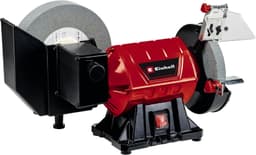
Einhell Einhell TC-WD 200/150

Best value

Einhell Einhell TC-WD 200/150
8.2/10about £71.06
On this page

Start with the tools you sharpen

Make a short inventory before comparing specifications. Bench chisels and plane irons need a rigid straight-edge jig that clamps blades square and moves consistently across the wheel. Knives need a clamp with clearance, and turning gouges usually need a specialist jig. That list also decides between a dedicated wet sharpening system and a combination wet-and-dry bench grinder. A dedicated machine centres on a slow wheel, a universal support and a leather honing wheel. A combination grinder can suit rough garden tools, yet its basic rests rarely match that repeatability. The best wet stone grinder for woodworking tools applies these differences to specific edge tools.

Wheel size, grit and maintenance

The common choice is a 200 mm or a 250 mm wet wheel. A 200 mm machine takes less bench space and is easier to store between occasional sessions. A 250 mm wheel has more abrasive and produces a shallower hollow grind at the same bevel angle. Diameter alone does not make an edge square. Around 220 grit is common. Grading changes how aggressively the abrasive cuts. Truing removes high spots and restores a round, flat face. Budget for a diamond truing tool and a stone grader before you compare two machines. If a wheel pulses against the tool, follow the wet stone grinder wheel wobble guide before removing material.
Bucktool Bucktool SCM-8101GB

Testsieger

Bucktool Bucktool SCM-8101GB
8.6/10about £138.99

Support, speed, torque and direction

For repeatable sharpening, support quality comes before headline wattage. The universal support should be straight, lock without twisting and allow fine height adjustment. A jig that rocks on the bar changes the bevel even when the wheel is true. The wheel should keep moving under modest pressure. Wattage does not reveal usable torque. Variable speed does not cure poor alignment, and a stable fixed-speed machine can sharpen accurately. Always hone with the leather wheel moving away from the cutting edge. Water cooling reduces heat, but it does not remove risk. For the operating sequence, see how to use a wet stone grinder.

Jigs, spares and total cost

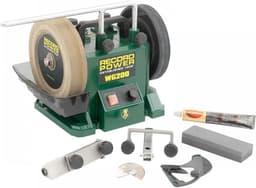
Ask what is actually in the box. “Universal jig” may mean one basic holder, not a set for chisels, knives and gouges. For flat woodworking tools, look for a square-edge jig, an angle-setting method and a safety stop. Price the usable system rather than the bare machine. Add the truing device, grader, honing compound and every jig you need in the first year. A £140 grinder that includes your core jig and maintenance tools may cost less overall than a £100 machine needing several separate purchases. The leather wheel removes the burr after grinding. A combination grinder without one can still be useful if you already own bench stones or a strop.

Which setup fits your workshop

For an occasional hobby workshop, a compact 200 mm dedicated system can be the compromise if the wheel runs true, the support is rigid and the jig is confirmed. Frequent chisel and plane-iron work favours a 250 mm dedicated system with a straight-edge jig, a truing tool and integrated honing. A mixed workshop may get more from a wet-and-dry grinder for mower blades, axes and rough repairs. You give up jig control, and a leather honing wheel is usually absent. Large chips and high-speed-steel reshaping are slow on a wet wheel.

Common questions

Is a 250 mm wet wheel better than a 200 mm wheel?
A 250 mm wheel gives a shallower hollow grind and usually more abrasive life, but it is larger and heavier. A 200 mm system can be a better fit for occasional use or a small workshop. Wheel truth, support alignment and jig rigidity have more influence on repeatability than diameter alone.
Do I need variable speed?
Variable speed is useful for adjusting surface speed as the stone wears and for choosing a comfortable working pace. It is not essential for accurate sharpening. A fixed-speed machine with a true wheel, stable torque and rigid jig can outperform a variable-speed model with poor alignment.
Is reversible rotation worth having?
It can be, especially when the grinder and jig support both edge-leading and edge-trailing work. Direction changes the feel, burr formation and risk of catching. Whatever the grinding direction, the leather honing wheel must move away from the cutting edge.
Which jig do I need for chisels and plane irons?
Look for a rigid square-edge jig that accepts the width and thickness of your blades, clamps them evenly and has a reliable stop or angle-setting method. Confirm compatibility with the exact grinder. Similar-looking universal supports do not prove that another brand’s jig will fit safely.
Do I need both a truing tool and a stone grader?
They perform different jobs. A truing tool restores the wheel’s roundness and flat face by removing high spots. A grader changes or refreshes the abrasive cutting character. Grading cannot fix an eccentric wheel, and truing does not automatically leave the surface at your preferred cutting grade.
Is a wet-and-dry grinder the same as a dedicated wet sharpener?
No. A combination grinder adds useful fast dry grinding at a lower price, but it generally has basic rests and a smaller accessory ecosystem. A dedicated system is built around controlled low-speed sharpening, purpose-made jigs and often a leather honing wheel, making it better suited to repeatable fine edges.

Related pages

Sources

Public UK sources on abrasive wheels, workplace equipment duties and bench-grinder safety, plus manufacturer notes on honing direction and wheel size. Listing prices and star counts are from the amazon.co.uk extracts used for this comparison. Prices move.

  1. HSE, Safety in the use of abrasive wheels (retrieved 17 October 2026)
  2. HSE, PUWER overview (retrieved 17 October 2026)
  3. HSE, Dust from abrasive (retrieved 17 October 2026)
  4. BSI, BS EN 62841-3-4:2016+A12:2020 (retrieved 17 October 2026)
  5. Tormek, Edge trailing vs edge leading (retrieved 17 October 2026)
  6. Axminster Tools, Tormek T-4 (retrieved 17 October 2026)
  7. Scheppach UK, Tiger 2500 (retrieved 17 October 2026)
  8. Amazon UK, Bucktool SCM-8101GB (retrieved 17 October 2026)