Independent comparisons. We may earn from shop links. More info

Best wet stone grinder for woodworking tools

Updated: October 2026

A cabinetmaker touching up a plane iron needs a different setup from a turner reshaping a gouge. The best wet stone grinder for woodworking tools is the system that holds your blades securely, repeats their bevels and can be maintained accurately, not simply the machine with the largest wheel. The [wet stone grinder comparison](/hub/sanders/wet-stone-grinder) covers current listings. This page matches grinder traits to chisels, plane irons, carving tools and turning tools. A qualifying purchase through our links can earn a commission at no extra cost to you.

A cabinetmaker touching up a plane iron needs a different setup from a turner reshaping a gouge.

Our top picks

Bucktool Bucktool SCM-8101GB

Best overall

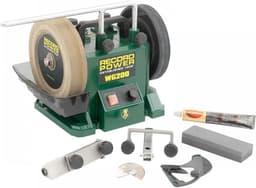
Bucktool Bucktool SCM-8101GB
8.6/10about £138.99
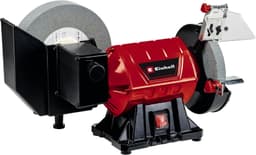
Einhell Einhell TC-WD 200/150

Best value

Einhell Einhell TC-WD 200/150
8.2/10about £71.06
On this page

Match the grinder to your woodworking tools

Bench chisels and plane irons suit a square-edge jig on a universal support. Water cooling gives you time to establish a bevel without stopping to cool the steel. The jig must hold the blade evenly, clear the wheel and repeat the projection. A clamp that twists a narrow bevel-edge chisel is a poor match, whatever the wheel size. If the abrasive face is crowned, a correctly clamped plane iron can still leave with the wrong geometry. Carving tools need a holder for a short blade or a curved profile. The wet stone grinder buying guide explains how to price that complete system. Major reshaping of a high-speed-steel gouge is much slower on a wet wheel than maintaining an established profile.

What makes a clean, square bevel

Three parts work together: a true wheel, a straight support and a rigid jig. If the wheel rises and falls, contact pressure pulses. If the support is skewed, a wide plane iron meets the wheel at different distances from side to side. If the jig lets the blade move, the angle will not hold. A new wheel can need truing, and wear can leave a hollow or crowned face. A diamond truing device restores roundness. A stone grader changes the cutting character and cannot correct runout. Seat the blade against the jig reference, tighten evenly and move the tool across the face. A 60 mm plane iron held on one part of a 50 mm-wide stone wears the abrasive unevenly if you never traverse it.
Bucktool Bucktool SCM-8101GB

Testsieger

Bucktool Bucktool SCM-8101GB
8.6/10about £138.99

Compact 200 mm or full-size 250 mm

A 200 mm system takes less bench space and is easier to store. The tighter radius leaves a slightly deeper hollow. With a rigid support and a true stone, it can still sharpen ordinary chisels and plane irons accurately. A 250 mm wheel gives a shallower hollow and more abrasive life. Full-size machines here can weigh more than 16 kg and need roughly 40–45 cm of bench depth. That mass helps at a permanent station and is awkward if you lift the grinder out every few weeks. A machine that fits the bench but lacks a plane-iron holder is not a woodworking system yet.

Best setup by workshop type

For occasional chisels and one plane iron, choose a compact dedicated system with a straight-edge jig and integrated honing. Spend first on accurate holding and the tools that keep the stone true. Frequent sharpening can justify a 250 mm system with a stable support, square-edge jig, truing device, grader and leather honing wheel. Carvers should prioritise short-tool jigs over wheel diameter. A combination grinder for mixed garden and cabinet work has basic rests, and a leather honing wheel may be absent. The preparation sequence is in how to use a wet stone grinder.

Where a wet grinder is not the first tool

A large chip or a thick bevel change is inefficient on a water-cooled wheel. A bench grinder or belt removes steel faster, then the wet system can set a repeatable bevel if you control heat on the dry stage. High-speed-steel turning tools may start on a dry or CBN wheel. Knives and very short carving tools need a compatible holder. A standard chisel jig may not grip them. For the task split, see wet stone grinder vs bench grinder.

Common questions

Which wet grinder is suitable for chisels and plane irons?
Choose a dedicated system with a true wheel, rigid universal support and square-edge jig that accepts your blade dimensions. An integrated leather honing wheel completes the workflow. Diameter is secondary: both 200 mm and 250 mm systems can work well when alignment and clamping are dependable.
Does a 250 mm wheel matter for plane irons?
It gives a shallower hollow grind and usually more wheel life, which can suit frequent sharpening. It does not ensure a square edge. Support alignment, wheel truth, jig rigidity and even clamping pressure remain the factors that determine whether a wide plane iron finishes accurately.
Can one jig hold chisels and plane irons?
Many square-edge jigs are designed for both, but check the permitted width, thickness and minimum blade length. Narrow bevel-edge chisels can clamp differently from broad plane irons. Compatibility with the grinder’s support and available wheel clearance must also be confirmed.
How do I create a slight camber on a plane iron?
Use a jig designed to permit controlled side pressure or camber adjustment, and follow its instructions. The wheel itself should remain true and flat. Deliberately crowning the stone is not a reliable camber method because it affects every tool sharpened afterwards.
Is a wet grinder suitable for carving tools?
Yes, when the system offers a holder for the specific short or shaped tool. Standard straight-edge jigs may not grip a short carving blade safely. Check the jig’s tool dimensions and movement before buying rather than assuming the general-purpose support is enough.
Do woodturning gouges need a different grinder?
Not always, but major reshaping of HSS gouges is usually quicker on a suitable dry or CBN setup. A wet grinder with the correct gouge jig can maintain or finish an established profile. Many turners use both methods rather than forcing one wheel to cover every stage.

Related pages

Sources

Public UK sources on abrasive wheels, workplace equipment duties and bench-grinder safety, plus manufacturer notes on honing direction and wheel size. Listing prices and star counts are from the amazon.co.uk extracts used for this comparison. Prices move.

  1. HSE, Safety in the use of abrasive wheels (retrieved 17 October 2026)
  2. HSE, PUWER overview (retrieved 17 October 2026)
  3. HSE, Dust from abrasive (retrieved 17 October 2026)
  4. BSI, BS EN 62841-3-4:2016+A12:2020 (retrieved 17 October 2026)
  5. Tormek, Edge trailing vs edge leading (retrieved 17 October 2026)
  6. Axminster Tools, Tormek T-4 (retrieved 17 October 2026)
  7. Scheppach UK, Tiger 2500 (retrieved 17 October 2026)
  8. Amazon UK, Bucktool SCM-8101GB (retrieved 17 October 2026)