Independent comparisons. We may earn from shop links. More info

Sheet sander vs random orbit sander

Updated: October 2026

You are about to buy a first powered sander, and the shortlist has split into rectangular sheet sanders and round random orbit sanders. The choice is pad shape and motion. A sheet sander reaches square corners. A random orbit sander removes stock faster on broad surfaces. Doors, cupboards and trim point to a sheet sander. Stripping large panels points to a random orbit. The rectangular models are in the [sheet sander comparison](/hub/sanders/sheet-sander). This is not a lab test. A qualifying purchase through our links can earn a commission at no extra cost to you.

You are about to buy a first powered sander, and the shortlist has split into rectangular sheet sanders and round random orbit sanders. The choice is pad shape and motion. A sheet sander reaches square corners.

Our top picks

Einhell Einhell TC-OS 1520

Best value

Einhell Einhell TC-OS 1520
8.8/10about £26.97
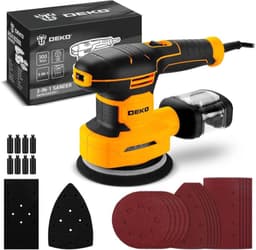
DEKOPRO DEKOPRO 3-in-1

Rank 3

DEKOPRO DEKOPRO 3-in-1
8.1/10about £36.99
On this page

How the two sanding actions differ

A sheet sander, also called a finishing sander, has a rectangular plate that moves in small circles, typically a 2 mm orbit. The plate does not spin. It takes a 1/3 or 1/2 sheet, held by clamps or hook-and-loop. A random orbit sander has a round pad, commonly 125 mm, that spins and orbits together. No grain follows the same path twice, so it cuts harder without the regular scratch pattern of a pure orbit. It takes hook-and-loop discs with matching holes. That motion is why speed, marks and reach differ.

Finish quality and removal speed

A random orbit sander removes material faster. On a weathered top or old varnish, the combined spin and orbit takes stock off quicker than a sheet sander with the same grit. It suits levelling and stripping. A sheet sander is easier to control. Less comes off per pass, so you are less likely to cut through veneer or round a painted edge. Between coats, that restraint helps. On a large rough face it is slower. Neither tool stays swirl-free if you press hard, tilt the pad or jump grits. The habits are in how to use a sheet sander.

Corners, edges and broad surfaces

A round pad cannot enter a square internal corner. On a panelled door or where a shelf meets a cabinet side, a random orbit sander leaves a crescent you finish by hand. A rectangular plate runs into the corner and along a straight edge. Housing and clamps still decide how close you get. A 1/2-sheet such as the Draper 57941, at 225 × 115 mm, covers a panel faster than a 1/3-sheet plate of about 90 × 187 mm. A random orbit still gets through a rough table top sooner because it cuts harder. Floorboards and thick old paint need a belt or a stripper. Older UK paint can contain lead, so test it first.

Abrasives, dust holes and running cost

Many sheet sanders take plain paper under clamps, cut from a roll. Hook-and-loop plates need pre-cut sheets, and sizes vary inside the 1/3-sheet class. Einhell specifies 187 × 94 mm for its cordless 187 × 90 mm plate. Random orbit sanders use discs only, often 125 mm. The hole pattern has to match, or extraction suffers, and you cannot cut a disc from a roll. A bag on either tool catches only part of the dust. A vacuum works better. Poor hole alignment clogs the paper whichever pad shape you bought.

Which should you buy for your jobs?

Choose a sheet sander for doors, frames, skirting, cupboards and square corners. It handles filler, veneer and cheap clamped paper. A 1/3-sheet model covers that mix. Choose a random orbit sander for table tops, worktops and bare boards that need levelling. You will still finish corners by hand. If you do both often, own both. The DEKOPRO 3-in-1 carries rectangular, round and delta plates, though reviews mention worn hook faces and awkward base changes. For one tool and typical UK decorating, a sheet sander is the recommendation unless you strip heavily. Plate size is in the sheet sander buying guide.

Common questions

Which removes material faster, a sheet sander or a random orbit sander?
A random orbit sander usually removes material faster. Its round pad spins and orbits at once, so it cuts harder than a sheet sander's small repeating orbit with the same grit. That suits stripping and levelling. A sheet sander is the more controlled finishing tool, and it is slower on a large rough panel.
Can a random orbit sander reach square corners?
No. A round pad cannot enter a square internal corner, so a small crescent stays for hand sanding. A sheet sander's rectangular plate reaches into corners and along straight edges. Housing and clamps still limit how close the plate sits. Check the front of the plate on a panel moulding before you buy.
Does a random orbit sander prevent swirl marks?
It reduces repeated scratch patterns. It does not stop marks. Hard pressure, a tilted pad, a clogged disc or a skipped grit still leaves swirls. A sheet sander can leave fine loops for the same reasons. Light pressure and a step-by-step grit change matter more than the tool type.
Which sander is better for veneer and painted furniture?
A sheet sander is usually the safer choice on thin veneer and painted furniture. Less material comes off per pass, so you are less likely to cut through veneer or round an edge. The rectangular plate also reaches inside panel corners. Use a fine grit, light pressure, and stop often to check the veneer.
Is a sheet sander good for stripping heavy paint?
Not for thick layers. A sheet sander is for finishing and light removal, so heavy paint takes a long time and clogs the paper. A random orbit sander is faster. Very heavy coatings may suit a chemical or heat stripper. Older UK paint can contain lead, so test it, and leave a confirmed lead coating to a professional.
If I can only buy one sander, which should it be?
For doors, frames, cupboards and furniture, a 1/3-sheet sander is the more versatile single tool, because it handles corners and fine finishing. If most of the work is levelling table tops or worktops, a random orbit sander is the better choice. One tool will compromise on the jobs it is not built for.

Related pages

Sources

Public UK sources on wood dust, hand-held sanders and hand-arm vibration, plus manufacturer pages for the Einhell, BLACK+DECKER and Draper models. Listing prices and star counts are the amazon.co.uk snapshots kept for this comparison. Prices move.

  1. HSE, WD7 Hand-held sanders (retrieved 17 October 2026)
  2. HSE, Wood dust (retrieved 17 October 2026)
  3. HSE, Cutting and sanding wood (retrieved 17 October 2026)
  4. HSE, Hand-arm vibration advice to employers (retrieved 17 October 2026)
  5. Einhell UK, TC-OS 1520 (retrieved 17 October 2026)
  6. Einhell UK, TC-OS 18/187 Li Solo (retrieved 17 October 2026)
  7. BLACK+DECKER, BEW220-GB (retrieved 17 October 2026)
  8. Draper 57941 user manual (retrieved 17 October 2026)