Independent comparisons. We may earn from shop links. More info

Flap disc vs grinding disc

Updated: 21 October 2026

The disc you grab is often the one already on the grinder. That is how a 1 mm cut-off wheel ends up side-loaded on a weld, and how a flap disc gets used to slit a bolt. This page separates the blend, the heavy grind and the slit on a 115 mm or 125 mm grinder. Cutwel’s UK guide sets the thickness line, FEPA’s leaflet sets the cutting-wheel limit, and the listings are in our [flap disc comparison](/hub/sanders/flap-discs). We did not break wheels in a lab. If you buy through our links, we may earn a commission at no extra cost to you.

The disc you grab is often the one already on the grinder. That is how a 1 mm cut-off wheel ends up side-loaded on a weld, and how a flap disc gets used to slit a bolt.

Our top picks

PRETEC PRETEC flap discs

Rank 2

PRETEC PRETEC flap discs
8.4/10about £11.99
Nisorpa Nisorpa flap discs

Rank 3

Nisorpa Nisorpa flap discs
7.2/10about £32.99
On this page

Three consumables, one spindle

A cut-off wheel is thin, often around 1–3 mm. It slits metal. FEPA’s bonded-abrasive leaflet tells you not to grind with a cutting wheel. Side pressure is how those discs burst. A grinding disc, in UK trade guides, is the thicker depressed-centre wheel, commonly about 6 mm and sometimes up to about 8 mm. Cutwel’s guide draws that line. A flap disc is neither. Overlapping flaps sit on a hub, at about 0–15° for Type 27 and about 15–25° for Type 29. The bore can be 22.23 mm on all three. The hole only proves they mount. The twelve flap packs ran from £9.99 to £32.99 on 19 October 2026. One contents line says metal cutting grit discs on a flap title. Thick 125 mm wheels are at 125 mm grinding discs. A straight cut continues at cutting discs.

When the flap disc is the one to fit

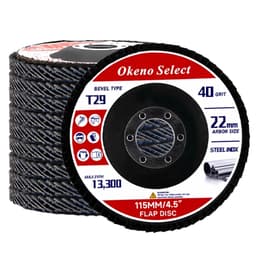
Fit a flap disc when you are blending a weld already near flush, taking rust back to metal, or stepping through a scratch pattern. A 40 grit Type 29 disc at about 15–25° is the usual first flap for a mild-steel weld cap. A Type 27 or a finer grit follows when the face has to stay flat. You can ease pressure and the cut softens, instead of a rigid 6 mm face digging a groove. Life still collapses if you lean on the disc. A mixed 40/60/80/120 box is several passes. Eleven packs are 115 mm. The 125 mm pack does not go under a 115 mm guard. Most flap listings print 13,300 rpm. A disc with no speed mark, or with 13.3 rpm in a broken spec line, stays in the box. Deburring with the face of a flap, not the rim, is the lighter way to knock an arris off sheet. The trial run is on how to use a flap disc.

When the thick grinding wheel still earns its place

Fit a depressed-centre grinding wheel when you need to move a lot of metal with one rigid disc: a heavy weld cap, a flame-cut edge, a gouge in thick plate. The 6 mm class keeps cutting when a flap would fold and glaze, and it leaves a coarser, hotter surface you will usually refine with a flap. Using only the wheel until the panel looks fine is how cosmetic work ends up dished. A flap grit such as 40 grit zirconia does not translate into an A24 or A30 specification. Thicker than a cut-off wheel is not permission to use the rim as a cutter. Choose the wheel for mill scale and a heavy cap. Choose the flap once the next mark will show under primer. Type 27 and Type 29 are both still flaps.

Cutting stays on a cut-off wheel

A flap disc will not slit a bolt, a hinge pin or a length of box section cleanly. The flaps shred, the hub can catch, and the cut wanders. A grinding wheel wastes the kerf because it is thick. A cut-off wheel enters the metal edge-on. Keep it square. Twist it to grind a weld and you are side-loading a disc that FEPA says not to grind with. Unplug, take the cutting disc off, and fit the flap or the grinding wheel with the guard still correct. For rust and a finish you will paint, use a flap on a matching guard. For a heavy cap on thick steel, use a grinding wheel, then a flap. For a slit, use a cut-off wheel and do not grind with it. Structural steel, overhead work you cannot brace, and stainless where contamination matters are reasons to hand the grinder over.

Common questions

Can a flap disc replace a grinding wheel?
On blending, rust and a weld already near flush, a flap disc is the better consumable, because you can step the scratch finer. On a heavy cap or a flame-cut edge, a grinding wheel about 6 mm still removes metal that would fold a flap. Many jobs use the wheel first and the flap second. Neither replaces a cut-off wheel for a slit. Match diameter and rpm, and keep the guard on.
Can I cut a bolt with a flap disc?
Use a cut-off wheel for a bolt, a pin or a length of bar. A flap disc blends at an angle, and the rim shreds rather than slits. A thick grinding wheel wastes a wide kerf. Fit a cutting disc marked for your guard, keep the cut square, and do not twist it to grind once the bolt is off. Side-loading is the failure FEPA warns about. Unplug before you swap back to a flap.
Which is safer for deburring an edge?
A flap disc at a shallow angle, with the guard on, takes the sharp arris off sheet or tube, and the cut eases when you ease off. A coarse grinding wheel is faster and leaves a deeper mark. A cut-off wheel is the wrong tool for deburring. Use the face of the flap, not the rim of a thin disc. Glasses and a clamped workpiece matter more than the brand.
Why does a cut-off wheel break when I angle it?
A cutting wheel is reinforced for an edge-on slit. Tip it and grind, and you side-load a thin disc, which is how bonded cut-off wheels burst. FEPA’s leaflet says not to grind with a cutting wheel. Stop, unplug, and fit a flap disc or a grinding wheel of the right diameter and rpm. Stand out of the plane of the disc whenever it is running.
Can I blend welds with a grinding disc instead of a flap?
A 6 mm depressed-centre wheel knocks a weld back, and on thick steel that is often the first pass. The surface is coarser, and it dishes if you dwell. A flap disc follows when the cap is near flush, especially Type 27 at about 0–15° or a finer grit. The wheel is for bulk. The flap is for the blend.
Where are cutting discs and 125 mm grinding wheels compared?
Straight cuts belong with the cutting-disc comparison, and thick 125 mm depressed-centre wheels have their own comparison. This page only draws the boundary so you do not side-load a cut-off wheel or expect a flap disc to slit. A 125 mm flap, of which this set has one listing, still needs a 125 mm guard.

Related pages

Sources

Sources taken from the research digest. Prices, stars and review counts are the stored amazon.co.uk listing figures from 19 October 2026.

  1. FEPA safety leaflet — flap discs (retrieved 19.10.2026)
  2. Engweld UK — flap disc guide (retrieved 19.10.2026)
  3. Norton Abrasives UK — flap disc guide (retrieved 19.10.2026)
  4. HSE HSG17 — safety in the use of abrasive wheels (retrieved 19.10.2026)
  5. HSE — PUWER overview (retrieved 19.10.2026)
  6. Cutwel UK — grinding discs explained (retrieved 19.10.2026)