Independent comparisons. We may earn from shop links. More info

Type 27 vs type 29 flap disc

Updated: 21 October 2026

The two codes on a flap disc box are shapes, and the shape sets the angle you can hold without tearing the flaps. You are deciding that for a weld still proud of a bracket, or a flat panel that has to stay flat. Grit and grain stay on the [flap disc buying guide](/hub/sanders/flap-discs/sub/flap-discs-buying-guide). Named packs stay on [best flap discs](/hub/sanders/flap-discs/sub/flap-discs-best). The rows are the [flap disc comparison](/hub/sanders/flap-discs). Engweld’s UK guide supplies the angle bands. The twelve amazon.co.uk listings were captured on 19 October 2026. We did not measure stock removal. If you buy through our links, we may earn a commission at no extra cost to you.

The two codes on a flap disc box are shapes, and the shape sets the angle you can hold without tearing the flaps. You are deciding that for a weld still proud of a bracket, or a flat panel that has to stay flat.

Our top picks

PRETEC PRETEC flap discs

Rank 2

PRETEC PRETEC flap discs
8.4/10about £11.99
Awutzut Awutzut flap discs

Rank 3

Awutzut Awutzut flap discs
7.5/10about £14.99
On this page

Two profiles, in plain sight

Type 27 is the flat flap disc, worked at a shallow angle. Type 29 is the conical flap disc. The flaps angle outward, so a little more tip puts a wider patch of abrasive on the metal. Weiler’s guide uses the same split: conical for heavier removal, flat when you are refining a surface. Neither code is a quality mark, a grit, or a speed rating. T29 on a title is Type 29. Jumbo or high-density, as on the EZARC and Total Abrasives titles, is a claim about how much flap is on the disc. It is not a third type. On a flat disc held too steep, one corner digs in. On a conical disc held dead flat, only the rim works. The how to use a flap disc page turns that into a fitting sequence.

The angles that match each shape

Engweld’s UK trade guide puts Type 27 at about 0–15° and Type 29 at about 15–25°. Those are working angles to the surface, not a licence to roll the disc onto its rim. At 15–25° a conical disc meets a tall weld. At 0–15° a flat disc blends without gouging the parent metal. Hold a Type 27 at 25° and you snag flaps. Hold a Type 29 at 5° and only the rim works. The ranges overlap around 15°. A conical disc shows a raised centre. A flat disc looks like a shallow stack. Type does not set the rpm. Most 115 mm rows print 13,300 rpm. One prints 13.3, which is not a speed, and the 125 mm pack prints nothing.

Weld removal, an edge, and a flat blend

For a weld bead on mild steel, start with Type 29 and a coarse grit, commonly 40, at 15–25°. When the bead is close to flush, swap to Type 27 or a finer grit if the panel has to look even. Engweld’s bands put 40–60 on weld grinding and 80–120 on cleaning and finishing. One 40 grit Type 29 disc is faster and leaves a coarser scratch. Only Type 27 is kinder to a flat face and slower on a tall cap. A painted panel is where Type 27 at a shallow angle earns the extra minute. Type 29 does not become a stainless disc because a title mentions stainless. A mixed 40/60/80/120 box can still be the wrong shape. MIDO’s assortment is Type 27. Gmozkrn’s title is Type 29 and 125 mm, which does not belong under a 115 mm guard.

What our table actually prints

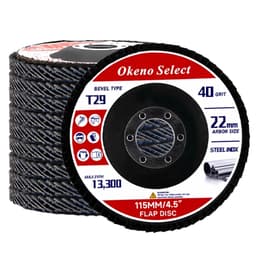
PRETEC and EZARC print Type 27. Anesty prints T27. Gmozkrn prints Type 29 on a 125 mm title. Awutzut’s title says T29 and the profile cell says P60. Okeno Select and Merryland say T29 in the title. Nisorpa’s profile says Backing Pad. ZJNGVF and SDLONLIGR leave the profile blank. Total Abrasives puts the model code TA-AD-03 in that cell. A blank is an unread shape, not a secret Type 29. If the cell and the title agree on Type 27, use it under about 15°. If they agree on Type 29, use it at about 15–25° on a matching guard. If they disagree, read the packet. A Type 29 in 120 grit will not knock a weld cap off.

Common questions

Which type removes a weld faster?
Type 29, used at about 15–25°, puts more abrasive on a weld cap than a flat Type 27 at a shallow angle. Engweld’s UK guide is the source of those bands. Grit still dominates: 40 grit removes more than 80 grit on either shape. We did not time these packs. The disc label still has to agree with the title.
Which type is for blending a flat face?
Type 27, at about 0–15°, is the usual choice when you do not want a deep crescent beside the weld. A finer grit, in the 80–120 band, finishes what a coarse Type 29 started. Holding a Type 27 at 25° tears flaps. Paint-ready metal is often a second disc, not a longer push with the same 40 grit.
Can I use a Type 27 disc at 25 degrees?
You physically can, and the flaps will tell you not to. At about 25° you are on the corner of a flat disc, which snags and wears one edge of the flap. The working band for Type 27 is about 0–15°. If the job needs 15–25°, fit a Type 29. A disc marked 13,300 rpm is still marked 13,300 rpm when you tip the grinder.
Why do listings say both T29 and Type 29?
They are the same conical shape. T29 is the short form in a crowded title. Type 27 and T27 are the flat profile. The risk is a title that says T29 while another field says a grit code, a model number, or nothing. Awutzut’s profile cell says P60 on a T29 title. Treat a lone abbreviation as a claim until the label repeats it.
Does the type change the maximum rpm?
No. Type is shape and working angle. The maximum speed is the number on the disc, and it has to be at least the speed of the grinder. Most 115 mm discs here print 13,300 rpm on either type. MIDO states Type 27 and then prints 13.3 rpm, which is a listing error, not a Type 27 speed. A missing rpm is not supplied by the word Type 29.
Is Type 29 always zirconia?
No. Okeno Select and Merryland pair a T29 claim with zirconia alumina. Awutzut’s T29 title is aluminium oxide. Gmozkrn’s Type 29 title is aluminium oxide and 125 mm. PRETEC’s zirconia pack is Type 27. Ceramic in this table sits on a pack with no profile in the cell. Buy the shape for the angle and the grain for the cut.

Related pages

Sources

Sources taken from the research digest. Prices, stars and review counts are the stored amazon.co.uk listing figures from 19 October 2026.

  1. FEPA safety leaflet — flap discs (retrieved 19.10.2026)
  2. Engweld UK — flap disc guide (retrieved 19.10.2026)
  3. Norton Abrasives UK — flap disc guide (retrieved 19.10.2026)
  4. HSE HSG17 — safety in the use of abrasive wheels (retrieved 19.10.2026)
  5. HSE — PUWER overview (retrieved 19.10.2026)
  6. Cutwel UK — grinding discs explained (retrieved 19.10.2026)