Independent comparisons. We may earn from shop links. More info

Thin or thick 230mm cutting disc: 1.9 mm or about 3 mm

Updated: 21 October 2026

Two packets can both say 230 mm and both claim to cut steel, with thickness as the real difference. A thin or thick 230mm cutting disc means about 1.9 mm for a narrow slot in sheet or tube, and about 3 mm when the thin disc wanders in heavier bar. Thin discs flex. Thick discs are stiffer and throw a wider slot. Neither is safer by default. Prices are on the [230mm metal cutting disc comparison](/hub/sanders/230mm-metal-cutting-disc). We used the amazon.co.uk listings of 19 October 2026. We did not measure a kerf in a lab. A purchase through our links can earn a commission at no extra cost to you.

Two packets can both say 230 mm and both claim to cut steel, with thickness as the real difference.

Our top picks

On this page

What 1.9 mm and 3 mm change

Thin bonded discs here cluster around 1.9 mm to 2.0 mm: Parweld, HAUTMEC at 2.0 mm, Merryland’s title, and the Bosch inox discs that state a thickness cleanly. The thick bonded discs are the Bosch 230 x 3 mm steel parts. Eternox’s title says 3.2 mm, but its reviews describe 115 mm discs, so they are not evidence. A 1.8 mm diamond wheel is a different tool, not the thin end of this comparison. A thinner disc leaves a narrower slot and, if you keep it moving, often puts less heat into sheet and tube. UK welders on the MIG Welding Forum, cutting around 10 mm plate, say thinner discs are less forgiving. A disc around 3 mm tracks more steadily in bar and angle. Speed does not change with thickness. A 230 mm resinoid wheel at 80 m/s is still about 6,650 rpm on Norton’s table.

What buyers in this set reported

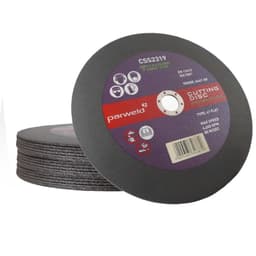
On the Parweld 1.9 mm ten-pack, a UK reviewer says the discs flex as they come up to speed and are hard to place until they are spinning, and says not to force them. That flutter is not, by itself, a cracked disc. It becomes a failure if you enter the steel early or twist to correct the line. The pack is £12.96, with 4.5 from 196 ratings, for mild steel and stainless at 6,600 rpm. Keep the feed light. On the Bosch 3 mm depressed-centre disc at £2.41, comments split between a usable cut and very fast wear. Thicker is not a promise of a longer afternoon. One buyer of the flat-hub Bosch 3 mm disc at £8.95, a different part, reports no blowouts on angled box steel after a cheaper disc failed. That is one person’s experience. Do not borrow the Eternox score to settle 3.2 mm. Those reviews are about 115 mm discs.
Bosch Bosch PRO metal 230 x 3 mm

Testsieger

Bosch Bosch PRO metal 230 x 3 mm
8.8/10about £2.41

Flat or depressed centre

Type 41 and type 42 are shapes, not a safety ranking. Type 41 is flat. Merryland’s title says type 41 at 1.9 mm, and Bosch part 2 608 603 168 is the 3 mm flat hub. Type 42 is a depressed centre, so the nut sits back and is less likely to rub on a shallow cut. The £2.41 Bosch steel disc is described as a depressed centre. Eternox’s title says T42, with the review mismatch already noted. Choose the shape for your flanges and the cut. A depressed centre is the usual answer when the nut would mark the surface. Both still cut on the edge. If a listing will not say the shape, and one Bosch row also prints 8,500 rpm, read the packet rather than the scrambled field.

Which thickness to take

Take about 1.9 mm for sheet, tube and a neat slot, with a light feed. Take about 3 mm when the section is heavy, when a thin disc has wandered, or when angle and bar will close on a flexible wheel. That is the recommendation. Parweld’s reviews describe flex. The Bosch 3 mm reviews describe wear. If the metal is stainless, you still need a disc that says inox. A 3 mm steel-only Bosch disc is the wrong fix for a wandering cut in stainless sheet. That chemistry is on the stainless page. Fitting is on how to cut metal with a 230mm angle grinder.

Common questions

Is 1.9 mm too thin for a 230 mm grinder?
No, if the disc is marked for that diameter and rpm and you cut edge-on without twisting. It is the wrong practical choice when the section is heavy and the disc wanders, or when you lean on it. Thin is a normal trade size, and it is the less forgiving one.
Does 3 mm last longer?
Not as a rule from these reviews. The Bosch 230 x 3 mm disc at £2.41 draws fast-wear comments as well as comments about a decent steel cut. A thicker disc resists flex better. It still consumes abrasive if you pinch the kerf or feed hard.
Why does a thin disc wobble when it starts?
A 230 mm disc at 1.9 mm has little stiffness, so it can flutter until it is at speed. A Parweld reviewer describes that. Let it reach speed clear of the steel. If it still wobbles hard, stop and check the flanges, the bore and the disc. Do not stabilise it by pushing it into the work.
What is the difference between type 41 and type 42?
Type 41 is flat. Type 42 is a depressed centre, so the nut sits back from the face. Merryland’s title uses type 41 at 1.9 mm. The £2.41 Bosch steel disc is a depressed centre, and the £8.95 Bosch part is a flat hub. The codes do not say which is stronger. They say how the nut meets the work.
Should I buy a thin disc if I twist the cut?
No. Twisting side-loads the wheel, and 1.9 mm has less material to resist that. If you steer the grinder like a jigsaw, use about 3 mm and still try to cut straight, or move the job to a saw that clamps the steel. A thinner disc punishes a crooked feed sooner. It does not teach a straighter one.

Related pages

Sources

Sources taken from the research digest. Listings were checked on 19.10.2026.

  1. HSE — HSG17 Abrasive wheels (retrieved 19.10.2026)
  2. HSE — PUWER overview (retrieved 19.10.2026)
  3. HSE — Training and competence (retrieved 19.10.2026)
  4. legislation.gov.uk — PUWER 1998 (retrieved 19.10.2026)
  5. oSa — Organisation for the Safety of Abrasives (retrieved 19.10.2026)
  6. oSa — Frequently asked questions (retrieved 19.10.2026)
  7. Norton — speed table following EN 12413 (retrieved 19.10.2026)
  8. FEPA — Bonded abrasives safety leaflet (retrieved 19.10.2026)
  9. Bosch Professional UK — EXPERT diamond metal wheel (retrieved 19.10.2026)