Independent comparisons. We may earn from shop links. More info

How to cut metal with a 230mm angle grinder

Updated: 21 October 2026

You are about to mount a disc and cut steel, and the failures that matter are side load, a missing guard, and a disc run faster than its label. This is how to cut metal with a 230mm angle grinder: inspect, fit, reach full speed, cut in a line, and stop if the kerf pinches. The table is the [230mm metal cutting disc comparison](/hub/sanders/230mm-metal-cutting-disc). We did not film a cut. There is no general UK ban on a 9 inch grinder. A smaller grinder is still the better tool when the cut allows it. A purchase through our links can earn a commission at no extra cost to you.

You are about to mount a disc and cut steel, and the failures that matter are side load, a missing guard, and a disc run faster than its label.

Our top picks

On this page

Check the disc before it goes on

The disc and the guard have to be 230 mm. A 115 mm or 125 mm grinder is the wrong machine. Norton’s table lists 6,650 rpm for a 230 mm resinoid wheel at 80 m/s. One amazon field says 8,500 rpm against a 230 mm description. That field is not your target. The number on the disc is the limit, and an unreadable disc stays off the spindle. Size checks before you buy are on the buying guide. Look for cracks, missing chunks, and any disc that was dropped. Resin-bonded wheels carry a use-by date on the metal ring, often about three years. An expired, damp or distorted disc is scrap. Use a face shield over safety glasses, hearing protection, and clothing that will not catch. The guard sits between you and the wheel. At work, PUWER 1998 requires suitable equipment and training. An oSa title does not replace that.

Mount the guard, the flanges and the nut

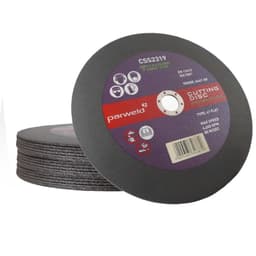
Unplug the grinder, or remove the battery, before the flanges come off. Seat the disc flat on the inner flange and fit the locking nut the way the grinder maker shows. The bore on most of these listings is 22.23 mm or 22.2 mm. Do not add washers the maker does not specify. Thin discs can spin on the flange if the nut is not seated. One Bosch buyer reported turning the nut when a thin disc spun. If the disc still slips, stop and check you have cutting-disc flanges rather than a grinding stack. The side handle stays on. Bosch’s UK notes say guard on, both hands, and do not exceed the wheel’s rpm. Stand clear of the plane of the disc for the first start. A Parweld reviewer says the 1.9 mm discs flex until they are up to speed. Let that happen in open air. If the disc still wobbles badly at speed, unmount it. Do not true a cutting disc by leaning its face on the work.
Bosch Bosch PRO metal 230 x 3 mm

Testsieger

Bosch Bosch PRO metal 230 x 3 mm
8.8/10about £2.41

Cut in a straight line and let the disc stop

Mark the line and clamp the steel so the offcut can fall without closing the kerf. Bring the disc to full speed, then enter at the edge with light pressure. If you have to push hard, the disc is glazed, the section is too heavy for that thickness, or the grinder is the wrong tool. Sheet and tube suit a light feed on 1.9 mm. Bar is where about 3 mm wanders less. Choosing between those thicknesses is on thin or thick 230mm cutting discs. Keep the cut straight. Twisting loads the side of the disc, and a cutting disc is not built for that. Throw sparks away from fuel and from anything that will smoulder. If the disc stalls, let it stop and lift it out before you start again. Let the disc stop before you set the grinder down. Do not deburr with the face of the same disc.

When you should not continue

Stop when the work is no longer a simple free cut in mild steel you can clamp. Structural steel, anything that is part of a building, and anything pressurised are not a disc experiment. Cutting a gas cylinder is a stop, not a method, and this page will not describe it. If the speed is unreadable, if the page and the packet disagree on diameter, or if the disc was dropped, that wheel is finished. At work, if nobody has been trained to mount abrasive wheels, the grinder stays on the shelf. In a home workshop the same limits apply: guard, eye protection, a disc inside its date and its rpm, and no side grinding. Overhead cuts, and cuts beside fuel or glass, belong with a smaller grinder or a chop saw and a clamp.

Common questions

Does the grinding guard also suit a cutting disc?
Use the guard that covers a cutting disc and sits between you and the wheel. A guard set only for face grinding can leave too much of a thin disc exposed. If you cannot fit the correct guard, do not cut. Adjust it with the grinder unplugged.
What rpm is too high for a 230 mm disc?
Anything above the rpm printed on that disc. Norton’s table gives 6,650 rpm for a 230 mm resinoid wheel at 80 m/s. An amazon field of 8,500 rpm belongs to a smaller diameter on that table. A 115 mm or 125 mm grinder is already too fast for this disc.
Can I deburr with the same disc?
No. A cutting disc cuts a slot, edge-on. Dressing the face is side load. FEPA’s leaflet on bonded wheels for angle grinders treats side grinding of cutting wheels as outside their use. Fit a grinding wheel or flap disc of the right diameter and speed, and keep the guard on.
Should I restart the grinder in the cut?
No. Let the disc stop, lift it clear, and start in free air. Bosch’s UK notes say not to restart in the cut. A stalled thin disc is often pinched. Starting against that pinch is how the wheel grabs. Clear the bind before you pull the trigger again.
When is this no longer a DIY job?
When the steel is structural or pressurised, or when you are being paid and nobody has had mounting training. Overhead work and cuts beside fuel or glass belong in that pause. A competent person is the next step.

Related pages

Sources

Sources taken from the research digest. Listings were checked on 19.10.2026.

  1. HSE — HSG17 Abrasive wheels (retrieved 19.10.2026)
  2. HSE — PUWER overview (retrieved 19.10.2026)
  3. HSE — Training and competence (retrieved 19.10.2026)
  4. legislation.gov.uk — PUWER 1998 (retrieved 19.10.2026)
  5. oSa — Organisation for the Safety of Abrasives (retrieved 19.10.2026)
  6. oSa — Frequently asked questions (retrieved 19.10.2026)
  7. Norton — speed table following EN 12413 (retrieved 19.10.2026)
  8. FEPA — Bonded abrasives safety leaflet (retrieved 19.10.2026)
  9. Bosch Professional UK — EXPERT diamond metal wheel (retrieved 19.10.2026)