Independent comparisons. We may earn from shop links. More info

How to use woodworm killer

Updated: October 2026

Fresh bore dust on a greenhouse rail you can reach is a different job from a tin still in the basket. You already have an amateur fluid. How to use woodworm killer then means bare wood, the rate printed on that tin, a dry surface before any paint, and people and animals kept off until the timber is dry. A quiet evening is not a cure. Which bottle fits a small interior job, and which tin to skip for a roof or a raised bed, sits on the [woodworm killer](/hub/raised-beds-greenhouses-and-compost/woodworm-killer) comparison. This page is the sequence once the cap is off.

Fresh bore dust on a greenhouse rail you can reach is a different job from a tin still in the basket. You already have an amateur fluid.

Our top picks

On this page

Confirm it is worth opening the tin

An old pinhole is not the same decision as pale dust that returns after you sweep. Fresh dust on a clean sheet, or a beetle you can see, is a reason to look harder. Historic holes with no new dust are a reason to stop and watch, compared with soaking a floor on a hunch. Separating those signs is covered on is woodworm active or old. Leave the tin shut if pets cannot be kept clear or you suspect a bat roost, and decide how leftovers will be disposed of before a 500 ml can ends up half used.

Bare wood and a coarse spray or a brush

Varnish, wax, and paint sit between the fluid and the timber. Barrettine’s sheet asks for clean, dry wood, dust vacuumed out, then a brush or a coarse low-pressure spray. Ronseal’s page specifies a brush, with coatings off before any coat. A piece you can turn and isolate is on woodworm killer for furniture. Bare wood is what makes the rate on the tin meaningful.

The rate is on the label, not in the star rating

These tins do not share one coverage figure, so a star rating will not tell you how much to pour. The published Barrettine 500 ml label states permethrin at 2.5 g per litre, 300 ml per square metre to eradicate and 200 ml per square metre to prevent, in two coats. The amazon.co.uk extract for that listing does not print those figures, so they belong to the label, not the product tile. A full 500 ml tin at the eradication rate wets about 1.7 square metres, a windowsill and a short run of skirting rather than a room. Ronseal’s page states a brush, three coats, and up to 10 square metres per litre for interior wood. The amazon.co.uk 1 litre extract matches that coverage and lists exterior wood under recommended uses, so the can you hold settles the clash. A blank label is a reason to stop, which is why a tin that states a job belongs in the woodworm killer buying guide.

Dry, overcoat, and keep watching

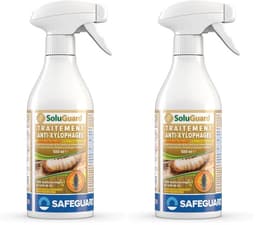
Drying times on these fluids are not interchangeable. Ronseal says you can paint once the treatment is dry. Cuprinol’s page asks for about three days before some floor coverings. Soluguard and Lignum reviews also wait for dry timber before any overpainting, which is a sequence rather than a same-afternoon top coat. Paint on a damp film hides the dust you need to see. Fresh dust can continue for weeks after a correct coat, and contractor pages disagree on how many weeks, so a quiet week is not proof. Date a pale patch under the treated face and look again through the next flight season, in the warmer months, before you call the job finished. If fresh dust returns on wood you stripped and wetted at the printed rate, a survey is the stronger next step compared with another amateur coat.

Common questions

Do you have to strip varnish before woodworm killer?
Yes, where a finish is still on the wood. Varnish, wax, and paint stop the fluid reaching the fibres, which is why Barrettine, Ronseal, and Which? all start from bare timber. Hardwood such as mahogany is harder still, and one Soluguard reviewer found it a poor surface compared with softer joinery. Strip what you can reach, vacuum the dust, and let the wood dry before the first coat.
How much woodworm killer do you use per square metre?
Use the figure on your tin. Barrettine’s published 500 ml label states 300 ml per square metre to eradicate and 200 ml per square metre to prevent, in two coats. Ronseal states up to 10 square metres per litre and three coats. Cuprinol’s page states 1 litre for 3.5 to 5 square metres, while its amazon.co.uk extract prints square feet. Soluguard’s listed 1.65 square metres is not the same instruction as 300 ml per square metre. A blank extract is a reason to stop, not to borrow a neighbour’s rate.
Can you paint over woodworm killer, and when?
You can overcoat once the treatment is dry, if the tin allows a finish afterwards. Ronseal says paint after it is dry. Cuprinol’s page allows about three days before some floor coverings, and a reviewer of the 1 litre tin reported that line on the container. Soluguard and Lignum reviews describe painting only after drying. If your label is silent, wait until the wood is dry rather than using another brand’s three days.
How long does woodworm killer take to work?
Longer than a weekend. Fresh dust can keep appearing for weeks, and the published guides do not agree on one number of weeks, so a clear sheet after seven days is not a result. Larvae of the usual furniture beetle spend years in the wood. Judge the job over the next flight season, with a dated patch under the treated face. A prevention rate on sound timber is a different claim from eradication where dust is already falling.
Do you keep pets away from woodworm killer?
Keep people and pets out of the room while you apply it, and off the timber until it is dry. Some maker pages say pets can return once the surface is dry. The published Barrettine 500 ml label is the one to follow when a website and a can disagree, and it warns of eye irritation and skin tingling. If your tin names a re-entry time, use that time. Dry to the touch after an hour is not a clearance.

Related pages

Sources

Public UK and manufacturer sources from the research digest, last checked on 16 October 2026.

  1. Health and Safety Executive — using biocides (retrieved 16.10.2026)
  2. Health and Safety Executive — product type 8 (retrieved 16.10.2026)
  3. GOV.UK — bat roosts and timber treatment (retrieved 16.10.2026)
  4. Property Care Association — woodworm (retrieved 16.10.2026)
  5. British Pest Control Association — insects that destroy wood (retrieved 16.10.2026)
  6. Society for the Protection of Ancient Buildings — wood-boring insects (retrieved 16.10.2026)
  7. Barrettine — 500 ml ready-to-use label (retrieved 16.10.2026)
  8. amazon.co.uk extracts, 16 October 2026 (retrieved 16.10.2026)