Independent comparisons. We may earn from shop links. More info

Treated or untreated raised bed timber

Updated: 21 October 2026

You want vegetables in a timber frame, and you are stuck on one word: tanalised. This page is treated or untreated raised bed timber as it applies in the United Kingdom: what you must not use, what the word can mean, what these amazon.co.uk kits actually claim, and when untreated pallet wood is the right buy. It does not rank the seven kits. Prices are on the [wooden raised bed comparison](/hub/raised-beds-greenhouses-and-compost/raised-bed-wood). Peter F. checked the listings and public UK sources on 20 October 2026. No leaching test. A qualifying purchase can earn a commission at no extra cost to you.

You want vegetables in a timber frame, and you are stuck on one word: tanalised.

Our top picks

On this page

What you must not use

Creosote-treated wood must not be used for growing containers, or in a garden where frequent skin contact is likely. That is the Creosote Regulations 2003. Industrial creosote timber stays out of gardens, and the RHS says creosote sleepers are no longer permitted. Old railway sleepers are the wrong material for a food bed and for a border where hands rest on the timber. That ban is not a ban on every pressure-treated board sold on amazon.co.uk in 2026. Do not reuse unknown brown sleepers as a salad frame. Gloves, no burning of offcuts, and corrosion-resistant fixings still apply. Those habits come from the Wood Protection Association’s buyer guidance, a trade note, not a statute.

What tanalised can mean

“Tanalised” has covered more than one chemistry. Older UK writing used it for CCA. Current Tanalith E-type treatment is copper and organic biocides, not CCA. The Wood Protection Association, writing with the RHS, says HSE-approved pre-treatments are not restricted for vegetable beds, and that modern pre-treatments do not contain the old heavy metals. That is a trade-and-RHS position, not a residue study we ran. Use Class 4 is the ground-contact class. A BSW note treats raised beds as Use Class 4, through BS 8417, with 15 years as the default desired service life unless 30 years is specified. “Tanalised” without a use class is not that specification. “Up to 10 years” on a seller page is not a 15-year UC4 target either. We did not test leaching, and we are not claiming a figure for copper moving into carrots.

What these kits actually claim

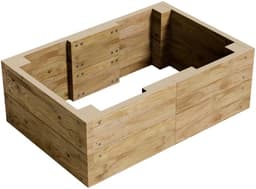
Eco states the wood has not been treated chemically. That is the untreated claim: pallet wood, 120 × 60 × 30 cm, about £44.99, and a shorter life unless you line it or brush something on later. Conka says FSC timber, pressure treated (tanalised), and up to 10 years. No use class is in the file. That is a pressure-treatment claim, not UC4 and not proof of one named product. Quickcrop’s Soil Association line has no certificate number. It is not an organic certificate for the crop, and it is not a use class. The RHS describes new treated wood as suitable for edible crops. A liner is optional on those boards and advised if you apply preservative yourself. Only the 90 × 30 × 15 cm Conka lists a liner in the components. The 180 × 90 cm title names one the components field does not list.

When untreated is the right buy

Untreated pallet wood fits when you want 30 cm without factory preservative and you accept a shorter life. Eco is that kit. One reviewer still wanted a coat of preservative, and two units in one order differed. Five ratings are not a rot trial. If you brush a product on later, line the inner face and keep offcuts out of the fire. A tanalised or Soil Association bullet is not a 15-year guarantee and not arsenic by default. A treated 15 cm kit is still 15 cm. Width and tools are on the wooden raised bed buying guide.

Common questions

Can you grow vegetables in pressure-treated timber bought now?
The RHS describes new treated wood as suitable for edible crops, and the WPA says HSE-approved pre-treatments are not restricted for vegetable beds. That is not a residue test on these seven ASINs, and none of the listings shows a use class. Creosote is a separate, older ban. A liner remains the cautious extra step, and it is the expected step if you apply preservative yourself.
Are railway sleepers legal in a garden bed?
Creosote-treated wood must not be used for growing containers or where frequent skin contact is likely in a garden. The RHS says creosote sleepers are no longer permitted in the garden. Industrial creosote poles stay out. Do not reuse unknown brown sleepers as a salad frame.
Does tanalised mean CCA?
It can mean that in older UK writing. Current Tanalith E-type treatment is copper and organic biocides, not CCA. Conka does not name the product. Do not read arsenic in, and do not read arsenic out, from the word alone on these listings.
What is Use Class 4 in plain words?
It is the ground-contact class under BS 8417. Raised beds sit there in specification notes, with 15 years as the usual desired service life unless 30 years is specified. A kit that only says tanalised or “up to 10 years” has not shown you that class.
What should you do with untreated pallet wood?
Use it if you want 30 cm without factory chemicals, then keep it drier than a sleeper in a ditch. Line it if you later brush on a preservative. Expect a shorter life than a named UC4 board. Eco is the untreated 30 cm kit here, with only five ratings.

Related pages

Sources

Public UK and manufacturer sources, last checked on 20 October 2026.

  1. RHS, How to make a raised bed (retrieved 20 October 2026)
  2. RHS, Growing veg in raised beds (retrieved 20 October 2026)
  3. RHS, Using sustainable materials (retrieved 20 October 2026)
  4. Wood Protection Association, Treated wood and raised beds (retrieved 20 October 2026)
  5. BSW, Specifying, buying and installing UC4 treated timber (retrieved 20 October 2026)
  6. Creosote (Prohibition on Use and Marketing) Regulations 2003 (retrieved 20 October 2026)
  7. House of Commons Library, Creosote and telegraph poles (retrieved 20 October 2026)
  8. Wood Protection Association, Buyer guide to preservative-treated wood (retrieved 20 October 2026)