Independent comparisons. We may earn from shop links. More info

Wooden raised bed buying guide

Updated: 21 October 2026

You are on an allotment path with a tape measure, trying to decide whether a £40 timber kit will grow carrots or only mark a border. This wooden raised bed buying guide is the order to use before you compare star ratings: wall height, width you can reach, the treatment claim, then liner and tools. Prices and the seven amazon.co.uk rows sit on the [wooden raised bed comparison](/hub/raised-beds-greenhouses-and-compost/raised-bed-wood). Peter F. checked those listings and public UK sources on 20 October 2026. There is no lab rot test. A qualifying purchase can earn a commission at no extra cost to you.

You are on an allotment path with a tape measure, trying to decide whether a £40 timber kit will grow carrots or only mark a border.

Our top picks

On this page

What you are buying

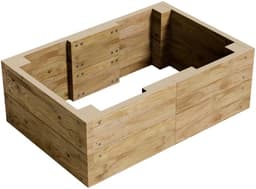
These kits are timber frames that hold soil above the surrounding ground. The floor is the plot you stand them on. A missing boarded base is the design, not a packing error. Drainage lines mean that open underside, not a sealed trough. One Quickcrop review cites a seller suggestion of three 60-litre bags for the 4 ft square, already in the same band as the kit price. Choose the height and the treatment claim before you treat stars as a ranking.

Width and height

The Royal Horticultural Society puts reachable width, without stepping on the soil, under 1.5 m. A bed against a wall must be narrower, because you work from one side. A 60 cm or 90 cm width is comfortable from a path. Quickcrop’s 122 cm square stays inside 1.5 m if you can walk all round it. One Conka listing prints 60 × 120 × 30 cm and 120 × 120 × 30 cm. Until one footprint is live, you cannot apply the reach rule. The RHS uses about 30 cm for salads and strawberries, and 45 cm or more for most other plants. None of these kits reaches 45 cm. Under 30 cm is an edge unless the soil below is already improved. On paving, a 15 cm wall is a herb strip, not a carrot bed.

Treatment and forest mark

Listing words are not a Use Class 4 specification. Eco states the pallet wood has not been treated chemically. That is the untreated claim, and a shorter life in ground contact unless you line the boards or brush on a preservative later. The RHS says to line the wood if you do that yourself. Conka says FSC timber, pressure treated (tanalised), and up to 10 years, with no use class in the file. The Wood Protection Association treats raised beds as ground contact and takes 15 years under BS 8417 as the default desired service life unless 30 years is specified. “Up to 10 years” is the seller. Quickcrop’s Soil Association line has no certificate number. FSC is a sourcing claim, not a rot test. Creosote is on treated or untreated raised bed timber.

Liner, base and tools

None of these kits is tool-free. Conka tells you a power drill and a cordless screwdriver are not included, and it recommends a second person. Eco attaches pre-drilled end planks to sides that already arrive assembled. Quickcrop includes fixings; UK reviews still describe a drill and pilot holes. A liner is in the included components only on the 90 × 30 × 15 cm Conka. The 180 × 90 × 15 cm title names a weed-control liner; the components field does not list it. Do not treat a title word as proof the liner is in the box. The 30 cm Conka family says 6 × 1 inch planks and, in the same sentence, centimetre figures that do not match. Read that as a conflict.

Common questions

How wide can the bed be before you step on the soil?
The RHS suggests staying under 1.5 m if you will not walk on the soil. A 90 cm bed is comfortable from both long sides. A 60 cm bed suits a fence. A 122 cm square is inside that limit if you can walk all round it. Against a wall, cut the width. If two dimension lines disagree, do not guess the reach.
Is 15 cm or 7 inches enough?
It is enough for a shallow edge on already improved soil, or for low herbs. It is not the RHS 30 cm band for salads, and it is not 45 cm for most other plants. Quickcrop is 17.78 cm. Two Conka kits are 15 cm. On paving, that wall is the whole depth. For carrots on poor ground, start at 30 cm and know that 45 cm is still missing.
Does tanalised mean arsenic?
Not on the wording in these files. Current Tanalith E-type treatment is copper and organic biocides, not CCA. Older UK factsheets used “tanalised” for CCA, so the word alone is not proof either way. Conka does not name a use class or a product. Treat “tanalised” here as a pressure-treatment claim, then read the treatment page if you are looking at old sleepers rather than a new kit.
Do you need a liner with factory-treated boards?
Not as a rule in the sources we used. The RHS describes new treated wood as suitable for edible crops and treats a liner as a cautious optional step. A liner is advised when you brush a preservative on yourself. In this comparison, only the 90 × 30 × 15 cm Conka lists a weed-control liner in the components. The 180 × 90 × 15 cm title names a liner that the components field does not repeat.
Why does one Conka listing show two footprints?
The listing titled 60 × 120 × 30 cm also prints 120 × 120 × 30 cm on another item-dimensions line. Both are in the export. You cannot apply the 1.5 m reach rule or a litre estimate until the live page, or the delivered frame, shows one size.

Related pages

Sources

Public UK and manufacturer sources, last checked on 20 October 2026.

  1. RHS, How to make a raised bed (retrieved 20 October 2026)
  2. RHS, Growing veg in raised beds (retrieved 20 October 2026)
  3. RHS, Using sustainable materials (retrieved 20 October 2026)
  4. Wood Protection Association, Treated wood and raised beds (retrieved 20 October 2026)
  5. BSW, Specifying, buying and installing UC4 treated timber (retrieved 20 October 2026)
  6. Creosote (Prohibition on Use and Marketing) Regulations 2003 (retrieved 20 October 2026)
  7. House of Commons Library, Creosote and telegraph poles (retrieved 20 October 2026)
  8. Wood Protection Association, Buyer guide to preservative-treated wood (retrieved 20 October 2026)