Independent comparisons. We may earn from shop links. More info

Plastic vs polycarbonate greenhouse

Updated: October 2026

A plastic vs polycarbonate greenhouse choice is a zip-up tent you can move in an afternoon, or a lean-to that stays on the wall. In the [greenhouse with base comparison](/hub/raised-beds-greenhouses-and-compost/greenhouse-with-base) those are different base patterns as well as different covers. Plastic here means the polyethylene walk-ins and the wider mini. Polycarbonate means the Outsunny lean-to panels, with the SG Traders timber cold frame as a smaller rigid middle. Captures are from amazon.co.uk on 20 October 2026. Products Compared did not lab-test light or wind. A qualifying purchase can earn us a commission at no extra cost to you.

A plastic vs polycarbonate greenhouse choice is a zip-up tent you can move in an afternoon, or a lean-to that stays on the wall.

Our top picks

On this page

What plastic means in this set

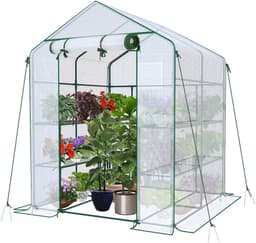
The plastic houses are cloth over a frame, with a skirt or feet rather than a steel rail you bolt down. The square VOUNOT at £44.49 is 143 cm by 143 cm by 195 cm, with a 135 g/m² polyethylene cover. The narrow VOUNOT at £33.49 is 73 cm deep. The Outsunny walk-in at £37.99 is about 72 cm deep and 191 cm high. Zips and tie-down loops fail within a season, and on a concrete yard one frame tried to lift until the hem was weighted. Both VOUNOT sizes share a 4.2 from 1,636 star line. The £17.29 DIVCHI is PVC, a seedling rack.

What the polycarbonate lean-to gives you

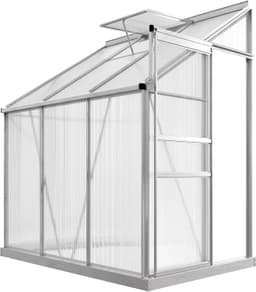
The Outsunny lean-to at £157.69 is about 192 cm wide, 127 cm deep and 214 cm at the peak, 17.3 kg, with an aluminium frame, a galvanised steel base, ground bolts, a sliding door and one roof vent. The bullets tell you to site it on an out-of-wind wall. UK reviewers say two people and a few hours, with picture instructions and parts sometimes mis-labelled or missing. They call the panels thin and tape or silicone them because spring clips were not enough. The star line is 3.6 from 52 reviews, beside 971 on the Outsunny PE walk-in. There is no 10-year life figure in the capture.
VOUNOT VOUNOT square walk-in

Testsieger

VOUNOT VOUNOT square walk-in
8.4/10about £44.49

Light and heat, without a winner on brightness

The Royal Horticultural Society says polycarbonate transmits slightly less light than glass, roughly 83% against about 90%. That comparison is with glass, not with 135 g/m² polyethylene, and this set has no lux reading. One SG Traders buyer found the semi-transparent panels too opaque and swapped two door panels for clear plastic. A zip house heats and cools when you open the door. A lean-to holds air against a wall and overheats at noon if the roof vent stays shut. Neither cover is a heater. Bamworld's stated LED modes, including 3,000 K and 660 nm, are a grow light on PE over timber.

Anchoring is part of the material choice

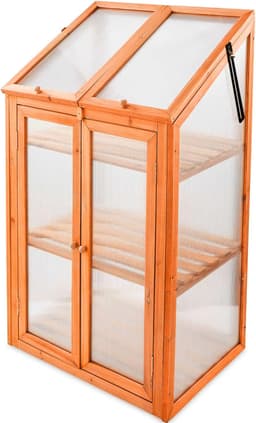
Plastic tents anchor with ropes, nails and a skirt: bury or cover the spare edge on soil, and on paving add bricks, rocks in side pockets, or a grow bag. The lean-to uses ground bolts on a galvanised base against a wall. A skirt method does not transfer to snap-in panels. SG Traders sits between them: hardwood and polycarbonate, about 69 cm by 49 cm and 120 cm high, £79.99, 4.2 from 220 reviews, and no steel rail. At 7 kg it still needs weight, and some buyers cannot line the holes up.

When to choose which

Use the square VOUNOT when you have 143 cm each way and will weight the skirt. Use the narrow VOUNOT or the Outsunny PE house when depth is about 72–73 cm. The extra-wide DIVCHI at £33.29 is a shelf, not a walk-in. Bolt the lean-to if you have a wall and two people to build it. Skip it if you must take the house down for winter. SG Traders is the small rigid frame if you can cope with a DIY assembly and semi-transparent sheets. The buying guide keeps the decision order.

Common questions

Is polycarbonate tougher in wind?
On this lean-to, the panels are rigid and the base is a steel rail with bolts, which is a better starting point than a skirt. The UK reviews still describe lost panels, a blown-off roof and a house wrecked in a storm within days. There is no wind-speed rating. Tougher than an unpegged tent is a fair hope. Storm-proof is not what 52 reviews support.
Will a PE cover last more than one season?
Some buyers keep them and some do not. On the Outsunny walk-in, ties and the zip are described as failing after weeks or a single summer of light use. On the VOUNOT file, stitching at the tie-downs rips. A careful site, a weighted hem and a cover you remove for a named gale improve the odds. The listings do not state a season count.
Which is better on a patio?
A PE mini or narrow walk-in is easier on slabs if you weight the skirt, because you are not drilling a steel base. The lean-to is better on a patio only when that patio meets a wall and you can bolt the rail. A square 143 cm tent needs the space. A 45 cm-deep DIVCHI needs less, and it still needs rocks or bricks.
Do I need a wall for polycarbonate here?
You need a wall for the lean-to, because that is how the listing is designed. You do not need a wall for the SG Traders timber polycarbonate frame, which is freestanding and about 120 cm high. The PE houses are freestanding too. A wall can shelter any of them, and one lean-to reviewer still lost panels in the lee of a 7 ft wall.
Which runs hotter?
Both run hot in sun if you leave them shut. The RHS figure to remember is damage risk above about 27°C without airflow. The tent cools when you open the zip. The lean-to cools when you open the roof vent and the sliding door. Neither listing gives an internal temperature, so do not buy one as the cooler house.
Can I move the plastic one later?
Yes. That is the practical advantage of the PE walk-ins and the DIVCHI minis. Empty the shelves, lift the anchors, and carry a frame in the 6.5–10 kg range. The lean-to is a glazed aluminium house at 17.3 kg with a bolted base. Moving it means a rebuild, which reviewers already found fiddly the first time.

Related pages

Sources

Public UK sources and amazon.co.uk listings, last checked on 20 October 2026.

  1. Planning Portal, Outbuildings (retrieved 20 October 2026)
  2. Planning Portal, Greenhouses and sheds (retrieved 20 October 2026)
  3. RHS, Choosing a greenhouse (retrieved 20 October 2026)
  4. RHS, Ventilation and shading (retrieved 20 October 2026)
  5. Consumer Rights Act 2015, section 11 (retrieved 20 October 2026)
  6. amazon.co.uk listings for the nine ASINs on this page (retrieved 20 October 2026)