Independent comparisons. We may earn from shop links. More info

Greenhouse with base buying guide

Updated: October 2026

You are standing on the patio with a tape measure, and the amazon.co.uk title says greenhouse with base. That phrase does not mean a concrete floor arrives in the box. On the listings compared here, captured on 20 October 2026, it means a galvanised steel rail, metal feet with a bury skirt, or timber legs. This greenhouse with base buying guide puts those patterns in order so you can match footprint, cover and ground before you compare stars. The [greenhouse with base comparison](/hub/raised-beds-greenhouses-and-compost/greenhouse-with-base) holds the nine rows. This page is the decision order. Prices are shelf prices in GBP from those captures. Products Compared editorial team, from those captures. No laboratory test was run. A qualifying purchase can earn a commission at no extra cost to you.

You are standing on the patio with a tape measure, and the amazon.co.uk title says greenhouse with base. That phrase does not mean a concrete floor arrives in the box.

Our top picks

On this page

What with base means on these listings

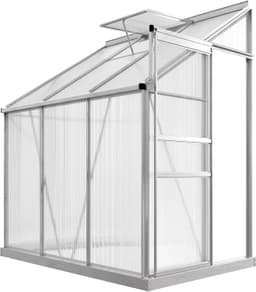
Start by naming the base, because the word is doing four jobs and only one of them is a foundation you can bolt. A galvanised steel base rail shows up on the Outsunny lean-to bullets, with ground bolts and a note to site the house on an out-of-wind wall. That is a metal rectangle under polycarbonate panels, not a poured slab. A metal shelf frame with feet and a longer skirt is the pattern on the VOUNOT walk-ins, the Outsunny polyethylene walk-in and both DIVCHI minis. The Outsunny walk-in spells it out: a 10 cm edge to bury, plus four guy ropes and four ground nails. Timber is the third pattern. Bamworld sells a eucalyptus rack under a polyethylene cover. SG Traders sells a hardwood cold frame with polycarbonate panels, two doors and four vents. The bullets do not describe a steel rail, so read the material line before you assume bolts. None of these kits include ready-mix concrete. If you want a slab, that is a separate job, and listed buildings or a new hardstanding are the point where you call a builder rather than following a zip-tent leaflet. Under the Consumer Rights Act 2015, section 11, goods should match the description. That matters when a title says steel and a reviewer, plus a PP-connector bullet, says the small DIVCHI frame is plastic tube.

Measure the footprint and the boundary first

Measure the strip of ground before you fall for a star rating. The narrow VOUNOT is 143 cm by 73 cm and 195 cm high. The square sibling is 143 cm by 143 cm at the same height, so you need a square of patio, not a path. The Outsunny walk-in is about 141 cm by 72 cm and 191 cm, with a door listed at 160 cm by 85 cm. The extra-wide DIVCHI mini is 105 cm by 45 cm by 160 cm. The cheaper four-tier DIVCHI is only 50 cm by 45 cm by 130 cm. The lean-to is the large rigid footprint: about 192 cm wide, 127 cm deep and 214 cm at the peak. A 73 cm depth fits a side return if you can still open the zip without standing in the border. A 143 cm square does not. One Bamworld reviewer said the photo looks larger than a unit that holds about six seed trays, and the page itself disagrees: bullets claim 22-inch shelves while the dimensions field prints 32 cm by 16 cm by 44 cm. Check that clash against your trays before you treat the picture as the size. Height also sits next to planning rules, even for a cloth tent. The Planning Portal’s outbuildings guidance sets single-storey limits, eaves at 2.5 m, and an overall height up to 4 m with a dual pitch or 3 m otherwise, with tighter rules within 2 m of a boundary. Half the original garden must stay uncovered, and listed buildings or designated land need extra care. These kits sit under those eaves figures, at about 1.3 m to 2.14 m, but a lean-to fixed to a house wall is not the same project as a freestanding mini. Garden buildings under 15 m² of floor area, with no sleeping, are generally outside building regulations, according to the Planning Portal’s greenhouse note. That is not a promise that every plot is permitted development. If the boundary is close, measure before the courier arrives.

Cover, light and the ventilation habit

The cover decides how you open the house on a warm afternoon, and it is the next choice after the footprint. Polyethylene zip covers are the walk-ins and the wider mini. VOUNOT’s bullets specify 135 g/m² high-density polyethylene. DIVCHI’s extra-wide uses a reinforced PE cover with a double-zip door and clips. The small DIVCHI uses clear PVC, and reviewers report tears along the zip if you are rough with it. Polycarbonate appears on two different jobs: thin panels on the lean-to, which reviewers tape or silicone, and semi-transparent sheets on the SG Traders timber frame. The Royal Horticultural Society says polycarbonate transmits slightly less light than glass, about 83% against about 90% in their choosing guide. That comparison is with glass, not with a PE tent, so do not treat 83% as a score against the zip houses. Ventilation is a habit, not a badge. The RHS warns that small houses overheat easily and cites plant damage above about 27°C when air cannot move. Their vent guidance talks about opening area in the region of 15–20% of the floor on a glazed house. A zip tent does not give you that roof-vent ratio. You get a door and, on some models, a mesh window. The square VOUNOT lists two vents. The lean-to lists one roof vent plus a sliding door. If you shut the zip all day in April sun, the cover type will not save the seedlings.

Match the base to lawn, paving or a wall

The ground under the base decides whether the included pegs are useful. Soil and lawn can take the VOUNOT anchors and the Outsunny ground nails, with the skirt buried or weighted. Paving cannot. Reviewers on the shared VOUNOT file describe a concrete yard where the frame tried to lift until the bottom tabs were weighed down, and they put bricks on the door hem. The extra-wide DIVCHI has side pockets that buyers fill with rocks, gravel or a grow bag, and bricks on the bottom shelf. Those are paving methods. Pegs alone are the soil method. The lean-to is the wall case. The bullets say to place it out of the wind and secure it with the included ground bolts. UK reviews on that ASIN still describe panels lost in strong wind and a roof that came off, so bolts are the start of the job, not a storm certificate. There is no wind-speed rating on any listing in this set. If the description and the parts disagree, stop before you plant. The narrow VOUNOT spec line says a plastic frame while the bullets say painted metal. The small DIVCHI title says steel while a reviewer and a connector bullet say plastic. Section 11 is the consumer-rights hook for a description that does not match, not a guarantee that a lightweight cover will survive a gale. Anchoring steps, including what to do on slabs, sit on the how to secure a greenhouse with base page. Once footprint, base type, cover and ground agree, use the main table to read walk-in, shelves, vents and price. A mini at about £17.29 and a lean-to at about £157.69 are different tools. Shared star counts are a trap on the two VOUNOT sizes: both captures show 4.2 from 1,636 reviews and the same opening UK texts, so you should not add them. If you only remember one order, use this. Measure the strip. Name the base. Choose the cover you will actually open on a hot day. Then decide whether the ground is soil, slabs or a wall. Stars come after that, and they are not a structural test.

Common questions

What is included when the title says with base?
In this set it is a steel base rail with ground bolts on the lean-to, a shelf frame with ropes or nails and a longer skirt on the polyethylene walk-ins, or timber legs on the Bamworld rack and the SG Traders cold frame. It is not a concrete floor. Read the bullets for pegs, bolts or a skirt before you assume the kit will sit still on your surface.
Do I need a concrete slab?
Not for these kits. Soil can take pegs and a buried skirt. Paving needs weight on the skirt, pockets or bottom shelf. A slab is your own building job. Call a professional if the plot is listed, the hardstanding is new, or you are adding mains power. The listings do not include concrete.
Will the supplied pegs work on paving?
Pegs and ground nails are for soil. On slabs they have nothing to bite. Buyers in the UK reviews weigh hems with bricks, fill side pockets with rocks or gravel, or sit a compost bag on the base. The lean-to is the exception in the bullets: it names ground bolts, and it still needs a wall line. Peg-only advice from a soil article will not hold a tent on a patio.
How do I tell the two VOUNOT sizes apart?
The narrow page is 143 cm by 73 cm, about 6.5 kg, with four shelves. The square page is 143 cm by 143 cm, about 10 kg, with eight shelves and two vents. Both show the same 4.2 from 1,636 star line in this capture, with the same opening reviews. Buy the footprint that fits, and do not treat that shared count as two independent tests.
Does planning permission apply in a typical back garden?
Often these low kits fall inside permitted development, but the Planning Portal still sets height, boundary and garden-coverage limits, and listed or designated land is stricter. Measure height and distance to the boundary before you order. Under 15 m² and with nobody sleeping inside, building regulations usually do not apply. That is a general rule, not a decision on your plot.
Should I choose polyethylene or polycarbonate at this stage?
Choose polyethylene when you want a light walk-in or mini you can move, and you accept zip wear and extra weight on the skirt. Choose the polycarbonate lean-to when you have a wall and will bolt a steel base, and you have read the 3.6 from 52 reviews. The timber cold frame is a third path: polycarbonate on wood, no steel rail in the bullets.

Related pages

Sources

Public UK sources and amazon.co.uk listings, last checked on 20 October 2026.

  1. Planning Portal, Outbuildings (retrieved 20 October 2026)
  2. Planning Portal, Greenhouses and sheds (retrieved 20 October 2026)
  3. RHS, Choosing a greenhouse (retrieved 20 October 2026)
  4. RHS, Ventilation and shading (retrieved 20 October 2026)
  5. Consumer Rights Act 2015, section 11 (retrieved 20 October 2026)
  6. amazon.co.uk listings for the nine ASINs on this page (retrieved 20 October 2026)