Independent comparisons. We may earn from shop links. More info

How to secure a greenhouse to its base

Updated: October 2026

The box is on the lawn or the patio, the poles are still bagged, and the leaflet says peg down without saying what to do when the ground is slabs. This is how to secure a greenhouse to its base for the kits in the [greenhouse with base comparison](/hub/raised-beds-greenhouses-and-compost/greenhouse-with-base): a skirt and anchors on soil, weight on paving, bolts on the lean-to’s steel rail. Products Compared editorial team, 20 October 2026, from amazon.co.uk listings, UK review texts and Royal Horticultural Society ventilation guidance. There is no lab test and no recommended trench depth, because the listings do not give one. A qualifying purchase can earn a commission at no extra cost to you.

The box is on the lawn or the patio, the poles are still bagged, and the leaflet says peg down without saying what to do when the ground is slabs.

Our top picks

On this page

Before you build, choose the surface and a helper

Secure the house to the surface you will leave it on. Building it on grass and dragging it onto slabs bends the skirt and pulls the pegs out of the plan. Lay the poles out and check the bags before you click anything. A VOUNOT reviewer said the bags are labelled, and that opening them early makes the parts harder to match. Another said the shelves only sit when the bars are pushed fully home. That tip shows up often enough to do it before you load pots. The square VOUNOT is about 10 kg once built, the narrow one about 6.5 kg, the Outsunny walk-in about 7 kg. One person can carry those. The lean-to is 17.3 kg of aluminium and panels, and reviewers call it a two-person job with image-only instructions. Do not start that build in a breeze. A UK reviewer said not to assemble it when it is windy, and to silicone panels straight away because the clips alone did not hold. If a part is missing, stop and contact the seller while you can still describe the unopened bags. A missing shelf clip on the Outsunny is a tie-shaped workaround. A missing polycarbonate sheet on the lean-to is not.

On lawn and soil, use the skirt and the pegs

On soil, the base pattern is the longer edge of the cover plus the anchors in the box. VOUNOT lists four ropes, four ground anchors and a bottom edge slightly longer than the frame. The Outsunny walk-in lists four guy ropes, four ground nails and a 10 cm extended edge to bury. Spread the skirt so it lies flat, then pin the frame. Bury or cover that spare edge so wind cannot get underneath and turn the house into a sail. Reviewers who talk about moderate wind still add weight. One uses bricks on the door hem so the zip stays shut and animals stay out. Another weighed the bottom tabs all the way round after the frame tried to lift while they were still tying it, in wind they put at about 15 mph. Do not invent a standard trench. The pages do not state a depth. A shallow turn of the skirt under the soil, held by the supplied anchors, is as far as the bullets go. If the tie-down tabs are poorly stitched, and reviewers on the VOUNOT file say those points snap and rip the cover, extra pegs through a sound part of the hem are safer than hauling on a torn loop. Guy ropes only work if the stake is in the ground and the rope is tight. A rope coiled on the frame does nothing. Shelf load comes after the frame is pinned. VOUNOT rates shelves at 10 kg each in the bullets. The Outsunny page states a maximum of 15 kg. Mesh on the small DIVCHI bends under heavier pots. Put seed trays on first, not a wet ceramic pot on the top tier of a rack you have not weighted. The Bamworld timber rack needs garden staples or it can blow over. Timber legs are not ballast.

On paving and decking, weight the base instead of pegging

Slabs and deck boards will not take ground nails. If you hammer pegs between slabs you crack the joint and you still have not held the skirt. The paving method in the UK reviews is weight. On the extra-wide DIVCHI, buyers drop flat rocks into the side pockets, or gravel, or they sit a grow bag on the bottom. One buyer put two bricks on the bottom shelf and reported no trouble in stormy weather after that. On the small DIVCHI, a buyer used a bag of compost on the base in a sheltered spot. On the shared VOUNOT file, bricks on the door and weight on the bottom tabs are the concrete-yard fix. Keep the weight low. A heavy pot on the top shelf raises the centre of gravity, and a light PVC rack will topple, which is what one DIVCHI reviewer described. The small DIVCHI’s weight field says 200 g. Ignore that number and feel the parcel. The title says steel, and a reviewer says the poles are plastic, so do not assume the frame will carry ballast without flexing. Decking needs the same low weight, plus a check that feet are not rocking. A shim under a short foot is reasonable. Screwing a cloth tent into deck boards is a modification the leaflet does not describe, and it makes the next move harder. If the site is a wind tunnel between houses, read the wind page before you fill the shelves. Weight stops everyday lift. It is not a named-storm rating.

Lean-to bolts, then ventilation

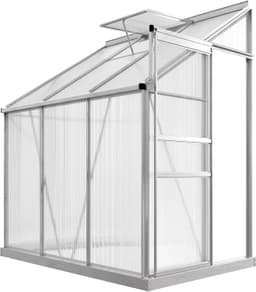
The Outsunny lean-to is the kit whose bullets name a galvanised steel base and included ground bolts, and they tell you to place it against an out-of-wind wall. Set the base square to the wall before you glaze. Reviewers who rushed the frame describe mis-numbered parts, panels filmed on the wrong face, and a sliding door that needed extra holes in the rail. Two people, a few hours, and silicone because the spring clips did not satisfy them: that is the pattern, not a five-minute click-together. Bolting the base to a slab is what the bullets point at. Fixing the frame to the house wall is a separate fixing into your masonry, and the listing does not specify wall plugs or drill sizes. If you are unsure of the wall, or the house is listed, stop and use a builder. One reviewer lost two side panels and part of the door after a day of wind they put at about 45 mph, even in the lee of a 7 ft wall, and then built a bench screwed to the ground. Another said the roof blew off. Bolts reduce that risk. They do not delete it. There is no miles-per-hour figure on the page. A secured house still cooks plants if you leave it shut. The RHS says small greenhouses are easily overheated and points to damage above about 27°C without airflow. On a zip tent, open the door and the mesh window on a bright morning. On the timber cold frame, use the lids. On the lean-to, use the roof vent and the sliding door. Walk the fixings after the first windy night. Look for a skirt that has pulled out, a tie that has snapped, and a shelf bar that has walked out of its joint. If a named gale is forecast, take the cover off a polyethylene house rather than hoping the pegs you added on Sunday will do a job the listing never claimed.

Common questions

Do I only trench the skirt on a lawn?
Bury or cover the spare edge on soil, using the anchors in the box. The listings do not give a trench depth, so do not copy a forum figure as if it were a standard. On paving there is nothing to trench. Use bricks, rocks in pockets, or a grow bag on the bottom instead.
How tight should the cover be?
Tight enough that the cloth does not flap against the shelves, and loose enough that you are not tearing the zip hem to force a corner. VOUNOT reviewers who could not fit shelves found the bars were not seated. Press those joints first, then tension the cover. A flapping door is a weight problem on the hem, not a reason to overstretch the zip.
When should I open the door?
On sunny days, including bright spring mornings, because small houses overheat. The RHS cites damage risk above about 27°C when air cannot move. Open the zip or the mesh window while you are around to close it if the weather turns. A closed tent in full sun is a heat problem even when the base is well pegged.
Can I bolt the lean-to to my wall?
The bullets tell you to site it against an out-of-wind wall and to use the included ground bolts on the steel base. They do not specify wall fixings. Bolt the base to a suitable slab or foundation. If the house wall needs anchors and you are not confident, use a professional, especially on a listed building. Do not glaze it in the wind.
The shelves wobble. What should I do before I load them?
Seat every horizontal bar fully. The VOUNOT review tip is that shelves fail to fit when the bars are not pushed in. On the extra-wide DIVCHI, the bottom poles have to be home before the upper shelves will stand. On the small DIVCHI, mesh bends under heavy pots, so keep the load to trays. Check the joints again after the first move.
Should I remove the cover before a named storm?
Yes for a polyethylene walk-in or mini if the forecast is a named gale and the house is only pegged or weighted. Reviewers describe torn zips and lifted frames in ordinary wind, and no listing here states a wind speed. The lean-to is a panel kit: you cannot pocket the cover, so check bolts and be ready for panels to need silicone.

Related pages

Sources

Public UK sources and amazon.co.uk listings, last checked on 20 October 2026.

  1. Planning Portal, Outbuildings (retrieved 20 October 2026)
  2. Planning Portal, Greenhouses and sheds (retrieved 20 October 2026)
  3. RHS, Choosing a greenhouse (retrieved 20 October 2026)
  4. RHS, Ventilation and shading (retrieved 20 October 2026)
  5. Consumer Rights Act 2015, section 11 (retrieved 20 October 2026)
  6. amazon.co.uk listings for the nine ASINs on this page (retrieved 20 October 2026)