Independent comparisons. We may earn from shop links. More info

Gabion vs wooden raised bed

Updated: 21 October 2026

You are choosing between a stone cage and a timber kit for the same rectangle of border, and the gabion page looks cheaper until you add the rock. Gabion vs wooden raised bed is a choice about weight, drainage and whether you want a stone face, not about which material wins a test. Peter F. set the six amazon.co.uk gabion cages from the [gabion raised bed comparison](/hub/raised-beds-greenhouses-and-compost/gabion-raised-bed) against that decision. On 20 October 2026 those empty cages cost about £33.90 to about £165.23, and none included stone, a liner or compost. There was no decay trial. A qualifying purchase can earn a commission at no extra cost to you. If the stone face is the point, start with the [best gabion raised bed](/hub/raised-beds-greenhouses-and-compost/gabion-raised-bed/sub/gabion-raised-bed-best) shortlist. If a lighter kit is the point, use the [wood raised bed comparison](/hub/raised-beds-greenhouses-and-compost/raised-bed-wood).

You are choosing between a stone cage and a timber kit for the same rectangle of border, and the gabion page looks cheaper until you add the rock.

Our top picks

On this page

Two products that both get called a bed

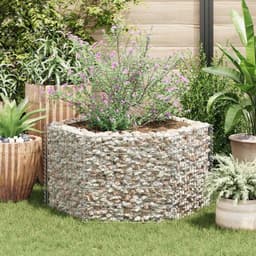
A wooden raised bed is a frame you fill with soil. A gabion raised bed is a wire basket you fill with stone for the walls and, separately, with soil for the plants. The amazon cages in this set are empty. Relaxdays at about £33.90 gives you a 30×100×30 cm basket, 4 mm wire, spirals and spacer hooks. BOWEKAM at about £50.15 gives you a 40 cm cube with 3.5 mm wire and a 10×5 cm mesh. Gawany at about £68.60 gives you a hex with an inner cavity printed at 80×70×50 cm. The generic run at about £165.23 is 360×90×50 cm of welded steel with no inner size. A timber kit in the same footprint usually arrives as boards and fixings, and you are not also buying a fraction of a tonne of rock. That difference is the whole comparison. Galvanised wording on a cage is not a dated lifespan, and timber life depends on the species, the ground contact and the stain, which this gabion file does not measure.

Drainage, summer watering and the soil you add

The stone face drains freely, which is the gabion’s real advantage on a plot where water sits, including heavy clay, if you also use a free-draining mix in the core. The cage does not break a pan in the ground underneath, and it does not feed the plants. You still fit a permeable geotextile so compost does not wash into the rock. A solid sheet will waterlog the bed, gabion or not. Because the face is open, the soil dries faster in a warm spell than it does behind a close-boarded timber wall, so you water more often in summer. The RHS raised-bed guidance is about depth and soil for vegetables generally. It is not a gabion specification. Depth still decides the crop. Gawany’s inner 50 cm is a workable vegetable depth if the liner holds. LLEZKBR’s inner line of 70×10×10 cm is about seven litres, which loses to almost any wooden kit sold as a bed. A 30 cm Keketa cube is a herb block once the stone has taken its share, not a potato bed. On clay, choose the gabion when you want that fast face and you can build the mix. Choose wood when you want soil volume without importing rock.

Cost, weight and how long the face stays honest

The cage price is the decoy. A rule of thumb is 1.6–1.8 tonnes of angular stone per cubic metre of stone volume, plus 5–10% waste, from trade calculators, not from a quote. Gawany’s printed shell is about 0.17 m³, roughly 0.3 tonnes before waste. The 360 cm generic cage is 1.62 m³ on the outside alone, which is a handling project before you have priced the timber alternative. HSE guidance does not give one safe lifting weight, and a bulk bag is a worse job than carrying a few scaffold boards. Wire can twist. One of two UK reviews on the Gawany hex said the wire was flimsy and needed extra wire once the weight was in. Spacer hooks, included with Relaxdays, are there to limit bulging, and they are not on every listing. Timber rots, cups and stains, and it is quieter to alter if you want to raise a board next year. A gabion is awkward to unpick once the stone has locked. Do not read rust-proof on a bullet as a 50-year claim. No cage here shows a certificate to BS EN 10223-8.

When the wooden kit is the simpler buy

Choose the gabion if you want the stone look, the site is flat, the cage states wire or mesh, and you can move the rock or you are happy with one small cube. Relaxdays is the top pick in the gabion table for a short wall because the 4 mm wire and the braces are stated, with the limit that the mesh is not. BOWEKAM is the best value cube because the 10×5 cm mesh lets you order stone that will stay in. Choose wood if you are on your own, you want vegetables in a deep box this weekend, or the only gabion you like hides both wire and mesh. A low 10 cm cage is not a substitute for a wooden bed. A retaining job is not a substitute for either catalogue product: if the structure holds a bank or sits on a boundary, the Planning Portal rules in England and the Party Wall etc. Act 1996 in England and Wales can apply, and Scotland, Wales and Northern Ireland do not copy those English height figures. Get a designer for a level change rather than a taller amazon cage. For a straight planter on level ground, wood is the simpler buy whenever the stone face is optional.

Common questions

Is a gabion better than wood on clay?
It drains faster through the stone face, which helps if water sits against a solid timber wall, but only if the soil in the core is a free-draining mix and a permeable liner is in place. The cage does not fix compacted clay under the bed. Wood is lighter and gives you more soil for the same weekend. Pick the gabion for the face and the drainage, not as a cure for the ground.
Which costs more once it is finished?
The cage is often the smaller bill. These baskets were about £33.90 to about £165.23 empty on 20 October 2026. Stone at about 1.6–1.8 tonnes per cubic metre of wall volume, plus liner and compost, can overtake a small timber kit, especially on the 360 cm run. A single 40 cm cube stays closer to a modest extra. That tonne rate is a rule of thumb, not a merchant’s price.
Which lasts longer, gabion or wood?
Nobody in this file has run that test. Galvanised wording is not a dated life, and one UK review already reported twisted wire on the Gawany hex during filling. Timber fails by rot and weather at the soil line, which depends on the board and the ground. Choose on drainage, weight and looks, and ignore any rust-proof-for-decades line that the listing does not support with a certificate.
Can I use a gabion where I would have used a wooden kit?
Yes on flat ground, if the inner cavity is deep enough and you accept the stone work. Gawany’s inner 80×70×50 cm is in range for a planted bed. LLEZKBR’s 10 cm inner depth is not. You will water a gabion more in summer than a close timber box, because the face is open. If you wanted a Saturday assembly with no bulk bag, stay with wood.
Do I need planning permission for either?
A low freestanding bed inside the garden is usually a different case from a boundary wall, in both materials. In England the Planning Portal’s limits for fences and walls are 1 m beside a highway and 2 m elsewhere, with exceptions for listed sites and local conditions. A gabion that retains soil can count as engineering. Scotland, Wales and Northern Ireland set their own rules, so ask the council rather than copying England.
Which should I buy if I want the least hassle?
Buy a wooden kit if the stone face is optional and you want soil volume without a tonne bag. Buy a gabion only when the look is the reason and the listing states wire or mesh, then add liner and angular stone larger than the holes. The Relaxdays cage is the strongest short-wall spec in this gabion set, and it is still an empty basket at about £33.90, not a finished bed.

Related pages

Sources

Public UK sources and the six amazon.co.uk listings, last checked on 20 October 2026.

  1. Planning Portal, Fences, gates and garden walls (retrieved 20 October 2026)
  2. Planning Portal, Building regulations for fences and walls (retrieved 20 October 2026)
  3. GOV.UK, Party Wall etc. Act 1996 explanatory booklet (retrieved 20 October 2026)
  4. HSE, Manual handling in construction (retrieved 20 October 2026)
  5. BSI, BS EN 10223-8:2013 welded mesh gabion products (retrieved 20 October 2026)
  6. TradeCalculator, Gabion wall calculator (retrieved 20 October 2026)
  7. Garden UK, Gabion building guide (retrieved 20 October 2026)
  8. RHS, Vegetables: raised beds (retrieved 20 October 2026)