Independent comparisons. We may earn from shop links. More info

How to fill a gabion raised bed

Updated: 21 October 2026

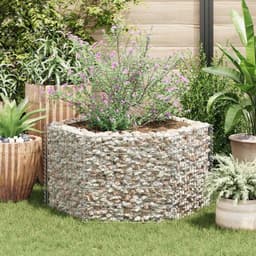
You have the flat-pack cage on the lawn and you are about to tip compost in first, which lets soil leak through the face. How to fill a gabion raised bed is a set order: square the basket, brace it, pack the stone faces, then line the inside and add a free-draining mix. Peter F. took that sequence from the six amazon.co.uk cages in the [gabion raised bed comparison](/hub/raised-beds-greenhouses-and-compost/gabion-raised-bed) and from public UK guidance. There was no demonstration bed. A qualifying purchase can earn a commission at no extra cost to you. None of these cages includes stone or membrane. Match the rock to the hole on the [gabion stone fill](/hub/raised-beds-greenhouses-and-compost/gabion-raised-bed/sub/gabion-raised-bed-stone-fill) page before you open the bags.

You have the flat-pack cage on the lawn and you are about to tip compost in first, which lets soil leak through the face.

Our top picks

On this page

Square the cage before any soil

Lay the panels on a flat, firm patch and join them the way the box allows. Relaxdays is the only set here that states the method: spiral connectors, spacer hooks, and a tool-free claim. You still want gloves, because cut ends are sharp. Gawany’s listing says so and also suggests safety shoes. Work on level ground. A cage that rocks will open a gap at the base once the stone arrives. If the listing says assembly is required, as LLEZKBR does, do not treat the lid or the clips as optional. LLEZKBR’s page says 90×30×10 cm in one place and 40 mm in another, so measure the steel you received. Its inner line of 70×10×10 cm will not take a vegetable crop. What the listing should have printed for wire and mesh is in the gabion raised bed buying guide.

Stone the faces, then add the liner

Pack angular stone into the outer faces first, and keep the pieces larger than the mesh. Where the opening is printed, use it. BOWEKAM states 10×5 cm, so stone needs to sit well above 100 mm or it walks out through the grid. Where the mesh is missing, which is every other cage in this set, measure a hole with a ruler before you accept a delivery. Hand-place the visible face so the stones lock. Rounded cobbles roll and push light wire outwards. Spacer hooks, where you have them, tie the faces together so the basket does not belly. A UK review on the Gawany hex, one of only two, said the wire twisted under the weight and needed extra wire. That is the failure you are trying to avoid by bracing as you go, not after the cage has already bowed. When the stone shell is stable, lay a permeable geotextile on the inner face, up the sides, with enough lap that soil cannot find a gap. Do not use a solid plastic sheet. It traps water against the steel and leaves the bed sour. No listing here supplies that membrane.

Soil, water and the first month

Fill the lined core with a free-draining mix, not pure clay from the hole you dug. The open stone face will shed water quickly, which is useful on a wet plot and thirsty in a hot spell, so plan to water more often than you would a solid timber box in July. The RHS talks about raised beds as a way to set soil depth and drainage. It does not specify gabion cages, so do not treat a gabion as a special vegetable system. Depth still rules the crop. Gawany’s inner cavity is stated at 80×70×50 cm, which gives you a real root run if the liner stays put. A 30 cm Keketa cube is much smaller once the stone face has taken its share, and the inner size is not printed. Leave the soil a little below the rim so water does not wash mix over the stone. After the first heavy rain, look for fines in the gravel and for a face that has bowed. A slight settle is normal. A twisted vertical wire, as in that Gawany review, means the brace was late or the wire was light. You can add ties on a low planter. You should not keep loading a cage that is already distorting.

When you stop and call someone

Stay with a hand-packed planter on flat ground, around the 30–50 cm heights in this set, if you can lift the bags without a struggle. HSE manual-handling guidance does not name one safe weight for every person. A bulk bag and a 360 cm run are a different job from a 2.5 kg empty cube. Stop and use a designer if the cage must hold back a bank, if you are changing levels, if you are excavating near a neighbour’s foundations, or if both wire and mesh are unstated on a tall face. Garden gabion guides often cite about 600 mm as a working height. That is editorial, not a standard, and it is a sensible point to get help if the listing also hides the wire. In England, Planning Portal enclosure limits are 1 m beside a highway and 2 m elsewhere, with exceptions, and a retaining gabion is not automatically permitted development. Those figures are England’s. If you are in Scotland, Wales or Northern Ireland, ask the local authority rather than copying them. Gloves stay on until the last clip is turned in.

Common questions

What order should I fill a gabion planter?
Assemble and brace the cage, pack angular stone into the faces so nothing can pass the mesh, then fit a permeable geotextile on the inside and add a free-draining soil mix. Compost first blocks the stone and leaks through the grid. None of the six cages compared here includes the rock or the liner, so both are on your list before the day you build.
Do I need a geotextile liner?
Yes, if the middle of the cage is for plants. The membrane keeps compost out of the stone while still letting water leave. A solid sheet does the opposite and waterlogs the bed. Every amazon.co.uk listing in this set omits the liner, including the Relaxdays box that otherwise lists spirals and hooks. Buy the membrane to the inner face area, not to the outer slogan size.
Why did the wire twist on a filled cage?
The stone load bends light wire, especially if you have no spacer ties and you drop the rock in from a height. One UK review of the Gawany hex said the wire was flimsy, twisted, and needed extra wire. Bracing as you pack, and stone larger than the mesh, reduces that. It will not turn an unstated thin wire into a retaining wall.
Can I plant vegetables straight into the stone?
No. Vegetables need the lined soil core, not the rock face. Use the inner dimensions. Gawany prints 80×70×50 cm inside. LLEZKBR prints 70×10×10 cm, which is only about seven litres and will not support a crop. If the inner size is missing, measure the cavity after the stone face is in, before you buy compost.
How do I lift the stone safely?
Split the delivery into loads you can actually carry, keep the bag close to your body, and do not twist while you hold it. The HSE does not publish one safe kilogram for every adult. A 40 cm cube is a short job. A 3.6 m run at roughly 1.6–1.8 tonnes of stone per cubic metre of fill volume is not a one-person afternoon, and that tonne figure is a rule of thumb, not your quote.
When should a professional take over?
Call someone when the gabion retains soil, changes a level, or sits on soft or sloping ground, and when you would be digging near foundations or a boundary. A flat 30–50 cm planter you can brace by hand is the DIY case in this comparison. Unstated wire on a tall run is a reason to stop, not a reason to buy a bigger cage and hope.

Related pages

Sources

Public UK sources and the six amazon.co.uk listings, last checked on 20 October 2026.

  1. Planning Portal, Fences, gates and garden walls (retrieved 20 October 2026)
  2. Planning Portal, Building regulations for fences and walls (retrieved 20 October 2026)
  3. GOV.UK, Party Wall etc. Act 1996 explanatory booklet (retrieved 20 October 2026)
  4. HSE, Manual handling in construction (retrieved 20 October 2026)
  5. BSI, BS EN 10223-8:2013 welded mesh gabion products (retrieved 20 October 2026)
  6. TradeCalculator, Gabion wall calculator (retrieved 20 October 2026)
  7. Garden UK, Gabion building guide (retrieved 20 October 2026)
  8. RHS, Vegetables: raised beds (retrieved 20 October 2026)