Independent comparisons. We may earn from shop links. More info

Gabion stone size fill UK

Updated: 21 October 2026

You are about to order a bulk bag, and the cage listing never says how wide the holes are. Gabion stone size fill UK comes down to one rule: every piece that sits in the face must be larger than the mesh, or it falls out the first time you brush past it. Peter F. checked the six empty cages in the [gabion raised bed comparison](/hub/raised-beds-greenhouses-and-compost/gabion-raised-bed), priced from about £33.90 to about £165.23 on 20 October 2026. None includes stone. The figures below use listing dimensions and a trade-calculator rule of thumb, not a quarry quote and not a lab fill. A qualifying purchase can earn a commission at no extra cost to you. Angular stone in the 100–200 mm range is the size garden gabion guides usually describe, and that range still has to clear your actual hole. The build order after the stone arrives is in [how to fill a gabion raised bed](/hub/raised-beds-greenhouses-and-compost/gabion-raised-bed/sub/gabion-raised-bed-how-to-fill).

You are about to order a bulk bag, and the cage listing never says how wide the holes are.

Our top picks

On this page

Measure the hole before you buy the tonne

Stone sizing starts with the aperture printed on the listing, not with a generic gabion-rock advert. In this set only the BOWEKAM 40 cm cube states a mesh, at 10×5 cm, with 3.5 mm wire, at about £50.15. A 10 cm hole needs angular stone comfortably above 100 mm. A 100 mm pebble is the same size as the opening and will work its way through. Relaxdays states 4 mm wire and ships spacer hooks, which helps the face stay put, but it does not state the mesh, so you measure a panel with a ruler when it arrives and only then you order. Keketa, Gawany, LLEZKBR and the 360 cm generic run also omit the opening. Guessing from a photo is how you pay for a second bag. If both wire and mesh are missing on a tall cage, treat that as a reason to choose a different basket, not as a puzzle to solve with smaller gravel. Gravel is for paths. It pours through garden gabion mesh. What else the product page should print is in the gabion raised bed buying guide.

Angular stone, tonnes and waste

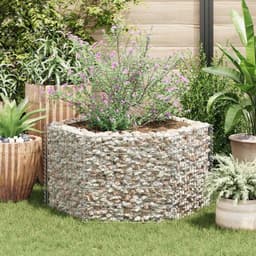
Use angular rock that locks, not rounded cobbles that roll and shove the wire. Garden guidance aimed at UK gabions often points at 100–200 mm angular stone. That is an editorial range, not a British Standard, and it only works when your mesh is smaller than the stone you picked. A trade calculator’s rule of thumb is about 1.6–1.8 tonnes per cubic metre of stone volume, plus 5–10% for waste and for pieces you reject at the face. It is not a price, and it is not the weight of a planted bed, because the middle is soil. Worked on Gawany’s printed sizes, the outer 100×90×50 cm block is about 0.45 m³ and the inner 80×70×50 cm cavity is about 0.28 m³. The difference, about 0.17 m³, is the shell if both lines are true. At 1.7 tonnes per cubic metre that shell is roughly 0.3 tonnes before waste, so a small bulk bag can cover one hex and will not cover two. The same sum on a solid 40 cm cube, 0.064 m³, is only about 0.11 tonnes if you filled the whole box with stone, which you should not do if you want to plant it. Measure the stone cavity you actually build.

What each cage in this set implies

BOWEKAM is the only basket here you can size from the page: 10×5 cm mesh, so stay well above 100 mm and keep the stone angular. Relaxdays, at about 30×100×30 cm and about £33.90, is a small outer volume of about 0.09 m³. Even if you wrongly filled it solid you would be under 0.2 tonnes at 1.7 tonnes per cubic metre. As a planter the stone share is less, and you still cannot order until you have measured the unstated mesh. The generic 360×90×50 cm run is 1.62 m³ outside. Without an inner size, a solid-fill sketch at 1.7 tonnes per cubic metre is about 2.8 tonnes, which tells you the handling problem and does not tell you the planting split. Do not buy that stone until you know the hole. LLEZKBR’s inner line of 70×10×10 cm is about seven litres of soil. Any serious rock face would erase that trough, so it is a poor candidate for a tonne bag. Keketa’s 30 cm cube has no mesh line at all. One UK review on Gawany already recorded wire twisting under fill weight. Oversized stone in a light, unbraced face makes that worse. Spacer hooks, where the box includes them, matter as much as the rock.

Weight, waste and the bag you should refuse

Add the 5–10% waste before you book the merchant, because broken faces and pieces smaller than the mesh cannot go in the visible grid. You will also want a few larger stones for the corners, where the basket is most likely to open. HSE manual-handling advice does not set one safe weight for every person. A 25 kg sack is a different task from a bulk bag that arrives on a pallet at the kerb. Plan the last metre from the drive to the cage before you pay. Refuse rounded decorative cobbles for the structural face, refuse anything that passes the mesh in your hand, and refuse a solid plastic liner as a substitute for sorting the stone. The liner is a separate permeable sheet so soil stays out of the rock. It does not hold the stones in. If the finished cage must retain a bank, the stone mass and the design do that job, not the mesh pattern on its own, and that is the point where a designer should specify the fill. For a flat planter, your check is simpler: one stone in your hand, one hole on the cage, and the stone is clearly larger.

Common questions

What size stone fits a gabion mesh?
The stone in the face must be larger than the opening, with a margin so it cannot turn and drop through. BOWEKAM’s stated mesh is 10×5 cm, so angular pieces well above 100 mm match that hole. A common garden range of 100–200 mm is a guide from UK gabion articles, not a standard, and it fails if your mesh is wider than the stone. If the listing hides the mesh, measure it before you order.
How many tonnes fill a gabion basket?
Use about 1.6–1.8 tonnes per cubic metre of the stone volume only, plus 5–10% waste. That is a trade-calculator rule of thumb, not a delivered price. On Gawany’s stated outer and inner sizes the shell is about 0.17 m³, or roughly 0.3 tonnes before waste. Do not multiply the whole outer box if the centre is soil. The 360 cm generic cage has no inner size, so you cannot finish that sum from the listing.
Are stones included with amazon gabion beds?
Not in this comparison. The six cages, from about £33.90 to about £165.23 on 20 October 2026, are empty steel. Relaxdays lists the basket, spirals and hooks and excludes stone. Other bullets tell you to add rocks or simply never mention them. The stone ticket is often higher than the cage once you leave the smallest cubes.
Is rounded cobble all right in a planter?
It is a poor face stone. Rounded pieces roll, leave gaps, and push outward on light wire. One UK review of the Gawany hex already described twisting under the load. Angular 100–200 mm rock locks together, provided it is bigger than your mesh. Keep cobbles for a path if you like the look, and build the cage with stone that cannot escape.
Can I use gravel to save money?
Gravel pours through the openings on these garden cages. A 10×5 cm mesh, the only opening printed in this set, will not hold it. You would also lose the lock that angular stone gives the face. Buy the size that stays in the grid. A cheaper bag that falls out is not a saving once you sweep it up and order again.
How much extra should I allow for waste?
Allow about 5–10% on top of the tonne figure for broken pieces, dust and stones that are too small for the face. Pick those rejects out as you pack rather than forcing them into the grid. On a single 40 cm cube the extra is a few handfuls. On a 3.6 m run it is a meaningful part of a bulk bag, and it is still not a quote until a merchant prices the grade you measured for.

Related pages

Sources

Public UK sources and the six amazon.co.uk listings, last checked on 20 October 2026.

  1. Planning Portal, Fences, gates and garden walls (retrieved 20 October 2026)
  2. Planning Portal, Building regulations for fences and walls (retrieved 20 October 2026)
  3. GOV.UK, Party Wall etc. Act 1996 explanatory booklet (retrieved 20 October 2026)
  4. HSE, Manual handling in construction (retrieved 20 October 2026)
  5. BSI, BS EN 10223-8:2013 welded mesh gabion products (retrieved 20 October 2026)
  6. TradeCalculator, Gabion wall calculator (retrieved 20 October 2026)
  7. Garden UK, Gabion building guide (retrieved 20 October 2026)
  8. RHS, Vegetables: raised beds (retrieved 20 October 2026)