Independent comparisons. We may earn from shop links. More info

Compost tumbler vs compost bin

Updated: October 2026

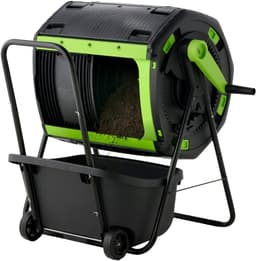
You are in the garden with a caddy of peelings, and you are not sure a drum is the right machine. Compost tumbler vs compost bin is a choice between a closed barrel you will turn, and a cheaper bin or bay that holds more and sits on the soil. If you do want a drum, the six are on our [drum composter comparison](/hub/raised-beds-greenhouses-and-compost/drum-composter). By the end you should know when the tumbler earns its price, and when a ground bin, a wormery or a hot box is the better tool. A purchase through our links can earn a commission at no extra cost to you.

You are in the garden with a caddy of peelings, and you are not sure a drum is the right machine.

Our top picks

On this page

What each machine is for

A ground bin or a bay is for volume. The Royal Horticultural Society treats heaps, bays, plastic bins and tumblers as legitimate, and says bins under about 1 cubic metre are less efficient and still work. A tumbler is for turning without a fork, on a hard surface. Garden Organic calls it a batch you stop at about half full, off the ground. In this set that is 130–180 litres at £54.99–£65.99, or £299.00 for the crank.

Speed is mostly the work, not the shape

Garden Organic’s range is the honest clock. Work at a heap and you might see compost in six to eight weeks. Leave it, and a year or more is common, plus a month or two to mature. New Forest District Council’s figure for an ordinary home bin is about nine months. The Moutta bullets say the right conditions in two weeks with regular stirring. The 140 litre Squeeze master says 4–6 weeks in hot sun with a balanced mix. The mix and the half-full stop are on how to use a compost tumbler.

Rats, cooked food and a patio

A raised drum changes rats and paving. Carry on Composting says an enclosed tumbler off the ground will usually keep rats out, and that lighter drums can be knocked over. None of these six listings includes a rodent test. The detail is on rats and a compost tumbler. Cooked food, meat and dairy point at a different machine. Garden Organic treats insulated boxes, naming Green Johanna, Hotbin and Aerobin, as another job, and their account of those boxes includes cooked food and dairy on a scale of about 12 weeks. A £55 plastic drum is not that box.

When to buy which

Buy a tumbler if you will turn it, you need it off the ground because of rats or because you only have paving, and you accept about £55–£66 for 130–160 litres or £299 for the crank in this set. Buy a static bin or a bay if you want volume and you will rarely turn anything. This page does not rank the six.

Common questions

Is a tumbler faster than a compost bin?
It can be, if you turn it and you stop adding to a batch. Garden Organic’s six to eight weeks is the worked end of the range, and a year or more is the neglected end. New Forest’s ordinary home bin is about nine months. Claims of two weeks, or 4–6 weeks in hot sun, belong to the seller. A tumbler you never turn will not beat a Dalek you actually tend.
Is a tumbler better for rats?
It is often harder for a rat to enter, because the drum is closed and off the soil. Carry on Composting says an enclosed tumbler off the ground will usually keep rats out, and that lighter drums can be knocked over. None of these six listings includes a rodent trial. Meat, bread and cooked food can still draw rats into the garden. If they are already in the house, a new bin is the wrong first call.
Can a tumbler take cooked food the way a hot bin can?
Keep cooked food, meat, fish and dairy out of an ordinary tumbler in this set. New Forest tells households to leave them out. Garden Organic places cooked food and dairy with insulated boxes such as a Hotbin, Green Johanna or Aerobin, a different method in their account, on about 12 weeks. A drum at £54.99–£65.99 is not an insulated hot box, and this page does not claim those temperatures for it.
What if I will not go out and turn it?
Buy the ground bin. The tumbler’s advantage is the turn you do instead of forking. If that turn will not happen, you have a closed box of 130–180 litres that still needs a sensible mix and still costs from £54.99 here. A bay or a Dalek holds more, costs less where a subsidy applies, and tolerates being ignored. You will get compost more slowly, without rolling a barrel that is too heavy to move.
I only have a patio. Is a tumbler the answer?
It is a strong candidate. A heap needs soil and a fork, and a patio has neither. You still have to turn the drum once it is wet, and you still have to live with the door and the space. In this set only the 140 litre listing mentions a balcony. If the patio produces almost no garden waste, a wormery may fit better than a 160 litre drum you cannot fill.
Is a £10 council bin the same job as a £55 tumbler?
Southwark’s subsidised bins from £10 are static compost bins. The cheapest tumbler in this set is £54.99 for a 160 litre dual-chamber drum you can turn, on a frame. You are paying for that raised barrel, often with a second chamber. Volume and a low price point back to the council bin. Turning on a hard surface points to the tumbler.

Related pages

Sources

Public UK sources from the research digest. Prices, stars and review counts are the amazon.co.uk figures in this set of six listings.

  1. RHS — Composting (retrieved 17.10.2026)
  2. Garden Organic — Different composting methods (retrieved 17.10.2026)
  3. GOV.UK — Animal material in home compost (retrieved 17.10.2026)
  4. GOV.UK — Simpler recycling in England (retrieved 17.10.2026)
  5. New Forest District Council — Home composting (retrieved 17.10.2026)
  6. WRAP — Home composting (retrieved 17.10.2026)
  7. REAL — PAS 100 (retrieved 17.10.2026)
  8. Test Valley Borough Council — Rats and mice (retrieved 17.10.2026)