Independent comparisons. We may earn from shop links. More info

Rats and a compost tumbler

Updated: October 2026

The ground bin on the allotment has been dug over, or you have seen a rat along the fence, and a drum is the fix you are considering. Rats in a compost bin tumbler is a smaller question than the adverts suggest. A closed drum off the soil is harder to enter than an open heap. It is still a plastic bin on a frame, and food smells do not stop at the hatch. The six drums are on our [drum composter comparison](/hub/raised-beds-greenhouses-and-compost/drum-composter). A purchase through our links can earn a commission at no extra cost to you.

The ground bin on the allotment has been dug over, or you have seen a rat along the fence, and a drum is the fix you are considering. Rats in a compost bin tumbler is a smaller question than the adverts suggest.

Our top picks

On this page

Why a compost heap draws rats

Rats come for food and for cover. Test Valley Borough Council, on a page updated on 11 August 2026, says an enclosed lidded bin beats an open heap, and tells households to keep meat, fish, dairy, bread and cooked food out. The same page wants the bin in the open, away from cover, rather than in a corner a rat can travel. First Tunnels says a fully enclosed bin, or a tumbler off the ground, is one tactic, and food smells still bring rats into the garden.

What a raised drum changes

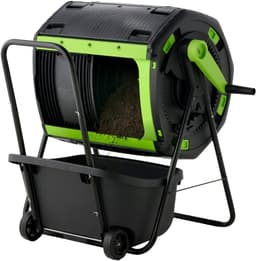
The useful change is physical. The sides are closed, and the compost is not sitting on soil a rat can tunnel through. Carry on Composting says an off-ground enclosed tumbler will usually stop rats getting into the compost, and that lighter drums can be knocked over, cost more, and are harder to run. Usually is the limit. None of the six amazon.co.uk drums in this set has a rodent test in the file. The Moutta title says anti-rodents. That is a seller’s line on B0C2PTPRR3 at £299.00, with no test in the file and no UK review text. Other reasons to buy, or not to, are on compost tumbler or compost bin.

What still has to stay out, and where it stands

Meat, fish, dairy, bread and cooked food stay out. That is the Test Valley list, and it matches the rat-relevant part of New Forest’s rules and the GOV.UK caution on catering waste. Potato peelings and fruit are normal compost, and they still attract rats once a rat can reach them. Stand the drum in the open, away from the fence, the shed and any stack of timber. Test Valley wants open ground. The mix is on how to use a compost tumbler.

When you need more than a new bin

Rats in the house, or a nest under the shed, are a pest-control job. A new tumbler does not clear an infestation that has moved inside. Call the council pest service or a contractor when you are seeing rats in the building. Anti-rodent on the Moutta is a £299.00 title claim, with no test and no UK review text. The drum is the harder entrance.

Common questions

Will a compost tumbler keep rats out?
A closed drum off the ground is harder to enter than an open heap or a bin on the soil. Carry on Composting says an enclosed tumbler off the ground will usually stop rats getting into the compost. Usually is the working word. Lighter drums can be knocked over, and food smells still draw rats into the garden, which is First Tunnels’ point. None of these six listings includes a rodent test, and a single UK review is not a pass rate.
Does “anti-rodents” on the Moutta mean it was tested?
The words are on the Moutta title, B0C2PTPRR3, a £299.00 double-cell drum with a crank and a collector truck. The file contains no rodent test, and the written reviews are marked Belgium, Spain, France and Germany. A title can say anti-rodents without a trial on UK rats, allotment fences or a winter of kitchen waste. The crank and the truck are on the listing. The rodent line is not a test.
What must I stop putting in if rats are already about?
Stop adding meat, fish, dairy, bread and cooked food. Test Valley lists those, and New Forest’s home-composting rules point the same way for an ordinary bin. Peelings, eggshells, tea and coffee can stay in a mix with enough torn card to stop it turning to sludge. Potato peelings and fruit still smell. Carry on Composting notes that they attract rats once a rat has access. The drum makes that access harder. The scraps still smell.
Where should the drum stand?
Put it in the open, away from fences, sheds and piles of timber. Test Valley wants the bin away from cover. A corner behind the greenhouse keeps failing because the cover is already there. On an allotment, mesh or slabs are for bins on the soil. Keep the ground under a tumbler frame clear enough to see.
Is a tumbler enough, or do I need to call someone?
Call the council pest service or a contractor when rats are in the house or under the shed. A new drum does not clear that. It helps when the problem was an open heap, and you also remove food and cover. If they are still indoors after that, the bin was never the whole answer.
Are potato peelings safe if I have already had rats?
They are normal compost, and they are still attractive. Council lists allow vegetable peelings, and Carry on Composting warns that potato peelings and fruit draw rats once the rats can reach them. Put them in the closed drum, with browns, rather than on an open heap. Keep them apart from bread, meat and cooked food, which should be out of the drum anyway. Peelings in a better bin will not shift a nest that is already under the shed.

Related pages

Sources

Public UK sources from the research digest. Prices, stars and review counts are the amazon.co.uk figures in this set of six listings.

  1. RHS — Composting (retrieved 17.10.2026)
  2. Garden Organic — Different composting methods (retrieved 17.10.2026)
  3. GOV.UK — Animal material in home compost (retrieved 17.10.2026)
  4. GOV.UK — Simpler recycling in England (retrieved 17.10.2026)
  5. New Forest District Council — Home composting (retrieved 17.10.2026)
  6. WRAP — Home composting (retrieved 17.10.2026)
  7. REAL — PAS 100 (retrieved 17.10.2026)
  8. Test Valley Borough Council — Rats and mice (retrieved 17.10.2026)