Independent comparisons. We may earn from shop links. More info

How to use a compost tumbler

Updated: October 2026

The drum is on the patio, or it is still in the box somewhere between £54.99 and £299.00, and the first caddy is where the routine works or turns sour. How to use a compost tumbler means one chamber run as a batch, browns in the mix, and every “ready in weeks” line kept as the seller’s claim. The models are on our [drum composter comparison](/hub/raised-beds-greenhouses-and-compost/drum-composter). A purchase through our links can earn a commission at no extra cost to you.

The drum is on the patio, or it is still in the box somewhere between £54.99 and £299.00, and the first caddy is where the routine works or turns sour.

Our top picks

On this page

What goes in, and what stays out

Follow a council list first. New Forest District Council tells households to add vegetable peelings, fruit waste, eggshells, tea, coffee and garden waste, and to keep meat, fish, dairy and cooked food out. That is the default for an ordinary home drum. Garden Organic’s working mix is equal volumes of greens and browns. A week of wet peelings needs a similar volume of torn card, ripped paper or woody stems, or the chamber slumps. Which drums have two chambers is on the compost tumbler buying guide.

Fill one chamber, then leave it

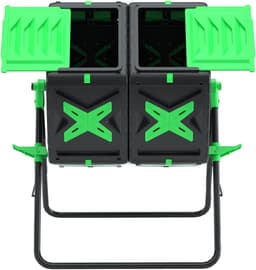
The divider stays put. You fill one side, you stop, and you empty that side when it has broken down. Garden Organic’s tumbler note is to stop at about half full. On a 160 litre dual drum, that means one chamber brought to the point where more fresh waste would smother it, then closed, while the other side takes the next caddy. Empty the chamber when it is dark and earthy, even if it is lumpy.

How often to turn it

The only numbered turning instruction in this set is on the 140 litre Squeeze master: close the door and turn five or six times every two or three days. The other five do not print that. A short turn every couple of days beats one heavy spin a month. The Moutta listing claims the right conditions in two weeks with regular stirring. The 140 litre bullets claim 4–6 weeks in hot sun. The 130 litre bullets say “just weeks”. All three stay claims.

Smell, liquid and a British winter

A sour drum needs dry browns and air. Tear card in, pause the wet peelings, and turn once the mix is no longer a paste. The 130 litre listing is the one with drain plugs, and UK reviews often say the drain blocks, weeps at the seams, or arrives without the tap. That liquid is not a feed. The Royal Horticultural Society’s 1:10 dilution is for wormery liquid. Cold slows the work. A 60°C figure on the RHS page is the centre of a heap, not a result for these drums. Rats and siting are on rats and a compost tumbler.

Common questions

What can I put in a compost tumbler in the UK?
Use the New Forest list unless you are in the narrow GOV.UK case. Peelings, fruit waste, eggshells, tea, coffee and garden waste can go in. Meat, fish, dairy and cooked food stay out of an ordinary drum. Match the greens with a similar volume of browns, such as torn card. Wet grass on its own is the load that slumps and smells. These listings are not insulated hot boxes, so plate scrapings do not inherit hot-box rules.
How full should one chamber get before I stop adding?
Stop at about half full, which is Garden Organic’s guidance for a tumbler, and then leave that chamber alone. On a dual-chamber drum the other side takes the fresh caddy. Every extra load on the working side resets the batch. Half full of a greens-and-browns mix is the aim. Half full of wet peelings alone is still too wet. Close the door before you turn, especially on a hatch with a history of opening.
How often do I turn it?
The 140 litre Squeeze master says five or six turns every two or three days. Treat that as the instruction on that listing, and as a workable rhythm if you can still move the drum. The other listings here do not print those numbers. A short turn every couple of days beats a rare heavy spin. If the full drum is too heavy to turn safely, switch to a collection or a bin you can leave.
How long until I can use the compost?
Use it when it is dark and earthy, even if it is lumpy. Garden Organic’s worked heap can take six to eight weeks, and a neglected one a year or more, then a month or two to mature. New Forest’s ordinary bin is about nine months. One UK review reported 12 weeks in the 140 litre drum, and another reported 19 then 17 weeks in the 130 litre drum. Two weeks, or 4–6 weeks in hot sun, are seller claims.
Can I use the liquid from the tap on vegetables?
Keep tumbler liquid off the vegetable beds. The Royal Horticultural Society’s 1:10 dilution is for wormery liquid, and these drums are not wormeries. The only listing with a tap is the 130 litre Squeeze master. UK reviews often say that drain blocks, drips at the seams, or arrives without the tap, sometimes with a smell and maggots once liquid sits. Compost from a finished, earthy chamber is the material these drums are for.
Does it keep working in a British winter?
It slows down. The Royal Horticultural Society says cold weather makes composting slower, and Garden Organic suggests turning in a mild spell. Keep torn card so winter peelings do not go in alone. A 60°C figure is for the centre of a heap, not these drums. The batch can still finish. It will take longer than a hot-sun line on the listing.

Related pages

Sources

Public UK sources from the research digest. Prices, stars and review counts are the amazon.co.uk figures in this set of six listings.

  1. RHS — Composting (retrieved 17.10.2026)
  2. Garden Organic — Different composting methods (retrieved 17.10.2026)
  3. GOV.UK — Animal material in home compost (retrieved 17.10.2026)
  4. GOV.UK — Simpler recycling in England (retrieved 17.10.2026)
  5. New Forest District Council — Home composting (retrieved 17.10.2026)
  6. WRAP — Home composting (retrieved 17.10.2026)
  7. REAL — PAS 100 (retrieved 17.10.2026)
  8. Test Valley Borough Council — Rats and mice (retrieved 17.10.2026)