Independent comparisons. We may earn from shop links. More info

Compost bin rats UK

Updated: October 2026

A plastic compost bin does not invent rats, and a lid does not magic them away. Rats visit when the heap smells of food they already want, and when the bin sits somewhere quiet they can dig under. This page is what to keep out, how the lids in this set actually behave, and when the problem is no longer a gardening question. Product scores stay on the [compost bin comparison](/hub/raised-beds-greenhouses-and-compost/compost-bin). The Products Compared editorial team used Recycle Now, Hampshire County Council, Gardeners’ World and the amazon.co.uk review notes, as at 20 October 2026. No listing here is certified rat-proof. A qualifying purchase can earn a commission at no extra cost to you.

A plastic compost bin does not invent rats, and a lid does not magic them away. Rats visit when the heap smells of food they already want, and when the bin sits somewhere quiet they can dig under.

Our top picks

On this page

Foods that do not belong in a standard heap

Recycle Now’s home composting steps leave out cooked food, meat and fish. Hampshire County Council states the same exclusions and treats cooked food as a job for an enclosed system, not for an ordinary heap. Dairy sits with that group. Bread, pasta, rice and other cooked starches are the foods that make a dalek interesting to rats, so they go in the council food-waste bin where you have one. Gardeners’ World makes the design point clearly. Cooked food belongs only in an enclosed, vermin-resistant system. The 300 litre clip bins, the 160 litre tumbler and the 127 litre bag in this comparison are not that class of product. A snap lid that reviewers find helpful is still a plastic cover, not a test report. Do not add a carcass, a curry or a tray of scraps and rely on the hinge. Pet waste, coal ash and diseased plants are also poor inputs to a heap you will spread on beds.

Foods that are usually fine

Raw vegetable peelings, fruit scraps in moderation, coffee grounds, crushed eggshells and garden waste are the normal greens and browns. Recycle Now’s mix is about half greens and half browns, with torn card and woody material as the dry half. A heap of only peelings is wet and smelly. Smell is what draws pests, even when the food itself was allowed. Loose tea and coffee grounds are fine. Empty plastic tea bags rather than composting the mesh. A few citrus peels in a large mixed heap are a normal green. They are not a rat lure in the way cooked food is. Grass cuttings go in thin layers so they do not collapse into a slimy mat. The kitchen caddy can hold the allowed scraps for a day. It can also hold the wrong scraps if you treat it as a single bucket. Split them when you empty it. That routine is on kitchen compost bin or garden compost bin.

Lids in this plastic set, without a rat-proof claim

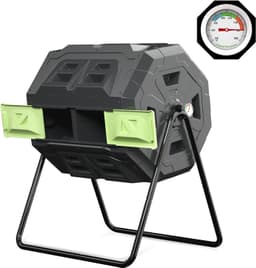
On the DIVCHI and PRADICHI 300 litre bins, UK reviews praise a snap lid. One DIVCHI note says the lid may need a weight in sun, because a lid that lifts is not doing the job. Neither file is a rat trial. The lines are 4.3 from 89 and 4.4 from 27. They describe assembly, not a burrow. The tumbler’s doors keep the drum closed if you shut them. The fabric bag’s zip, on three reviews of a £10.99 sack, is not a locked hatch. Slatted timber needs mesh, and some council examples use a hole size around 15 mm. That detail lives on wooden compost bins. A bin that will not clip shut cannot claim a seal.

Site, allotments and when to call

Put the bin where you can see it, not against a neglected fence. Turn a smelly heap and add browns. Do not leave peelings around the base. Allotment sites can ban food composting even when your council allows a home heap. England’s weekly food-waste collection, required under Simpler recycling from 31 March 2026, is the destination for foods a heap must not take. It does not replace careful heap practice. Scotland, Wales and Northern Ireland need the local page. Call pest control if rats are in the house, the shed, or a burrow that returns after you have removed the food. This guide will not talk you through poison beside a compost bin. If the bin arrived unusable, that is a retailer question under the Consumer Rights Act 2015.

Common questions

Will a plastic dalek attract rats?
It attracts them if you put cooked food, meat or bread in it, or if you leave scraps around the base. The plastic itself is not the lure. A shut lid on the 300 litre bins is worth using, and it is still not a certificate that rats cannot dig underneath.
Can I compost bread or pasta?
No, not in a standard home heap. Treat bread, pasta and rice as cooked food and put them in the council food-waste bin. They are among the scraps that make a compost bin worth visiting. An ordinary snap lid does not change that.
Does a kitchen caddy stop rats in the garden?
No. A caddy only stores scraps indoors. Rats in the garden respond to what you then tip into the heap or leave on the ground. Use the caddy to carry raw peelings out, and keep cooked food in the council stream. Fruit flies in the caddy are a separate indoor problem.
Should I use mesh under a wooden bin?
On a timber bin, mesh is the usual way to block digging, and some council examples use a hole size around 15 mm. That belongs to the wooden compost bin guide. The plastic bins here have a solid base or a tumbler stand, so you are managing the lid, the food and the ground around them instead.
Does England’s food-waste collection replace safe heap practice?
No. From 31 March 2026, weekly food-waste collection in England gives you a legal destination for cooked food. The heap still should not take that food. The collection is the alternative, not permission to fill a dalek with leftovers. Keep the lid discipline either way.

Related pages

Sources

Public UK sources and amazon.co.uk listings, last checked on 20 October 2026.

  1. RHS, Composting (retrieved 20 October 2026)
  2. Recycle Now, Home composting (retrieved 20 October 2026)
  3. Gardeners' World, Which type of compost bin is best? (retrieved 20 October 2026)
  4. Hampshire County Council, Composting (retrieved 20 October 2026)
  5. GOV.UK, Simpler recycling: household recycling in England (retrieved 20 October 2026)
  6. Garden UK, Garden compost bin ideas (retrieved 20 October 2026)
  7. Consumer Rights Act 2015, section 9 (retrieved 20 October 2026)