Independent comparisons. We may earn from shop links. More info

Kitchen compost bin or garden compost bin

Updated: October 2026

The peelings on your board can go to two different places, and the bin you buy does not decide that by itself. A kitchen compost bin holds them for a day or two. A garden compost bin is where raw scraps and garden waste become a soil improver, if you keep the mix legal for a home heap. This page is that split. Prices and star lines for the twelve listings are on the [compost bin comparison](/hub/raised-beds-greenhouses-and-compost/compost-bin). The Products Compared editorial team checked the amazon.co.uk rows and the public UK rules on 20 October 2026. A caddy is not a small composter. A qualifying purchase can earn a commission at no extra cost to you.

The peelings on your board can go to two different places, and the bin you buy does not decide that by itself. A kitchen compost bin holds them for a day or two.

Our top picks

On this page

Two jobs, two destinations

The worktop caddy is transport. You scrape the board, close the lid, and later you carry it either to an outdoor heap or to the council food-waste bin. The garden bin is a process. It needs months, a balance of greens and browns, and a site in the shade. Putting a filter caddy next to the kettle does not start that process. Flat dwellers can stop at the caddy. If the council collects food waste, the caddy empties into that stream and you never buy 300 litres of plastic. A house with beds usually wants both. Buying only the outdoor bin leaves you walking out with a colander every evening. England adds a date, not a new type of heap. From 31 March 2026, Simpler recycling requires weekly household food-waste collection in England. Scotland, Wales and Northern Ireland follow their own council pages. That weekly collection is the right destination for cooked food. It does not turn a dalek into a system that can take meat.

What can go on the heap

Recycle Now’s home composting steps exclude cooked food, meat and fish. Hampshire County Council gives the same exclusions for a standard heap, and it points cooked food towards an enclosed system rather than an ordinary bin. Vegetable peelings, coffee grounds, crushed eggshells and garden clippings are the usual heap inputs, mixed about half and half with browns such as torn card. A long UK review pattern on the Joseph Joseph caddy is the practical version of that rule. Vegetarian peelings go to the garden bin. Cooked food and the awkward scraps go to the council brown bin. You can run that split with any caddy in this set. The brand does not change the rule. Compostable liners make the caddy easier to tip. They do not make a heap rat-proof, and they do not make cooked food acceptable in a 300 litre clip bin. The pest rules are on compost bin rats.

What should go to the council bin instead

Cooked leftovers, meat, fish, bones, dairy and oily food belong in the council food-waste collection where you have one. That is also the honest place for bread and rice if you are trying to keep a standard heap dull to pests. Recycle Now does not treat those foods as home-composting inputs. The outdoor bins in this comparison do not change that. The DIVCHI and PRADICHI 300 litre plastics have snap lids that reviewers mention as a help against pests. A lid is not a test certificate, and this page does not call either bin rat-proof or safe for meat. The tumbler’s doors and the fabric bag’s zip are the same kind of claim: useful covers, not a licence to add a Sunday roast. If your council does not yet collect food waste, store cooked scraps in the residual bin rather than hiding them in the heap.

Which caddy size matches the walk you take

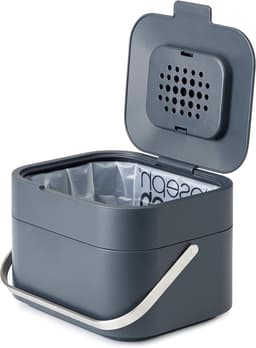
A 3 litre tin is enough when you empty it most days. The cream Living Nostalgia at £12.89 and the grey one at £23.99 share one review line of 4.5 from 9,459. Flies through the vents are why some people tape the holes. The KitchenCraft pedal bin, also 3 litres, tips if you use the pedal on the floor. A 4 litre Joseph Joseph, £28.07 in stone or £29.99 in graphite, is what reviewers keep for several days, with a filter about every three months. The simplehuman at £49.95 is the steel version of that worktop job. The EKO Puro Plus at £24.99 holds 10 litres on a cupboard door. None of these is the garden bin. How to run either routine is on how to use a compost bin.

Choosing one, both, or a different material

Choose only a caddy if you have no soil and a council food round. Choose only a garden bin if you already have a bowl you are willing to carry out. Choose both if peelings are daily and you want finished compost for beds. Steel caddies are a material choice, not a different destination. If the outdoor bin must be timber, use wooden compost bins. Plastic versus wood is not the decision this page is for. The decision is where the food ends up tonight.

Common questions

Do I need both a caddy and a garden bin?
You need both if you cook at home and you also want compost for the garden. The caddy keeps peelings out of the main kitchen bin. The garden bin does the months of composting. If you have no garden, the caddy plus the council collection is enough.
Can I put caddy contents straight on the heap?
Only the part that is raw fruit and vegetable waste, coffee grounds and similar greens. Tip cooked food, meat, fish and dairy into the council food bin instead. A full caddy is often a mixture, so you may have to sort it at the heap rather than dumping the liner in one go.
What goes in the council brown bin instead?
Cooked food, meat, fish and dairy, where your council accepts them in the food-waste stream. That includes the leftovers a standard home heap is not meant to take. Your council page is the list that counts, especially outside England, so do not copy an English leaflet if you live elsewhere.
Do I still need a caddy after March 2026 in England?
Yes, if you want scraps off the counter between the weekly collection. Simpler recycling changes the council destination in England from 31 March 2026. It does not remove the need for a small indoor holder, and it does not replace a garden bin if you still want homemade compost.
Is a 3 litre caddy enough?
It is enough for a day or two of peelings in many kitchens. Active cooks in the Living Nostalgia reviews empty daily. If you hate that trip, a 4 litre filter caddy or the 10 litre cupboard caddy holds more, and it still is not a composter.
Can flat dwellers skip outdoor bins?
Yes. With a council food-waste collection, a worktop or cupboard caddy is the whole purchase. A 160 litre tumbler or a 300 litre dalek needs outdoor space you do not have. Do not buy garden litres to store indoors. A caddy by the sink is the whole kit.

Related pages

Sources

Public UK sources and amazon.co.uk listings, last checked on 20 October 2026.

  1. RHS, Composting (retrieved 20 October 2026)
  2. Recycle Now, Home composting (retrieved 20 October 2026)
  3. Gardeners' World, Which type of compost bin is best? (retrieved 20 October 2026)
  4. Hampshire County Council, Composting (retrieved 20 October 2026)
  5. GOV.UK, Simpler recycling: household recycling in England (retrieved 20 October 2026)
  6. Garden UK, Garden compost bin ideas (retrieved 20 October 2026)
  7. Consumer Rights Act 2015, section 9 (retrieved 20 October 2026)