Independent comparisons. We may earn from shop links. More info

Cut mild steel with a circular saw

Updated: 21 October 2026

A circular saw will cut mild steel only when the section is thin enough for that model and the shoe can sit. Cut mild steel with a circular saw by naming the shape first: sheet, box, angle, or stud, then the thickness, then the blade. Which saw to buy is on the [main comparison](/hub/power-saws/metal-circular-saw). Prices are amazon.co.uk figures from 20 October 2026. The 8 mm plate example is a UK dealer’s figure for one model, not a cut we made. A qualifying purchase can earn a commission at no extra cost to you. If the member carries load, or you cannot support it, a fabricator should make the cut.

A circular saw will cut mild steel only when the section is thin enough for that model and the shoe can sit.

Our top picks

On this page

Mild steel forms you will meet

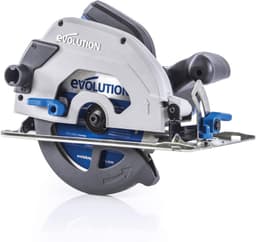
Sheet is the flat offcut, often 2 mm, 3 mm or 5 mm. It flaps if you do not support it. Box and square tube are what benches and gate frames use. You meet a wall, a hollow, then the far wall, and the saw can grab if the tube rolls. Metal stud is thin, often mixed with timber, and closer to what an R185 is sold for. The Evolution S185CCSL listing names steel plate, box section, cast iron pipe, scaffolding, cladding and roofing. The R185 bullets name steel among wood, aluminium and plastic. The Enventor title says soft metal. Cast iron pipe is on the S185 bullet only.

Thickness and capacity

Keep each number on its model. A UK dealer page for the S185CCSL gives an example mild-steel plate capacity of 8 mm. Use that for the S185CCSL only. It is not a lab figure from this site, and it is not the capacity of the R185CCS, the track bundle, the bag model, or the Enventor. All four Evolution saws state a depth adjustment up to 64 mm. That is how far the blade can project, not how thick a solid plate you may cut. The Enventor title stops at 42.8 mm at 90° and 28 mm at 45°. Clamp square tube so it cannot roll as you cross the hollow. Generic clamping is on the how to cut metal page. Scaffold and thick-wall box are chop-saw work, outside this handheld set.

Blade and feed for clean cuts

The S185 bullets specify a 185 mm, 40-tooth mild-steel TCT blade, 1600 watts and a 0–45° bevel, at about £105.00 with 4.4 from 54 reviews. The materials row says alloy steel, which conflicts with the TCT bullet, so read the live blade line before you order. The R185CCS at about £69.95 is not track compatible. The track model at about £116.00 adds 1,020 mm of rail and an EU-plug line. Feed by sound. If the motor drops or the edge blues, back off. Cutting fluid is not in the Evolution bullets. They describe a cold cut. A track helps a long sheet stay straight. It does not add capacity. The buying guide is the class decision if you have not bought yet.

Deburr and weld prep

A clean review edge is not a weld procedure. The bullets say little or no burr and an instantly workable finish. File the cut before anyone handles it. Galvanised steel is the renovation trap. The listings talk about mild steel, not a zinc coating, and cutting the coating can fume. If the bullet does not mention galvanised stock, do not treat a coated post as bright mild sheet. Stainless is not in these five titles. HSE noise for circular sawing of metal is roughly 95–105 dB(A), so defenders stay on for the cut.

Common questions

How thick a plate can I cut with the S185CCSL?
A UK dealer page publishes an 8 mm mild-steel plate example for the S185CCSL. That is their figure for that 185 mm steel saw, not a test by this site. An amazon.co.uk review describes 5 mm plate as an easy, clean cut and says the saw is loud. Another review stays at 2–3 mm and calls it light duty. The stated 64 mm depth is blade projection, not 64 mm of plate. If your plate is thicker than the dealer example, do not try it.
Can the R185CCS cut the same plate?
Not by borrowing the S185’s 8 mm line. The R185CCS is a 1600 watt multi-material saw at about £69.95 whose bullets include steel and do not state that plate thickness in the file we used. It fits nails, studs and thin occasional metal. It is the wrong assumption for regular plate at the dealer figure. Read the current bullet. If it still has no millimetre limit, stay thin or buy the steel-first model.
Do I need to deburr before welding?
Yes, if the weld matters. Bullets that say no burr are manufacturer claims. A 5 mm review likes the edge and does not describe a weld. File the arris and check the fit. For a hidden bracket, a file so the edge is safe to handle may be enough. For anything load-bearing, a fabricator should do the cut and the weld.
Can I cut galvanised steel?
These listings specify mild steel, not galvanised stock. The coating can fume, and the bullets do not give a procedure for it. If the section is galvanised, check the manufacturer’s line or have it cut where the fume is controlled. Do not copy a 5 mm bright-plate review onto a coated post of a different thickness.
What about square tube walls?
Plan on more than one wall, and keep each wall inside the plate example for that model. Clamp the tube so it cannot roll in the hollow. The S185 listing is the one that names box section. The Enventor’s soft-metal line is not a box specification, even when the wall is only a few millimetres. Thick-wall and scaffold tube are chop-saw or fabricator work once you are past the handheld limit.

Related pages

Sources

Public UK sources and the amazon.co.uk listings compared on this page. Listings captured 20 October 2026.

  1. HSE EIS12: metal-cutting circular saws (retrieved 20 October 2026)
  2. HSE: engineering noise (retrieved 20 October 2026)
  3. Evolution R185CCS on amazon.co.uk (retrieved 20 October 2026)
  4. Evolution S185CCSL dealer specification (retrieved 20 October 2026)
  5. Consumer Rights Act 2015, section 9 (retrieved 20 October 2026)
  6. HSE: PUWER overview (retrieved 20 October 2026)
  7. Evolution RAGE multi-material saws (retrieved 20 October 2026)